
What if the most persuasive Opendoor review tells you very little about what you’ll net from your San Diego home? Opendoor reviews San Diego can show how individual sellers experienced the process, but each account reflects a particular property, market, and point in time. One seller’s smooth transaction doesn’t guarantee the same offer or outcome for you.
You’re right to weigh convenience against the possibility of stronger net proceeds. The useful comparison isn’t a review score or an advertised offer alone. It’s the amount you could keep after fees, repair deductions, closing costs, and the expenses of a traditional listing.
This guide shows you how to read reviews as clues, not guarantees, and compare a direct offer with a listing using consistent terms. You’ll see which details to focus on, how to estimate net proceeds for each route, and how your property, timing, and priorities can shape the decision. That gives you a clearer next step without letting someone else’s sale stand in for your own.
Key Takeaways
- Use Opendoor reviews San Diego to spot recurring process themes, then weigh each account against its date, property, and transaction details.
- Compare a direct offer and a traditional listing across market exposure, seller responsibilities, timing, and estimated net proceeds.
- Build a side-by-side estimate that accounts for written offer deductions, likely selling expenses, and the work you’ll take on.
- Define your timing needs, property condition, and acceptable tradeoffs before deciding which sale route fits.
- Use a local San Diego agent’s perspective to assess your property, goals, and offer terms without treating either option as right for every seller.
Table of Contents
What Can Opendoor Reviews Tell You About Selling in San Diego?
What can a review reveal, and what do you still need to verify for your home? Opendoor reviews San Diego can help you assess a seller’s experience with communication, process clarity, and follow-through. They can’t establish the offer you’ll receive, the deductions on your property, or the amount you’ll take away from a sale.
Read each account as a record of one transaction. The seller’s property condition, timing, expectations, and written offer terms all shape what happened. A positive account of a straightforward closing doesn’t prove your home will receive similar terms, and a negative account doesn’t predict your outcome either.
Keep service feedback separate from financial and property-specific details. A reviewer may describe how clearly the company explained a step, while the offer amount, home assessment, repair deductions, and closing schedule require their own evaluation. For company background, the Opendoor Wikipedia page provides an overview of its history and business model. Your written offer contains the terms that matter to your decision.
Which parts of an Opendoor review deserve your attention?
Look for specific first-hand details: what the seller was told, when communication occurred, and whether the next step matched expectations. Repeated, concrete accounts can point to questions worth asking about process clarity and follow-through. Broad praise or criticism without transaction details gives you less to apply to your own sale.
Check the review’s date and location. An account from a different period or market may describe different processes or conditions from a current transaction in San Diego or Chula Vista. Separate what the person directly experienced from conclusions about every seller, home, or the company as a whole.
Why can two San Diego sellers describe different experiences?
Your property condition, priorities, timing, and actual offer terms shape the sale experience. A seller who values a defined closing schedule and fewer sale-preparation tasks may judge convenience differently from someone who wants broad market exposure and is willing to prepare the home for a listing.
Those priorities don’t make one route universally better. They change what you count as a good outcome. Read reviews with your own tradeoffs in mind, not as a vote that settles the decision for you.
San Diego and Chula Vista include different homes and seller situations, so a review from one area can’t stand in for the whole local market. Use location details to understand the context, then compare your property’s condition and goals with the terms in your written offer.
Reviews can help you identify what to examine, but they can’t predict your home’s offer or sale result. Assess the specific terms, property details, timing, and responsibilities in front of you. That keeps someone else’s experience useful without treating it as a promise about yours.
How Should You Evaluate Opendoor Reviews Before Comparing Offers?
Before you use a review to judge an offer, check where the account came from, what the seller actually experienced, and whether its details apply to your transaction. Opendoor reviews San Diego can help you frame questions, but reviews describe experiences, not personalized offer terms for your home.
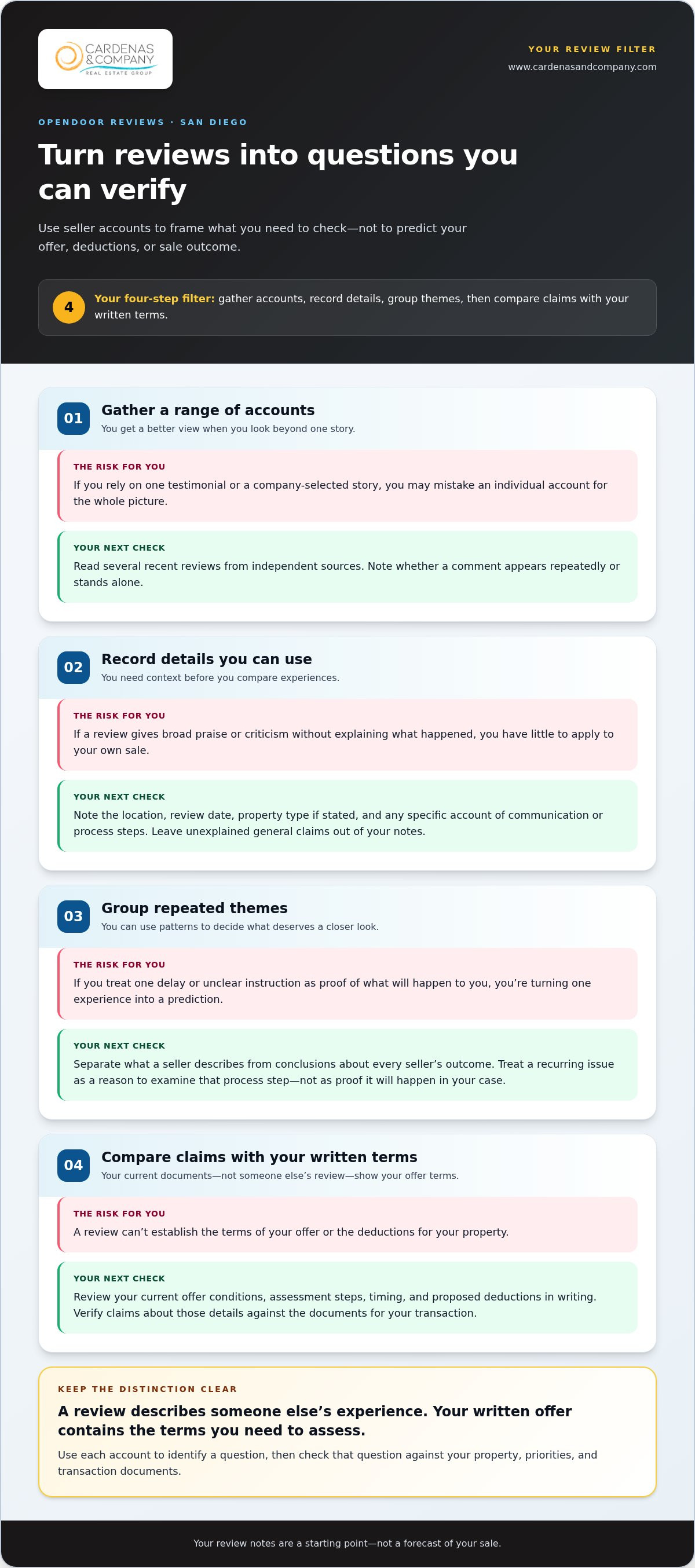
Use this sequence to keep the review stage focused and separate from the financial comparison:
- Gather a range of accounts. Read several recent reviews from independent sources instead of relying on one testimonial or a company-selected story. Different sources can help you see whether a comment appears repeatedly or stands alone.
- Record the useful details. Note the location, review date, property type if stated, and any concrete account of communication or process steps. Leave general claims out of your notes unless the reviewer explains what happened.
- Group repeated themes. Separate described experiences, such as a delay or unclear instruction, from conclusions about every seller’s outcome. A recurring issue is a reason to examine that part of the process, not proof it will happen in your case.
- Compare claims with written terms. Review the offer conditions, assessment steps, timing, and proposed deductions in the current documents for your property. A review can’t establish the terms of your offer.
How do you tell a useful review from an unhelpful one?
A useful review gives you enough context to understand the seller’s experience: what they needed, what communication they received, and which process event shaped their view. Compare those specifics across sources, while remembering that people who post reviews may not represent every customer. A star rating summarizes one person’s opinion, but it can’t explain the transaction behind it.
Which claims need verification before you rely on them?
Check whether the review concerns a San Diego-area transaction and a sale process comparable to yours. Match claims about assessments, timing, offer conditions, or deductions against the written terms for your transaction. If a review gives no details about the property or terms, treat its outcome claim as limited evidence, not a forecast.
Keep a simple note beside each review: “What happened?” and “What would I need to verify?” That distinction turns feedback into specific questions without letting an isolated complaint or glowing account settle the decision. As you compare routes, focus on your written terms and goals rather than trying to average unrelated sellers’ experiences.
For a local perspective on how a direct offer compares with a listing strategy for your property, learn more about Cardenas & Company Real Estate Group's San Diego real estate services.
How Does an Opendoor Offer Compare With a San Diego Listing?
A direct offer and a traditional listing solve different problems. A direct offer may appeal if you value a more contained process; a listing puts your home before potential market buyers through a strategy shaped around your property. Neither route guarantees a particular price, timeline, or level of effort.
Compare the written terms and assumptions side by side. For a listing, use a realistic expected sale price and account for the costs and responsibilities you expect to take on. For a direct offer, use the specific offer and deductions presented to you, not a number from a review or earlier estimate.
| Factor |
Direct offer |
Traditional listing |
| Process |
Review the written offer and its stated conditions. |
Prepare a listing strategy, bring the home to market, and review offers received. |
| Market exposure |
Consider the terms of the offer presented to you. |
Present the home to potential market buyers through your chosen marketing plan. |
| Seller responsibilities |
Review any assessment requirements, deductions, and tasks in the offer. |
Plan for preparation, access, and decisions during the marketing and sale process. |
| Timing |
Compare the proposed schedule with your move or other deadlines. |
Account for the time needed to prepare, market, negotiate, and complete the sale. |
| Estimated net proceeds |
Start with the written offer and subtract stated costs or deductions. |
Estimate a likely sale price, then subtract expected selling costs and obligations. |
What tradeoffs matter when you compare a direct offer with a listing?
Convenience and process simplicity matter if you have a firm move date, limited capacity to prepare the home, or a strong preference for fewer sale decisions. Treat them as priorities to evaluate, not guaranteed benefits. A listing offers broader market exposure, but you’ll make decisions about presentation, access, offer terms, and timing.
Process convenience concerns how you sell; market exposure concerns who may have the chance to buy your home. Opendoor reviews San Diego can point to seller experiences, but they can’t replace a comparison of your written terms, expected responsibilities, and estimated proceeds.
How does your San Diego location shape the comparison?
Your property’s location and condition help shape a listing strategy. A home in central San Diego and a home in Chula Vista or another South Bay community may attract different buyer interest. The home’s condition also affects how you plan its presentation and likely audience. Don’t apply one neighborhood’s experience to a different property without examining those details.
For a practical look at local listing decisions, see “Selling Your Home in Chula Vista: The 2026 Strategy for Maximizing Your Equity”. Then compare both routes using the same assumptions, including costs, expected timing, and your own responsibilities. Cardenas & Company Real Estate Group provides residential listing services and can help you assess your property and priorities without presuming one route fits every seller.
What Should You Calculate Before Accepting an Opendoor Offer?
Compare estimated net proceeds, not just the headline offer or estimated listing price. Net proceeds means the amount you expect to keep after sale-related costs and deductions. Your estimate depends on the written terms, accurate property information, and clearly stated assumptions, so mark unknown items instead of filling gaps with guesses.
Use two columns, one for the direct offer and one for a traditional listing. Keep the same property facts in both scenarios, then record money, effort, and timing separately. This makes the tradeoffs visible without pretending an estimate is a final closing statement.
Which numbers and terms belong in your comparison?
Start with the actual documents for your property. Keep each amount or responsibility on its own line so a deduction doesn’t disappear inside a broad estimate. Distinguish confirmed terms from inputs you still need to resolve.
- Direct offer: Record the written offer amount, each stated deduction, seller-paid items, assessment-related terms, and any tasks assigned to you. Mark costs or terms as unknown when the offer documents don’t specify them.
- Traditional listing: Write down a reasoned estimate of the sale price, expected transaction expenses, preparation work, and responsibilities during marketing and sale. Base the sale estimate on your property and a local listing strategy, not a general market headline.
- Both scenarios: Note the source and date for each figure, then calculate estimated proceeds by subtracting identified costs and deductions from the expected sale amount.
For example, if a proposed deduction appears in the offer, include it as a separate line and use the stated amount. If the amount or responsibility remains unclear, label it “unknown” and leave the estimate open until you have written information. Don’t substitute a reviewer’s reported cost for a term in your own paperwork.
How can you compare the options without guessing?
Use consistent assumptions. If you update your property condition or expected sale price in one scenario, revisit the other; otherwise, you’re comparing two different versions of your home. For each estimated net figure, show the starting amount, every known subtraction, and any unresolved input that could change the result.
Then add three nonfinancial notes beneath the figures: your timing needs, the condition of the property, and the tradeoffs you’re willing to accept. A seller managing a firm move date may value a different schedule than someone prepared to invest more time in listing preparation and market exposure. Keep expected effort visible alongside money, rather than treating it as a footnote.
Opendoor reviews San Diego can’t supply your property’s figures. Your written offer, current transaction documents, and property-specific listing estimate must do that work. Once you have both scenarios on paper, you can see which assumptions drive the difference and which unknowns deserve attention before you decide.
Compare home-selling options with Cardenas & Company
How Can a Local San Diego Agent Help You Choose Your Next Step?
A local agent can help you compare a direct offer with a listing strategy using your property, priorities, and written terms, rather than someone else’s review as the deciding factor. Cardenas & Company Real Estate Group is a San Diego-based residential real estate team affiliated with Realty ONE Group Pacific, serving sellers across San Diego, Chula Vista, and the South Bay.
Bring the written offer, any assessment information, your preferred timing, and a clear picture of the home’s condition to the conversation. That gives you a practical basis for weighing an offer against a listing plan tailored to your property. Opendoor reviews San Diego may suggest questions to raise, but your decision should reflect the terms and goals in front of you.
What should your next conversation help you clarify?
Start with what matters most to you. You may need a particular move date, want to limit preparation work, or prefer to expose the property to potential market buyers through a listing. A useful discussion identifies those priorities before comparing routes, because the same tradeoff can feel different depending on your circumstances.
Next, put the written offer beside a listing strategy built on transparent assumptions. Compare estimated proceeds, expected responsibilities, and timing implications without treating either estimate as a promise. For a Chula Vista-specific perspective on listing decisions, review the guide to selling your home in Chula Vista.
Your agent can provide real estate guidance on the sale process and help you assess the property and transaction terms. Legal and tax questions require advice from the appropriate qualified professional; keep those questions distinct from your real estate comparison.
How can you take a low-pressure next step?
You don’t need to arrive with a final decision. Start by laying out your home’s condition, timing needs, and acceptable balance between convenience, responsibilities, and potential proceeds. That creates room to assess the options without assuming one route fits every San Diego-area seller.
If you have a direct offer, bring its written terms so you can discuss the actual conditions and deductions rather than relying on general descriptions. If you’re also considering a listing, compare it with a property-specific strategy and make the assumptions behind the estimate clear.
Bottom Line
Reviews offer context, not a forecast. Compare the actual offer with a grounded listing strategy, then choose based on your property, timing, and priorities. You deserve a decision that makes sense for your next chapter, not just a transaction that looks simple on paper.
If you’d value a calm, no-pressure conversation about your San Diego-area home and selling priorities, you’re welcome to reach out to Cardenas & Company Real Estate Group. The team is affiliated with Realty ONE Group Pacific.
Choose the Sale Path That Fits Your Next Chapter
Your home sale can be a bridge to what comes next, whether you’re relocating, simplifying your living arrangements, or putting your equity toward another goal. Think through the transition beyond the closing date, including the decisions and practical steps that will help you feel ready for your next chapter.
Bottom Line: A sound decision should support the life you’re moving toward, not just complete a transaction. You can take the next step at your own pace.
Use the information you’ve gathered to decide what you want to clarify next, whether that means reviewing offer terms or comparing them with a listing plan.
San Diego home-selling options from Cardenas & Company
Move forward with greater confidence when your plan reflects what matters to you.
Frequently Asked Questions
Are Opendoor reviews reliable when you are selling a home in San Diego?
Opendoor reviews San Diego can help you identify experiences to investigate, but they can’t establish what will happen with your sale. A review about a recently assessed, move-in-ready home may not apply to a property that needs work or has different timing needs. Check the reviewer’s location, date, and transaction details, then treat conclusions about offer amounts or outcomes as specific to that seller.
Does Opendoor buy homes in San Diego and Chula Vista?
A neighborhood name alone doesn’t establish whether an individual property qualifies for an offer. Your address, property details, and the written terms determine what you can compare. San Diego-area communities include Chula Vista, Bonita, Del Mar, La Jolla, Otay Ranch, Carlsbad, Coronado, El Cajon, Santee, La Mesa, Lemon Grove, Encinitas, Imperial Beach, Oceanside, Poway, San Marcos, and Escondido.
How do you compare an Opendoor offer with a traditional listing?
Compare the estimated amount you would keep, not only the offer amount or a possible listing price. Use the same property details in both scenarios and account for the costs and responsibilities specific to each route. Include any mortgage payoff in your personal proceeds estimate, since it affects the funds remaining to you. Keep assumptions visible so you can see which figures are documented and which are estimates.
What fees or deductions should you check in an Opendoor offer?
Review the written offer breakdown for the service fee, any assessment-related repair deductions, closing costs, and other seller-paid items. Opendoor’s service fee can vary, so don’t assume a fixed percentage based on an older review or online discussion. Check that each deduction has a clear description and amount in the current documents, and include seller responsibilities that could affect your final proceeds.
Can you negotiate an Opendoor offer on your San Diego home?
Don’t assume an offer can be changed or that a revision will be available. Start with the written terms you received and identify a specific concern, such as a property detail or assessment deduction that doesn’t match your records. A real estate agent can help you review the offer and assess proposed deductions; rely on updated written terms for any change, not a verbal expectation or another seller’s experience.
How quickly can you sell a home through Opendoor in San Diego?
Your timeline depends on the schedule and conditions in the current offer, so a review describing a fast sale doesn’t set a date for your property. Check the proposed closing date and any preceding assessment or documentation steps, then compare them with your move plans. Leave room for unresolved conditions rather than treating a general description of speed as a guaranteed timeline.
What should you do if your Opendoor experience differs from online reviews?
Use your own transaction record as the basis for your next decision. Keep copies of the offer, assessment details, written updates, and revised terms, then compare what you received with what the documents state. If a review created an expectation your paperwork doesn’t support, rely on the terms for your property and get real estate guidance before deciding how to proceed. For a no-pressure conversation about selling in San Diego, Chula Vista, or the surrounding communities, reach out to Cardenas & Company Real Estate Group, affiliated with Realty ONE Group Pacific.
Disclaimer
The information provided on this blog is for educational and informational purposes only and does not constitute legal, financial, or investment advice. While we strive for accuracy, real estate markets and insurance regulations (including Living Trusts and IUL strategies) are subject to change. David Cardenas (DRE 01862173) is a licensed real estate salesperson; however, this content does not create an agency relationship. Please consult with a qualified attorney or tax professional regarding your specific situation.