
What if your home sells for the price you hoped for, but the amount you receive is still lower than expected? The cost to sell a house in San Diego includes more than charges due at closing. The sale price alone won’t show what you may take away after expenses and existing obligations.
It makes sense to want a clear estimate before deciding whether to list, make repairs, or adjust your timing. Some expenses depend on your property and transaction. Others, such as your mortgage payoff, reduce your proceeds but aren’t costs charged for selling.
This guide explains common sale-related expenses, including agent compensation, escrow, title, transfer taxes, home preparation, and possible HOA fees. It also separates those costs from mortgage payoff, property taxes, and tax considerations, then shows how to estimate net proceeds using your own figures. With the categories organized, you can compare representation and preparation choices more clearly.
Key Takeaways
- Estimate the cost to sell a house in San Diego by separating negotiated services, closing charges, preparation choices, and existing obligations.
- Use written agreements to understand real estate compensation. It’s negotiable, not a fixed amount.
- Verify transfer-tax treatment for the property’s specific city and location, since rules may differ across San Diego communities.
- Build a proceeds worksheet with your expected sale price, signed agreements, payoff statement, and verified charges. Keep estimates and unknowns distinct.
- Compare self-management with listing representation by considering the time, marketing, negotiation, and coordination involved in each.
Table of Contents
What costs can reduce your proceeds when you sell a San Diego house?
Your sale price is not the same as your net proceeds. Net proceeds are the estimated amount remaining after sale expenses and existing obligations are accounted for. The final figure depends on your property, contract, and transaction details.
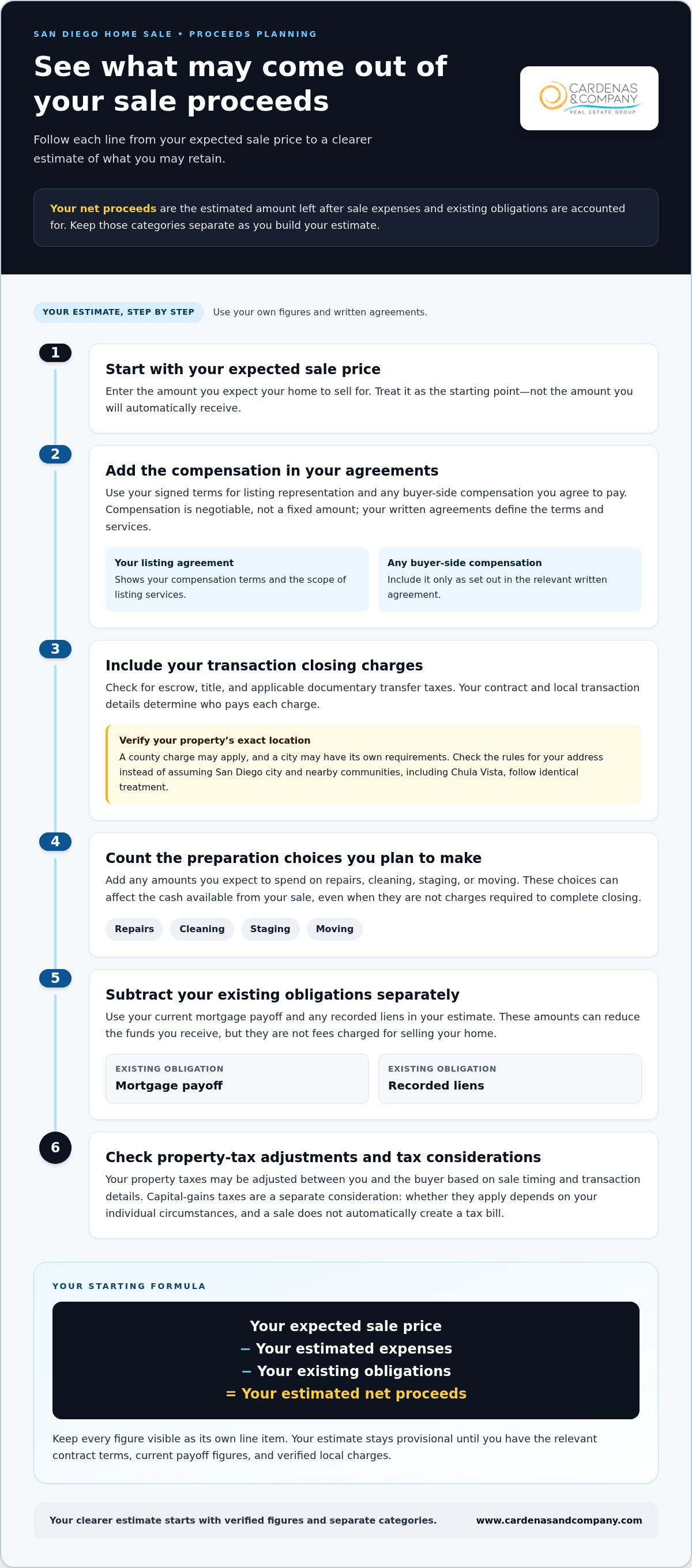
Start by sorting potential deductions into four groups: negotiated services, closing charges, preparation choices, and existing obligations. This makes it easier to identify which amounts come from written agreements, which depend on local or property-specific details, and which are not selling fees.
Which expenses commonly appear in a home sale?
Negotiated services can include listing representation and any buyer-side compensation you agree to pay. Listing representation covers responsibilities defined in your agreement, while buyer-side compensation is a separate negotiated item. At closing, the transaction may also involve escrow, title, and applicable documentary transfer taxes. These closing costs are charges connected with completing the sale. The contract and local transaction details determine who pays each one.
Preparation choices are separate from closing charges. You might spend on repairs, cleaning, staging, or moving, depending on your home and plans. These choices can affect the cash available from the sale, even when they aren’t charges required to complete closing.
Transfer-tax treatment can vary by location. A county charge may apply, and a city may have its own requirements. Check the rules for the property’s exact address rather than assuming San Diego city and nearby communities, including Chula Vista, follow identical treatment. For a local perspective, see Selling Your Home in Chula Vista: The 2026 Strategy for Maximizing Your Equity.
Which amounts reduce proceeds but are not selling fees?
Your mortgage payoff is the amount still owed on the home, not a fee charged to sell it. Recorded liens, which are claims against the property that may need to be resolved as part of the transaction, can also reduce the funds you receive. Include these obligations in your estimate, but list them separately from sale expenses.
Property taxes may be adjusted between buyer and seller based on the timing of the sale and transaction details. The final treatment depends on the specific closing, so use the figures for your property. Capital-gains taxes are another separate consideration. Whether they apply depends on your individual circumstances, and a sale does not automatically create a tax bill.
Separating these categories gives you a clearer view of the cost to sell a house in San Diego without treating every deduction as the same kind of expense. It also gives you a more useful starting point for estimating proceeds before making decisions about the sale.
How do commissions and closing costs affect your San Diego net proceeds?
Your net proceeds are the estimated amount left after applicable sale expenses and existing obligations are subtracted from the sale price. That estimate addresses the practical question behind the cost to sell a house in San Diego: how much might you retain after the transaction is complete?
Real estate compensation is negotiable. The parties set the terms in their written agreements, so buyer-agent compensation isn’t automatic, and no single party always pays it. Review the signed agreements to understand what you’ve agreed to pay and which services those terms cover.
Negotiated compensation is separate from taxes, escrow charges, and your mortgage payoff. Put each item in its own line of your estimate, even though all may affect the amount you receive.
What does real estate compensation cover?
Your listing agreement sets out the compensation terms and the scope of the listing services. Depending on the agreement, those services may include marketing your home, advising on pricing, reviewing offers, and coordinating transaction steps. The signed agreement, rather than an assumed standard rate, defines the responsibilities and compensation.
This distinction helps you compare the expense with the work involved. The service agreement should clarify what support you’ll receive throughout the sale. Any separate buyer-side compensation should be understood through the relevant written agreement. Read the terms together to see how each negotiated amount fits into your plan.
How should you interpret an estimated seller net?
Use this simple formula as a starting point:
Expected sale price − estimated expenses − existing obligations = estimated net proceeds
Enter your expected sale price, subtract the compensation specified in your agreements and other estimated transaction charges, then subtract the current mortgage payoff and any recorded liens. Keep each figure visible as a separate line item. A gross sale price alone can’t show what you’ll retain because it doesn’t account for your contract terms, property obligations, or transaction charges.
Treat the result as provisional until you have the relevant contract terms, current payoff figures, and verified local charges. Property-tax amounts and adjustments depend on the timing and details of the sale. The San Diego County property taxes page provides official local information about the tax component.
Cardenas & Company Real Estate Group provides residential listing guidance in the San Diego area. Explore the team’s San Diego listing services as you consider your sale plans.
Which San Diego-specific sale costs should you verify before listing?
The cost to sell a house in San Diego can include charges tied to the county, the property’s city, the home itself, and the terms you negotiate. Check each layer against the property address and proposed contract so your estimate reflects the specific transaction rather than a different San Diego-area sale.
Local charges depend on property location and transaction terms. San Diego city and nearby communities may not share identical transfer-tax treatment, so use the property’s actual city when checking applicable rules.
| Cost category |
What to review |
| Countywide |
Any county documentary transfer tax or other county-level closing charge that applies to the transaction. |
| City-specific |
Whether the property’s city has a separate transfer-tax requirement or other local charge. |
| Property-specific |
HOA document or transfer charges, property condition, and any work or credits connected with the home. |
| Negotiated |
Written terms for escrow charges, agreed repairs, credits to the buyer, and other costs allocated between the parties. |
Can transfer taxes vary across San Diego County?
A documentary transfer tax is a charge associated with transferring ownership of property. Before using a figure in your estimate, verify current county and city rules for the specific property address through the applicable official sources. Don’t assume that a home in San Diego city and one in Chula Vista, La Jolla, or Carlsbad will have identical treatment based on the community name alone.
Which property and contract details can change the estimate?
Your home’s features and sale terms can add costs or change who pays a particular charge. If the property belongs to an HOA, review any fees for transfer documents. The parties may also agree to repairs or a credit, an amount applied for the buyer’s benefit under the contract. Escrow terms, which set how transaction funds and documents are handled, can affect the seller’s share of charges.
Property condition matters because needed work may affect your preparation budget or become part of negotiations. A home in Chula Vista, La Jolla, or Carlsbad may have different property or contract details, but its neighborhood name alone doesn’t determine the seller’s final costs. Use the exact address, property records, HOA information if relevant, and written sale terms to refine your estimate.
How can you estimate sale proceeds without overlooking expenses?
A useful estimate starts with your own documents, not a broad percentage applied to the sale price. To estimate the cost to sell a house in San Diego, label each line as a known figure, an estimate, or an unknown. That way, you can see which parts of your projected net still need attention.
What figures should you gather for a first estimate?
Use recent comparable sales, meaning nearby homes with similar features that have sold, along with your home’s condition to develop a realistic sale-price range. Then gather your current mortgage payoff statement, details of recorded obligations, signed service agreements, and transaction-specific estimates for closing charges that apply to your property.
Worksheet columns: Record each item under Known figure, Estimate, or Unknown. Update the column as reliable information becomes available.
- Expected sale price. Enter a realistic range informed by comparable sales and your home’s condition. Mark it as an estimate, not a guaranteed outcome.
- Written agreements. Record negotiated compensation and any other agreed terms. Put signed amounts under known figures; note terms still being discussed as unknown.
- Mortgage payoff and obligations. Use the current payoff statement for the loan balance, and list any recorded obligations separately. Don’t substitute an old account balance for a current payoff figure.
- Closing charges. Add verified transaction-specific charges, including applicable local charges and escrow costs. Keep unverified amounts in the unknown column instead of treating a placeholder as final.
- Repairs, credits, and adjustments. List planned preparation separately from any repair or buyer credit in an offer. Keep timing-related adjustments as estimates until the transaction details establish the amount.
How do you stress-test the estimate?
Create conservative, expected, and stronger sale scenarios using different points in your reasonable price range. These are planning cases, not promises. Keep potential repairs, buyer credits, and timing-related adjustments as separate assumptions in each case so you can see how each change affects the estimated net.
For each scenario, subtract estimated expenses and existing obligations from the expected sale price. If an offer changes the price, requests a credit, or includes different contract terms, update those line items and recalculate. This lets you compare offers by their likely effect on proceeds, not just by headline price.
A tailored sale plan can help organize the figures and clarify the tradeoffs behind your estimate. Refine the worksheet as written terms and verified charges become available.
San Diego home sale planning with Cardenas & Company
What is your next step for selling a San Diego house with clarity?
Decide how you want to handle the work of the sale, then compare that choice with your priorities, available time, and estimated proceeds. Selling on your own and hiring listing representation involve different responsibilities. Neither approach guarantees a particular sale price or net amount.
How should you weigh the tradeoffs of selling on your own?
Self-management may reduce your reliance on paid listing services, but it places more of the process on you. You’ll need to set a price, market the property, review offers, discuss repairs or buyer credits, and track transaction documents and deadlines.
Listing representation involves negotiated compensation in exchange for services defined in your written agreement. Depending on that agreement, those services may include pricing advice, marketing, offer review, negotiation support, and transaction coordination. Compare the work you would take on yourself with the responsibilities and terms in a listing agreement, rather than assuming either path will produce a better net.
What can a tailored sale plan help you clarify?
A tailored plan brings your pricing approach, preparation decisions, written agreement terms, and estimated proceeds into one practical view. This can help you weigh a repair against a possible buyer credit, understand the work covered by representation, and see how changes in an offer may affect the amount you expect to retain.
Cardenas & Company Real Estate Group provides residential listing guidance in the San Diego area and is affiliated with Realty ONE Group Pacific. For a local perspective on selling in Chula Vista, see Selling Your Home in Chula Vista: The 2026 Strategy for Maximizing Your Equity. Your home, timing, and transaction terms will shape the decisions that matter most.
Bottom Line
Understanding the cost to sell a house in San Diego starts with a clear view of the expenses and responsibilities involved. Organize your numbers, compare your options, and decide what kind of support fits your plans. Cardenas & Company’s residential listing services can help you plan the sale around your home and priorities.
Plan Your San Diego Sale With a Clearer Picture
The cost to sell a house in San Diego depends on more than the expected sale price. Your net estimate should account for negotiated service terms, closing charges, property-specific costs, and existing obligations such as a mortgage payoff. Verify local charges for the property’s actual location, and keep confirmed figures separate from estimates and unknowns.
A practical proceeds worksheet can help you compare possible sale scenarios and see how repairs, buyer credits, or changing contract terms affect your estimate. These figures aren’t promises, but they can support clearer decisions.
Cardenas & Company Real Estate Group provides residential listing services across San Diego and South Bay communities and is affiliated with Realty ONE Group Pacific. The relationship-driven team supports families, including military households, as they consider their next move.
Talk with Cardenas & Company about your San Diego home sale
With a thoughtful plan and a clearer view of the numbers, you can approach your sale at your own pace and feel more prepared for the transition ahead.
Frequently Asked Questions
How much does it cost to sell a house in San Diego?
Seller costs in San Diego vary with your sale price, written agreements, property, and closing terms. As a broad planning range, research estimates total seller costs, including negotiated real estate compensation, at about 6% to 10% of the final sale price. Your actual total may fall outside that range. Build a personal estimate from signed agreements, verified charges, preparation choices, and obligations such as your mortgage payoff.
What fees does a seller typically pay when selling a house in California?
California sellers may pay negotiated listing compensation, any buyer-side compensation agreed to in writing, escrow and title charges, applicable transfer taxes, and HOA document or transfer charges when relevant. Repairs, cleaning, and staging are separate preparation choices. Your contract and property determine who pays particular transaction charges. A mortgage payoff or recorded lien can reduce your proceeds too, but it’s an existing obligation, not a fee for completing the sale.
Are real estate commissions negotiable in San Diego?
Yes. Real estate compensation isn’t fixed by law, and the parties negotiate terms in written agreements. Your listing agreement should explain the compensation and the listing services it covers, such as pricing guidance, marketing, offer review, or transaction coordination. Buyer-side compensation is also a separate negotiation, not an automatic seller expense. Read the relevant agreements to understand what you’ve agreed to pay and which services are included.
Do sellers pay transfer tax in San Diego?
San Diego County’s documentary transfer tax is $1.10 per $1,000 of sale price, and the seller customarily pays it. City-level treatment can differ, so verify current county and city rules for the property’s actual address. Assess a property in San Diego, Chula Vista, Bonita, Del Mar, La Jolla, Otay Ranch, Carlsbad, Coronado, El Cajon, Santee, La Mesa, Lemon Grove, Encinitas, Imperial Beach, Oceanside, Poway, San Marcos, or Escondido by its location, not community name alone.
How do I calculate my net proceeds from selling my house?
Start with your expected sale price, then subtract estimated sale expenses and existing obligations to estimate net proceeds. Include compensation from your signed agreements, verified escrow and title charges, applicable transfer taxes, and any agreed repair credit. Subtract your current mortgage payoff and recorded liens separately. Keep confirmed figures, estimates, and unknown amounts distinct, then update the worksheet when an offer or contract term changes.
Is it cheaper to sell a house without a real estate agent?
Selling without a real estate agent may reduce your reliance on paid listing services, but it doesn’t automatically mean you’ll keep more. Selling on your own puts pricing, marketing, offer review, repair negotiations, and transaction administration on you. You may still have closing charges and could negotiate other compensation in the transaction. Compare the written terms and responsibilities for each approach, and estimate your likely net rather than assuming a particular route guarantees savings.
Are home sale proceeds taxable in California?
Not necessarily. Tax treatment generally depends on your gain and individual circumstances, rather than the gross amount you receive at closing. Your purchase cost, eligible improvements, use of the property, and other details may affect the calculation. A mortgage payoff reduces your cash proceeds but isn’t itself a measure of taxable gain. Because federal and California tax rules can apply, discuss your situation with a qualified tax professional before relying on an estimate.
Disclaimer
The information provided on this blog is for educational and informational purposes only and does not constitute legal, financial, or investment advice. While we strive for accuracy, real estate markets and insurance regulations (including Living Trusts and IUL strategies) are subject to change. David Cardenas (DRE 01862173) is a licensed real estate salesperson; however, this content does not create an agency relationship. Please consult with a qualified attorney or tax professional regarding your specific situation.