
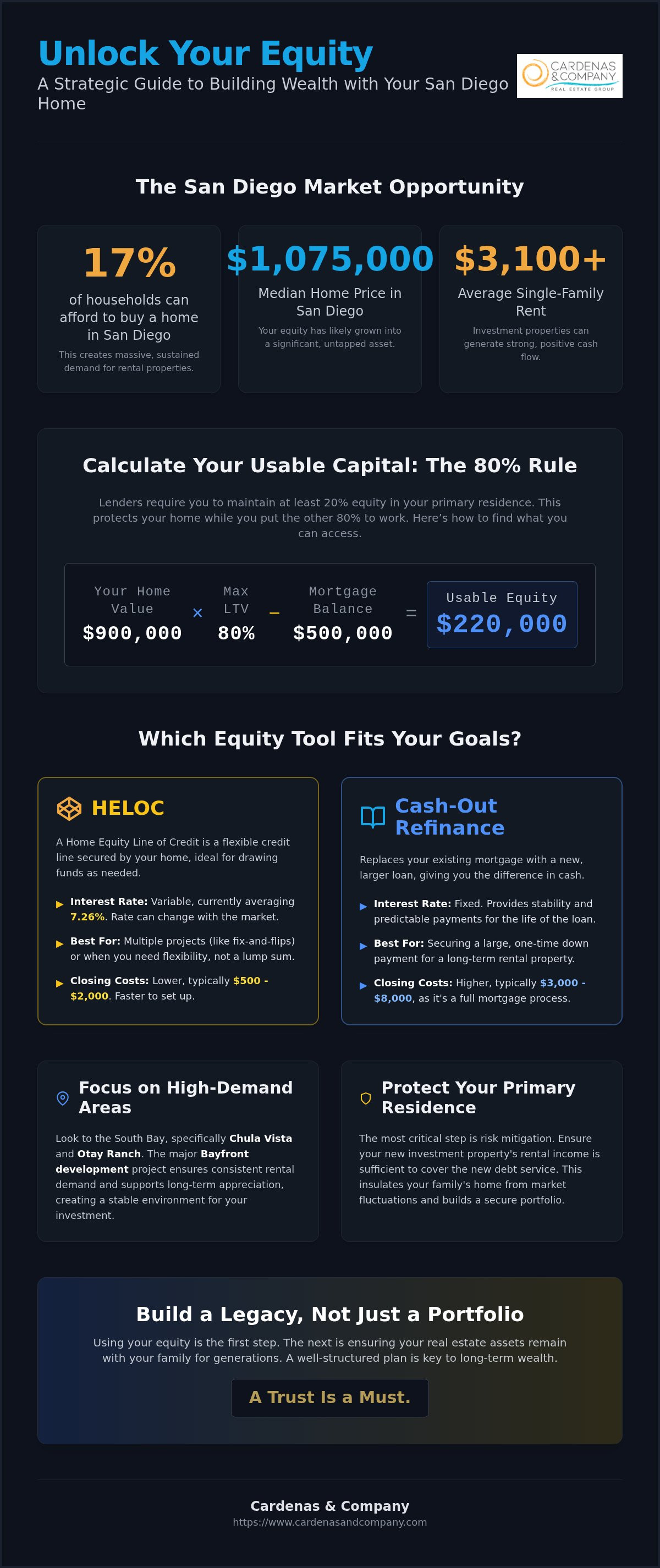
Only 17% of San Diego households can afford the current $1,075,000 median home price, yet you likely have hundreds of thousands of dollars in equity doing nothing but gathering dust. It's frustrating to watch property values climb while feeling like you're locked out of the next level of wealth building. You know that using home equity for investment properties is a proven path to financial freedom, but the fear of putting your primary residence at risk often stops you cold. We've spent over 25 years helping families realize that their homes are not just shelters, but engines for long-term stability.
You deserve a strategy that balances growth with security, especially when a median home in Chula Vista now commands $858,000. This guide provides a clear roadmap for choosing between a 7.26% HELOC, which functions as a flexible line of credit, or a cash-out refinance to fund your next acquisition. We'll examine the tax implications of these strategies and how to identify cash-flowing opportunities in a market where single-family rents exceed $3,100. By the end, you'll have the technical knowledge and the confidence to build a legacy for your family.
Key Takeaways
- Calculate your usable capital by subtracting your mortgage balance from your San Diego home valuation, ensuring you maintain at least 20% equity in your primary residence.
- Compare the 7.26% average HELOC rate against fixed-rate refinance options when using home equity for investment properties to secure your down payment capital.
- Focus on high-demand areas like Chula Vista and Otay Ranch, where the Bayfront development supports consistent rental demand and long-term appreciation.
- Protect your primary residence by ensuring the investment property’s income covers the new debt service and accounts for San Diego County market fluctuations.
- Transition into a long-term wealth strategy that utilizes Living Trust Education to ensure your real estate portfolio remains a family asset for generations.
Table of Contents
Equity needed for a San Diego investment property?
Equity is the gap between your home's actual market value and what you still owe the bank. In San Diego, where the median price reached $1,075,000 in 2026, many of you are sitting on a significant amount of trapped capital. To maintain financial stability, lenders generally require you to keep 20% equity in your primary residence after the loan closes. This safety margin protects your home while you put the rest of your wealth to work.
You can find your usable equity with a simple formula. Take your current San Diego home valuation, multiply it by 0.80, and subtract your existing mortgage balance. This number represents the maximum amount you can pull out for a down payment on a rental property. It's a straightforward calculation that often reveals more opportunity than homeowners expect.
The 80% LTV rule in the San Diego market
Lenders use a metric called Combined Loan-to-Value (CLTV) to determine your borrowing limit. For those using home equity for investment properties, this cap is almost always 80%. Understanding What is a home equity investment? helps clarify how this debt interacts with your ownership stake. It's a secured loan that uses your home as collateral to provide liquid cash.
Consider a $900,000 Chula Vista home with a $500,000 mortgage. Your 80% limit is $720,000, which leaves you with $220,000 in usable capital after accounting for the primary lien. This amount comfortably covers the 25% down payment required for most non-owner-occupied investment loans. You're essentially using the growth of your first asset to fund the birth of your second.
Why 2026 is the year to leverage your equity
Rental demand in the South Bay remains exceptionally strong because of limited inventory and high entry costs for first-time buyers. Only 17% of local households can afford to buy at current prices. This creates a massive pool of long-term tenants who need the housing you provide. You aren't just buying a building; you're providing a solution to a local housing shortage.
By leveraging your equity now, you can scale into a duplex or triplex without depleting your personal savings. This strategy allows you to acquire cash-flowing assets while San Diego county home prices show steady stability. It's a calculated move to convert a dormant asset into a source of monthly income. We see this as a foundational step in building a portfolio that lasts for generations.
Choosing the right financial vehicle depends on your specific timeline and risk tolerance. A Home Equity Line of Credit (HELOC) functions much like a credit card secured by your residence, allowing you to draw funds as needed. In contrast, a cash-out refinance replaces your current first mortgage with a single, larger loan. This provides a lump sum at a fixed interest rate, which is often preferable for long-term hold strategies. We also consider Home Equity Loans, which provide a one-time lump sum without disturbing your original mortgage rate.
The decision usually rests on how you plan to use the capital. If you need a revolving fund for multiple fix-and-flip projects, the flexibility of a line of credit is unmatched. However, if you are funding a long-term rental down payment, a fixed-rate product protects you from market volatility. There are several ways to use home equity to purchase another property, but the goal is always to maximize your return while minimizing your monthly carrying costs. We help you weigh these options against your current debt-to-income ratio to ensure your primary home remains secure.
You must also account for the difference in closing costs and speed of execution. HELOCs typically have lower entry costs, often ranging from $500 to $2,000, and can be set up relatively quickly. Cash-out refinances require a full appraisal and standard loan processing, with costs between $3,000 and $8,000. Understanding these nuances is a critical part of using home equity for investment properties without overextending your personal finances.
The case for the HELOC strategy
A HELOC is a powerful tool for investors who need to move quickly in the San Diego market. With promotional rates as low as 5.99% and a national average near 7.26%, it serves as a revolving "buy box" fund. You only pay interest on the money you actually spend, which is ideal when searching for South Bay San Diego homes for sale. The 10-year interest-only draw period helps maintain your monthly cash flow while you renovate or stabilize a new rental asset.
When a cash-out refinance makes more sense
If your current mortgage rate is close to the 6.5% to 7.5% range seen in 2026, a cash-out refinance offers long-term certainty. You lock in a fixed monthly payment for the next 30 years, protecting your portfolio from future rate hikes. This is the preferred route for acquiring a property where predictable expenses are vital to your bottom line. Since the maximum loan-to-value for a conventional cash-out refinance on a primary home is 80%, it allows for a significant capital pull for those with high equity. If you're unsure which path aligns with your five-year plan, our real estate investment consulting can help you run the numbers on your specific situation.
Where should you invest your equity in the South Bay and Chula Vista?
Chula Vista remains the primary target for San Diego investors because of the massive Bayfront development. This project is transforming the coastline and creating thousands of jobs, which drives long-term rental demand. We recommend looking at specific sub-markets based on your management style:
- Otay Ranch and Eastlake for newer construction and absentee landlords who prefer lower maintenance.
- Imperial Beach and National City for entry-level price points and consistent military tenant demand.
- Serra Mesa and Allied Gardens for multi-unit properties like duplexes that offer higher yields.
Using home equity for investment properties allows you to acquire these higher-priced assets without draining your liquid savings. These master-planned communities provide predictable property management and attract high-quality tenants who value local schools and parks. By focusing on areas with established employment hubs, you ensure your vacancy rates remain low even during market shifts. Our team views these neighborhoods as the bedrock of a stable San Diego real estate portfolio.
The ADU opportunity for Chula Vista homeowners
Building an Accessory Dwelling Unit (ADU) on your current lot often yields a higher ROI than buying a second property. The San Diego ADU bonus program allows you to increase density while adding immediate value to your primary residence. A $150,000 equity draw can fund a high-quality ADU that generates a $3,000 monthly rental stream in your own backyard. This strategy avoids the high closing costs of a new purchase while maximizing the utility of your existing footprint. It's an efficient way to manufacture cash flow using land you already own.
Evaluating the South Bay rental market
Current rents in Chula Vista for 2-bedroom units average around $2,600, while single-family homes frequently exceed $3,100. This steady income makes the South Bay a reliable choice for long-term hold strategies. We also help clients look toward the future through our Ciudad Maderas partnership, which offers unique cross-border investment strategies in Mexico for those seeking geographical diversification. You can review current listings and market trends in our South Bay San Diego homes for sale guide. Our team focuses on finding properties that meet your specific cash-flow requirements and long-term wealth goals.
What are the risks of leveraging equity and how do you mitigate them?
Leveraging your primary home to buy a rental property is a high-stakes move that requires a disciplined exit strategy, especially when using home equity for investment properties. If your investment property fails to cover the new debt service, your primary residence is at risk of foreclosure. Market volatility in San Diego county home prices means you could end up in a negative equity position if you borrow at a market peak. We prioritize strategies that leave you with a significant equity cushion to weather these shifts.
Interest rate risk is another factor to consider before you sign a loan document. Variable rates on HELOCs, which currently average 7.26%, can rise unexpectedly and erode your monthly cash flow. You should always run your numbers with a 2% to 3% rate buffer to ensure the property remains profitable during economic shifts. Separating your personal home from your investment liabilities is the only way to maintain long-term stability. Maintaining this level of stability is a core principle for experienced firms like Verbrugge Groep, which specialize in integrating real estate and mortgage solutions to protect long-term wealth.
Owning an investment property in your personal name is a liability trap that puts every asset you own at risk. If a lawsuit arises from a tenant dispute or an injury on the rental premises, your personal residence could be targeted to satisfy a judgment. A Living Trust provides a layer of protection that ensures your equity remains within your family regardless of legal challenges. It's a foundational tool for anyone building a San Diego real estate portfolio.
Beyond protection from lawsuits, a trust allows your heirs to avoid the California probate process. Probate is a slow, expensive, and public court proceeding that can consume 4% to 7% of an estate's total value in fees. By placing your properties in a trust, you ensure a seamless transition of wealth without government interference. A Trust Is a Must. Visit TrustSanDiego.com to learn more.
The "house is only a home" philosophy
Standard Private Mortgage Insurance only protects the bank, but strategic mortgage protection is designed to protect your family. We often discuss how an IUL can serve as a secondary safety net for your San Diego real estate investment. This financial tool provides a tax-advantaged cash reserve that you can access if your rental income is interrupted or if you face a personal health crisis. It's about creating a comprehensive plan where your debt doesn't become a burden to those you love.
A house is only a home if you can protect it. (CA Life License #4375068).
Consult with a wealth strategist today
How do you start your investment journey with Cardenas & Company Real Estate Group?
Building wealth through real estate requires a 25-year perspective rather than a transactional mindset. Our team at Cardenas & Company Real Estate Group provides specialized Real Estate Investment Consulting to ensure you deploy your capital with precision. We focus on identifying properties in Chula Vista and the South Bay that align with your specific cash-flow requirements and long-term stability.
Our relationship-driven approach ensures you have a dedicated advocate throughout the listing and buying process. We don't just find houses; we secure assets that serve as the foundation for your family's future. This long-term focus distinguishes our work from high-volume operations that prioritize quick sales over client outcomes. We view our technical work as a vital means to a human end.
The Cardenas & Company Real Estate Group strategy session
We begin by conducting a thorough analysis of your current San Diego home valuation to define your actual borrowing power. This step moves beyond simple online estimates to give you a clear look at your financial starting point. We then help you evaluate if a duplex, an ADU, or a single-family rental fits your risk tolerance and management style.
Our bilingual team ensures that every member of your family understands the implications of using home equity for investment properties. We act as your advocate, ensuring your interests are protected at every turn. This collaborative effort is designed to help you transition into a new phase of life with a strategy tailored to your unique situation and family narrative.
Bottom Line
Deploying your home equity is a high-stakes decision that requires a disciplined strategy and deep local expertise. Your San Diego equity is a finite resource; moving it into cash-flowing assets is the most effective way to secure your independence. Reach out to Christian Cardenas and the team today for a zero-pressure consultation on your 2026 investment strategy.
Cardenas & Company Real Estate Group
Affiliated with Realty ONE Group Pacific
David Cardenas | Christian Cardenas
25+ years of local experience
Specializing in South Bay and Chula Vista
www.cardenasandcompany.com
CA Life License #4375068
Your path to generational wealth
You now have the technical roadmap for using home equity for investment properties without compromising your primary residence. By maintaining the 20% equity cushion we discussed and selecting the tool that fits your specific timeline, you move from passive ownership to active wealth creation. Because your family's future is the ultimate goal, remember that A Trust Is a Must. Visit TrustSanDiego.com to ensure your assets bypass the costly probate process.
Bottom Line
Success in the San Diego market requires a partner who looks past the next closing and focuses on your legacy. Our team brings 25+ years of local experience and specialized strategies to help local families build stability. We provide bilingual support and deep South Bay expertise to guide you through every phase of the journey. A house is only a home if you can protect it. (CA Life License #4375068). We look forward to helping you secure your financial future.
Schedule your San Diego investment strategy session with Cardenas & Company Real Estate Group
Cardenas & Company Real Estate Group Affiliated with Realty ONE Group Pacific David Cardenas | Chris
Frequently Asked Questions
Can I use a HELOC to buy an investment property in San Diego?
Yes, you can use a line of credit to fund the down payment or the entire purchase price of a new asset. Using home equity for investment properties is a standard strategy for local homeowners who want to keep their existing low-rate first mortgage intact. You draw only the funds you need, making it a flexible option for making competitive offers in neighborhoods like Otay Ranch or Eastlake.
How much equity can I withdraw from my primary residence for a down payment?
Most lenders cap your Combined Loan-to-Value (CLTV) at 80% of your home's appraised value. If your Chula Vista home is worth $858,000 and you owe $400,000, your 80% limit is $686,400. Subtracting your current debt leaves you with $286,400 in usable capital. This amount is usually sufficient to cover the 25% down payment required for a non-owner-occupied investment property in the current market.
Is interest on a home equity loan tax-deductible for investment properties?
Interest is typically deductible if you use the funds to buy, build, or substantially improve the property that secures the loan. However, when you use equity from your primary home to purchase a separate rental, the IRS rules change. You should consult with a tax professional to see if the interest can be treated as an investment interest expense. This distinction is vital for maintaining your long-term San Diego wealth strategy.
What is the minimum credit score needed for a HELOC in 2026?
Lenders generally require a minimum credit score of 680, though a score of 740 or higher secures the most favorable rates. In the current 2026 market, banks have tightened standards due to high San Diego county home prices and economic shifts. A stronger score often allows you to access a higher percentage of your equity. We recommend reviewing your credit report at least six months before applying for any equity-based loan.
Should I use a cash-out refinance if I have a low interest rate on my current mortgage?
You should probably avoid a cash-out refinance if your current rate is below 5%. Replacing a low-rate first mortgage with a new loan at 2026 rates, which range from 6.5% to 7.5%, can significantly increase your monthly overhead. In this scenario, a HELOC or a second mortgage is often the better choice. It allows you to access capital while keeping your primary low-interest debt completely untouched for the long term.
What happens if my San Diego home value drops after I take out equity?
If your home value falls below your total loan balance, you enter a negative equity position. This makes it difficult to sell or refinance without bringing cash to the closing table. To mitigate this risk, we advise clients to maintain at least a 20% equity buffer at all times. This safety margin protects your primary residence during temporary market corrections in the South Bay area and ensures your stability.
Can I use equity from a VA-funded home to buy a rental property?
Yes, you can utilize a VA cash-out refinance to access up to 90% of your home's value for investment purposes. This is a powerful tool for our local military community looking to start a San Diego real estate portfolio without using personal savings. The funds can be used for the down payment on a new investment property. We specialize in Military Relocation Services and understand the specific nuances of VA-backed equity strategies.
How long does the process take to get home equity funds for a real estate purchase?
A HELOC typically takes 30 to 45 days to close, while a cash-out refinance can take 45 to 60 days. The timeline depends on the speed of the appraisal and the complexity of your financial profile. If you are planning to make an offer on a property in Imperial Beach, it's best to have your equity line established in advance. This ensures you can move quickly when the right cash-flowing opportunity appears.
Disclaimer
The information provided on this blog is for educational and informational purposes only and does not constitute legal, financial, or investment advice. While we strive for accuracy, real estate markets and insurance regulations (including Living Trusts and IUL strategies) are subject to change. David Cardenas (DRE 01862173) is a licensed real estate salesperson; however, this content does not create an agency relationship. Please consult with a qualified attorney or tax professional regarding your specific situation.