
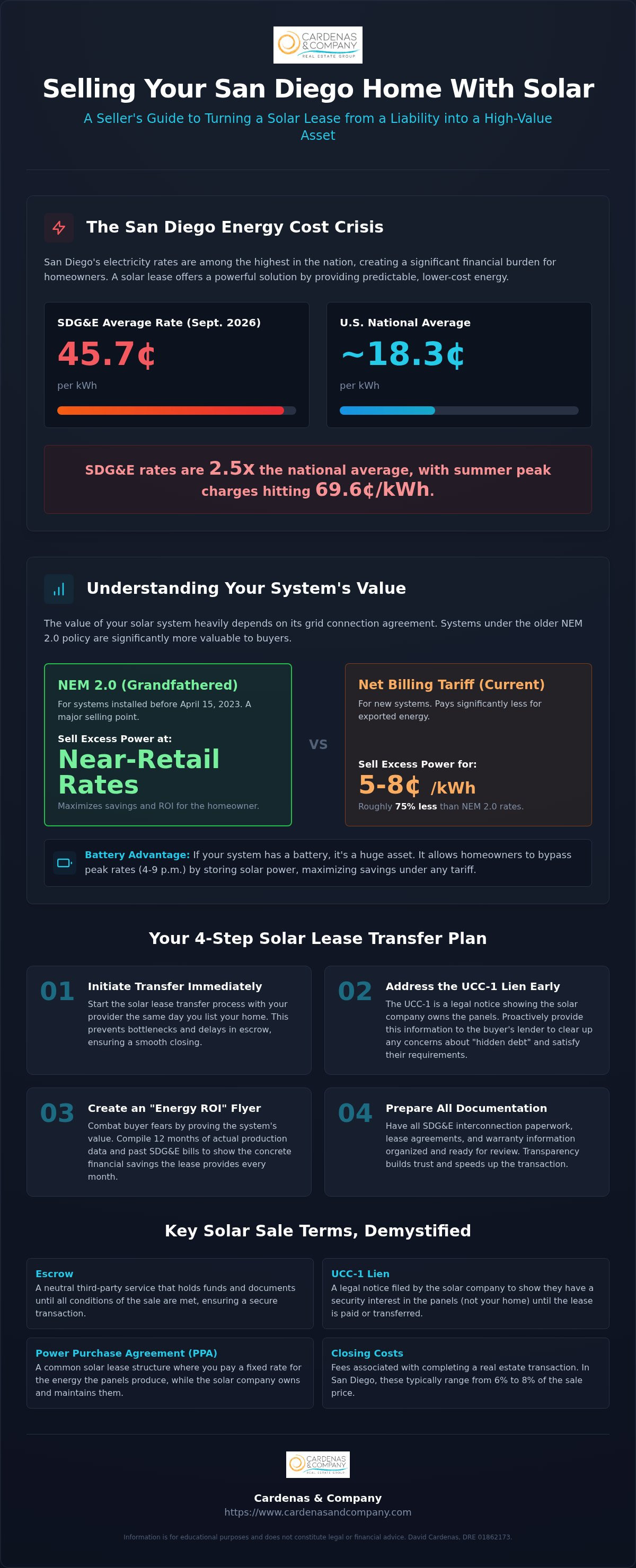
What if your solar lease was the strongest selling point of your home rather than a liability? Most sellers fear that selling a home in San Diego with a solar lease will cause buyers to walk away or demand a price reduction. It's an understandable anxiety when, as of September 2026, SDG&E rates average 45.7 cents per kilowatt-hour (kWh), which is 2.5 times the national average.
We'll show you how to turn this perceived hurdle into a wealth-protection tool that secures your equity. You'll learn to handle the transfer process without delays in escrow. Escrow is a neutral third-party service that holds funds and documents until all conditions are met. We also explain how to manage a UCC-1 lien, which is a legal notice filed by the solar company to show they have a claim on the panels until the lease is transferred.
By understanding the 2026 Net Billing Tariff impact and growth signals like the Chula Vista Bayfront project, you can position your home as a sanctuary from volatile utility hikes. This guide provides the tactical steps to manage your closing costs, which typically range from 6% to 8%, and ensures a smooth transition for both you and the buyer.
Key Takeaways
- Position selling a home in San Diego with a solar lease as a hedge against SDG&E rates that remain significantly higher than the national average in 2026.
- Initiate the lease transfer the same day you list to avoid bottlenecks in escrow. Escrow is the neutral third-party service that handles your sale documents and funds.
- Combat "hidden debt" fears by providing an Energy ROI flyer based on 12 months of actual production data to prove the system's value.
- Address the UCC-1 early to ensure the buyer's lender is satisfied. A UCC-1 is a legal notice filed by solar companies to show they own the panels.
Table of Contents
The 2026 San Diego Solar Landscape: Why Structure Matters
San Diego residents face a stark reality in September 2026. Electricity rates from SDG&E average 45.7 cents per kilowatt-hour (kWh), while summer peak charges climb to 69.65 cents/kWh. These figures are roughly 2.5 times the national average. When selling a home in San Diego with a solar lease, you aren't just selling a house; you're selling a protected energy budget.
A solar lease is often structured as a Power Purchase Agreement (PPA). This is a financial arrangement where a third-party developer owns and maintains the solar system on your roof while you pay a fixed rate for the energy it produces. This structure acts as a critical hedge against utility inflation. Since SDG&E raised rates again on January 1, 2026, buyers are more sensitive than ever to monthly carrying costs.
NEM 2.0 vs. Net Billing Tariff in San Diego
The value of your system depends heavily on its interconnection agreement. Systems installed before April 15, 2023, are likely grandfathered under NEM 2.0. This older policy allows homeowners to sell excess power back to the grid at near-retail rates. In contrast, the current Net Billing Tariff (the 2026 version of solar billing) pays roughly 75% less for exported power. Under this tariff, the utility pays an "avoided cost" rate of only $0.05 to $0.08 per kWh.
Buyers in Chula Vista and the South Bay look for homes that mitigate these export losses. If your leased system includes battery storage, you hold a significant advantage. Batteries allow homeowners to store power during the day and use it during those expensive 4 p.m. to 9 p.m. peak hours, completely bypassing high utility charges. This setup turns a standard lease into a high-performance asset.
The High Cost of Waiting: San Diego Utility Trends
Energy demand in the South Bay continues to surge. Projects like the Chula Vista Bayfront Harbor Park expansion, which broke ground on March 3, 2026, signal long-term regional growth and increased pressure on the grid. For a buyer, the cost of inaction is high. Without solar, they face volatile bills that fluctuate with every regulatory shift and infrastructure project.
We frame the solar lease as a predictable, fixed expense. While utility rates are unpredictable, a lease payment is a known quantity. This transparency builds trust during the sale. We ensure all SDG&E interconnection paperwork is ready for review, proving that the home is equipped to handle San Diego's high-cost energy market without the shock of a $500 monthly electric bill.
Leased vs. Owned Solar: The Financial Reality for Sellers
Selling a home in San Diego with a solar lease requires addressing the "hidden debt" elephant in the room immediately. Many buyers see a monthly payment and panic, viewing it as an added liability on top of their mortgage. We counter this by explaining the Amortization, which is the process of paying off the solar equipment cost over a set period through regular payments. When compared to the alternative of paying full SDG&E rates, the lease often reveals itself as a strategic savings tool.
You must understand the UCC-1 filing. This is a legal notice solar companies file to show they own the panels on your roof. It appears on your San Diego preliminary title report and can cause friction if the buyer's lender isn't prepared. We recommend reviewing consumer advice from the FTC to understand how these filings impact your property rights and the sale process.
The transfer happens within Escrow, which is a neutral third party that holds funds and documents until all conditions of the sale are met. If the solar company is slow to respond, it can delay your closing. In the 2026 market, where inventory levels remain tight, a delay can jeopardize your next move. If you are unsure about your current lease terms, we can help you analyze your solar contract before you hit the market.
The UCC-1 Lien and Your Title Report
Coordinate with your solar provider the moment you list your home. Most major providers in San Diego have dedicated transfer teams, but they often move slower than the real estate market. If you don't address the UCC-1 early, the buyer's lender may refuse to fund the loan. Lenders typically want to be in the first lien position, meaning their debt takes priority over others. We work to ensure the solar company "subordinates" or temporarily lifts their notice so the mortgage can close without a hitch.
Transferring the Lease: A Step-by-Step Financial Move
The buyer must qualify for the lease just like they qualify for a mortgage. This involves a separate credit check by the solar company. Transfer fees in South Bay transactions usually range from $250 to $1,000. While everything is negotiable, many sellers in Chula Vista choose to cover this fee to keep the deal moving. Transparency about these costs prevents "buyer's remorse" during the final week of the transaction.
The Lease Assumption Process: Navigating Escrow in San Diego
Success in selling a home in San Diego with a solar lease depends on your speed. Don't wait for a buyer to fall in love with your floor plan before you call your solar provider. Contact companies like Sunrun, Tesla, or PosiGen the day you go active on the MLS. You need a dedicated transfer coordinator to manage the parallel timeline of your home sale and the lease assumption process.
We recommend gathering 12 months of SDG&E bills to prove the system's performance. Buyers in September 2026 are often skeptical of anything that adds to their monthly overhead. Showing them a documented drop from the average 45.7 cents/kWh utility rate to a lower, fixed lease payment turns a perceived debt into a tangible asset. In a market with tight inventory levels, providing this data upfront prevents buyers from getting cold feet during the inspection period.
Your contract likely follows the guidelines set by the Solar Energy Industries Association regarding transferability and end-of-term options. To protect your equity, we draft a specific Solar Lease Addendum to accompany the California Residential Purchase Agreement. This document ensures the buyer acknowledges the lease terms and credit requirements before they sign the final offer. It also clarifies who covers the transfer fee, which typically ranges from $250 to $1,000 in the South Bay.
Documentation You Need Before the First Showing
Transparency builds trust and keeps your timeline on track. Have these items ready in a digital folder for serious prospects:
- The original signed lease agreement and the current monthly payment schedule.
- System production reports from your solar monitoring app.
- The "Permission to Operate" (PTO) letter from the utility.
Having these documents ready prevents delays in Escrow. Escrow is the neutral third-party service that handles the exchange of funds and legal documents to ensure all sale conditions are met. Missing paperwork is the primary cause of solar-related closing delays in San Diego County.
Managing Buyer Expectations and Credit Checks
The buyer must pass the solar provider's credit check early in the transaction. If a buyer is rejected by the solar company, the deal could collapse, even if their mortgage is approved. We address this by screening for qualified buyers who understand the value of solar in a high-cost energy market. If a buyer demands you pay off the lease, we use SDG&E rate data to show them why the lease is a smarter financial hedge than a total buyout. If you need a more detailed wealth strategy session to analyze these trade-offs, we can run the numbers for your specific property.
Strategic Marketing: Turning a Lease into a Listing Asset
Marketing a home with a solar lease requires a shift in perspective. You aren't just selling a roof; you're selling a financial strategy that protects the buyer's long-term wealth. Most agents rely on tired clichés, but savvy sellers use data to show how they've locked in lower rates while SDG&E prices continue to soar. When selling a home in San Diego with a solar lease, we focus on active benefits. We use phrases like "Secure fixed energy costs" or "Shield your income from utility hikes" to attract buyers who value stability.
We create a custom "Energy ROI" flyer for every listing. This document provides a side-by-side comparison between the fixed solar lease payment and a standard SDG&E bill at the current 45.7 cents/kWh rate. This transparency reduces the fear of "hidden debt" and proves the system is an asset. If you want to see how we position these assets, you can request a sample marketing plan for your property.
Proving the Value in San Diego and Chula Vista
Neighborhoods like Otay Ranch and Eastlake have high energy demands due to larger square footage and family-centric layouts. Buyers in these areas are acutely aware of how utility costs impact their monthly budget. We use the Chula Vista Bayfront growth as a signal for the region's future. As the Harbor Park expansion moves forward after its March 3, 2026 groundbreaking, local demand for modern, energy-efficient homes will only rise. For more on maximizing your return in this area, see our guide on Selling Your Home in Chula Vista.
Property taxes are the annual fees homeowners pay to the local government based on the assessed value of their home. While these are a standard part of closing costs, which are the various fees and expenses paid at the end of a real estate transaction, a solar lease offers a way to manage the other major monthly expense: utilities. High inventory levels in some parts of San Diego mean your home must stand out. Proving that your home has lower monthly carrying costs than the house down the street is a powerful competitive advantage.
Transparency as a Sales Tool
Radical transparency prevents canceled contracts. We include the full solar lease agreement in the digital disclosure packet before the first showing. This allows buyers to review the terms, escalator clauses, and transfer requirements without surprises during Escrow. Escrow is the neutral third-party service that handles the exchange of funds and legal documents to ensure all sale conditions are met. We also use professional photography to showcase the panels and inverter. High-quality visuals build confidence that the equipment is well-maintained and professionally installed. This approach ensures that when a buyer makes an offer, they are fully committed to the energy-saving lifestyle your home provides.
Closing the Deal: Avoiding Last-Minute Delays
The final week of selling a home in San Diego with a solar lease requires precise coordination to ensure a successful transition. We confirm that the solar provider has received and processed the buyer’s signed assumption documents well before the scheduled closing date. A common bottleneck occurs when the solar company’s administrative timeline lags behind the fast pace of a San Diego real estate transaction. We proactively verify that the UCC-1 release or subordination is ready for the new lender. A UCC-1 is a legal notice filed by solar companies to show they own the panels on your roof, and it must be handled correctly so it does not block the buyer’s mortgage.
On the day of closing, we facilitate a final meter reading and account transition. This ensures you aren't billed for energy used after the keys change hands. We also invite the buyer to a brief session to understand the system’s monitoring tools. This small act of mentorship reduces post-sale anxiety and reinforces the value of the energy hedge they’ve inherited. In a market where closing costs range from 6% to 8%, ensuring every detail is settled prevents expensive delays or credits.
The Final Escrow Checklist for Solar Sellers
We work closely with the Escrow officer to ensure all financial demands are accurate. Escrow is a neutral third-party service that holds all funds and documents during the home sale, releasing them only when every condition is met. Our checklist includes:
- Confirming the Escrow officer has the exact transfer demand from the solar company.
- Verifying the buyer’s lender has factored the lease payment into the debt-to-income ratio.
- Ensuring all service guarantees and equipment warranties transfer to the new owner.
This level of detail protects your equity and prevents last-minute surprises that could jeopardize the sale. With San Diego County’s gross assessed value reaching $845 billion in 2026, precision in high-value transactions is more critical than ever. Likewise, maintaining your personal health requires the same level of professional precision; for those seeking experienced oral care, colonydentalcaresa.com offers personalized services backed by over 30 years of expertise.
Success in this transaction is just one step in your broader financial journey. You can carry the knowledge gained from this solar lease transfer into your next property purchase in San Diego or Chula Vista. Whether you’re looking at the new infrastructure near the Chula Vista Bayfront or staying in the South Bay, protecting your assets remains the priority. We invite you to explore Trust San Diego for advanced strategies on asset protection and long-term wealth management. We view every home sale as a collaborative effort to secure your family's stability and future growth.
Bottom Line: Successfully transferring a solar lease requires early documentation and constant communication with both the provider and the escrow team. By positioning the lease as a shield against high utility rates, you protect your equity and ensure a smooth transition into your next home.
Ready to secure your home equity and master the complexities of the San Diego market? Contact David & Angela Cardenas and the Cardenas & Company Real Estate Group today for a personalized strategy session at cardenasandcompany.com or TrustSanDiego.com.
Information is for educational purposes and does not constitute legal or financial advice. David Cardenas, DRE 01862173.
Secure Your Equity in San Diego’s Energy Future
Selling in San Diego's high-cost energy market doesn't have to be stressful. By treating your solar system as a wealth-protection tool, you differentiate your property in a competitive landscape. Success in selling a home in San Diego with a solar lease requires early preparation and radical transparency. Documented savings provide the proof buyers need to commit to the purchase.
Managing the technical aspects of the UCC-1 and the Escrow process ensures your equity remains intact. A UCC-1 is a legal notice filed by solar companies to show they own the panels on your roof. Escrow is the neutral third-party service that handles the exchange of funds and legal documents until all sale conditions are met. We turn these complex administrative hurdles into a seamless transition for your family.
Bottom Line: A solar lease is a powerful asset when you present it as a fixed-cost shield against rising utility inflation. Proactive coordination with your solar provider and escrow team ensures you close on time without sacrificing your home equity.
Ready to secure your financial future? Schedule a Strategic Equity Session with Cardenas & Company today to leverage our 25+ years of local expertise. We invite you to a zero-pressure strategy session with David & Angela Cardenas and the Cardenas & Company Real Estate Group at cardenasandcompany.com or TrustSanDiego.com.
Information is for educational purposes and does not constitute legal or financial advice. David Cardenas, DRE 01862173.
Frequently Asked Questions
Can I sell my San Diego home if I still owe money on a solar lease?
Yes. You can transfer the lease to the buyer or pay it off during the sale. Most sellers choose the transfer option to preserve cash for their next purchase. The buyer must meet the solar provider's credit requirements. Initiating this process early prevents delays in Escrow. Escrow is a neutral third-party service that holds funds and documents until all conditions of the sale are met.
Do buyers in San Diego actually want to take over a solar lease in 2026?
Yes, because SDG&E rates currently average 45.7 cents/kWh. Buyers view solar as a necessity rather than a luxury in high-cost areas like Otay Ranch. A lease offers them a fixed monthly payment that is significantly lower than standard utility bills. We emphasize this value by providing 12 months of production data to prove the home's energy efficiency and long-term cost stability.
How does a solar lease affect my home’s appraisal value in Chula Vista?
Appraisers typically don't add direct value for leased equipment since you don't own the asset. However, the system increases the home's marketability and "effective age" in Chula Vista. Buyers often pay more for homes with lower monthly carrying costs. We provide the appraiser with documentation showing the system's performance to justify a higher sales price compared to homes without solar in the same neighborhood.
What happens to the UCC-1 lien during the San Diego escrow process?
The solar company temporarily lifts or subordinates the UCC-1 so the buyer's mortgage can be recorded. A UCC-1 is a legal notice filed by solar companies to show they own the panels on your roof. This coordination happens behind the scenes between the solar provider, the title company, and the lender. We manage these technical communications to ensure the lien doesn't stall your closing timeline.
Should I pay off my solar lease before listing my home for sale?
Not necessarily. Paying off the lease requires a significant cash outlay you might not recover. Most homeowners find success by selling a home in San Diego with a solar lease through a simple transfer. If lease terms are unfavorable, we analyze if a buyout makes sense based on your closing costs. Closing costs are the fees and expenses paid at the end of a real estate transaction.
How long does the solar lease transfer process typically take in California?
The process usually takes 30 to 45 days. You should contact your provider the moment your home goes active on the market. Major companies like Sunrun or Tesla have dedicated teams, but they require the buyer's credit application and signed assumption documents to move forward. Starting early ensures the transfer happens in parallel with your standard 30-day escrow period to avoid any last-minute delays.
Will a solar lease prevent a buyer from getting a VA or FHA loan in San Diego?
No, as long as the lease meets specific agency guidelines. VA and FHA lenders are familiar with solar leases in Southern California. The buyer's total debt-to-income ratio must account for the monthly lease payment. We work with the buyer's lender to provide the necessary Amortization schedules. Amortization is the process of paying off the solar equipment cost over a set period through regular payments.
What is the difference between a solar lease and a Power Purchase Agreement (PPA)?
A lease has a fixed monthly payment for the equipment, while a PPA charges you per kilowatt-hour produced. Both involve third-party ownership and a UCC-1 filing on your title. In the 2026 market, both structures serve as a hedge against SDG&E rate hikes. We review your specific contract to explain the transfer requirements and monthly cost escalators to potential buyers during the showing process.
Bottom Line: Successfully selling a home with a solar lease requires early coordination with the provider and transparent data sharing with the buyer. By highlighting the fixed-cost benefits against rising utility rates, you protect your equity and ensure a smooth closing.
Ready to secure your home equity and master the complexities of the San Diego market? Contact David & Angela Cardenas and the Cardenas & Company Real Estate Group today for a personalized strategy session at cardenasandcompany.com or TrustSanDiego.com.
Information is for educational purposes and does not constitute legal or financial advice. David Cardenas, DRE 01862173.
Disclaimer
The information provided on this blog is for educational and informational purposes only and does not constitute legal, financial, or investment advice. While we strive for accuracy, real estate markets and insurance regulations (including Living Trusts and IUL strategies) are subject to change. David Cardenas (DRE 01862173) is a licensed real estate salesperson; however, this content does not create an agency relationship. Please consult with a qualified attorney or tax professional regarding your specific situation.