
Accepting a fast cash buyout from an institutional investor rarely saves you genuine stress; it routinely strips 15% to 25% of your accumulated wealth directly off the table. When you are selling a home in Chula Vista, you already know the financial stakes are massive, whether you are coordinating a military PCS move or transitioning into your next property. You should not have to choose between leaving your listing stranded on the market and accepting predatory terms that discount your family's future.
Discover the exact financial framework and local steps required to maximize your net proceeds in 2026. In the sections ahead, we break down actual South Bay transfer taxes, clear up California disclosure rules, and outline strategic pricing techniques spanning from older West Chula Vista neighborhoods to master-planned communities in Eastlake and Otay Ranch. You will gain the clarity needed to protect your hard-won equity and command top dollar on your own terms.
Key Takeaways
- Learn how the distinct market dynamics between older single-family properties in West Chula Vista and master-planned developments in East Chula Vista dictate your listing strategy.
- Master the real financial math behind selling a home in Chula Vista, including the local $1.10 per $1,000 transfer tax and escrow fees, so your closing statement holds zero surprises.
- Discover why standard open-market exposure consistently protects tens of thousands of dollars in equity compared to discounted institutional cash buyouts.
- Identify high-return preparation steps and architectural staging methods that attract serious offers without sinking money into structural remodeling.
- Protect your liquid proceeds after escrow closes by utilizing smart estate planning tools that keep your family wealth out of California probate court.
Table of Contents
What Does the Chula Vista Real Estate Market Look Like in 2026?
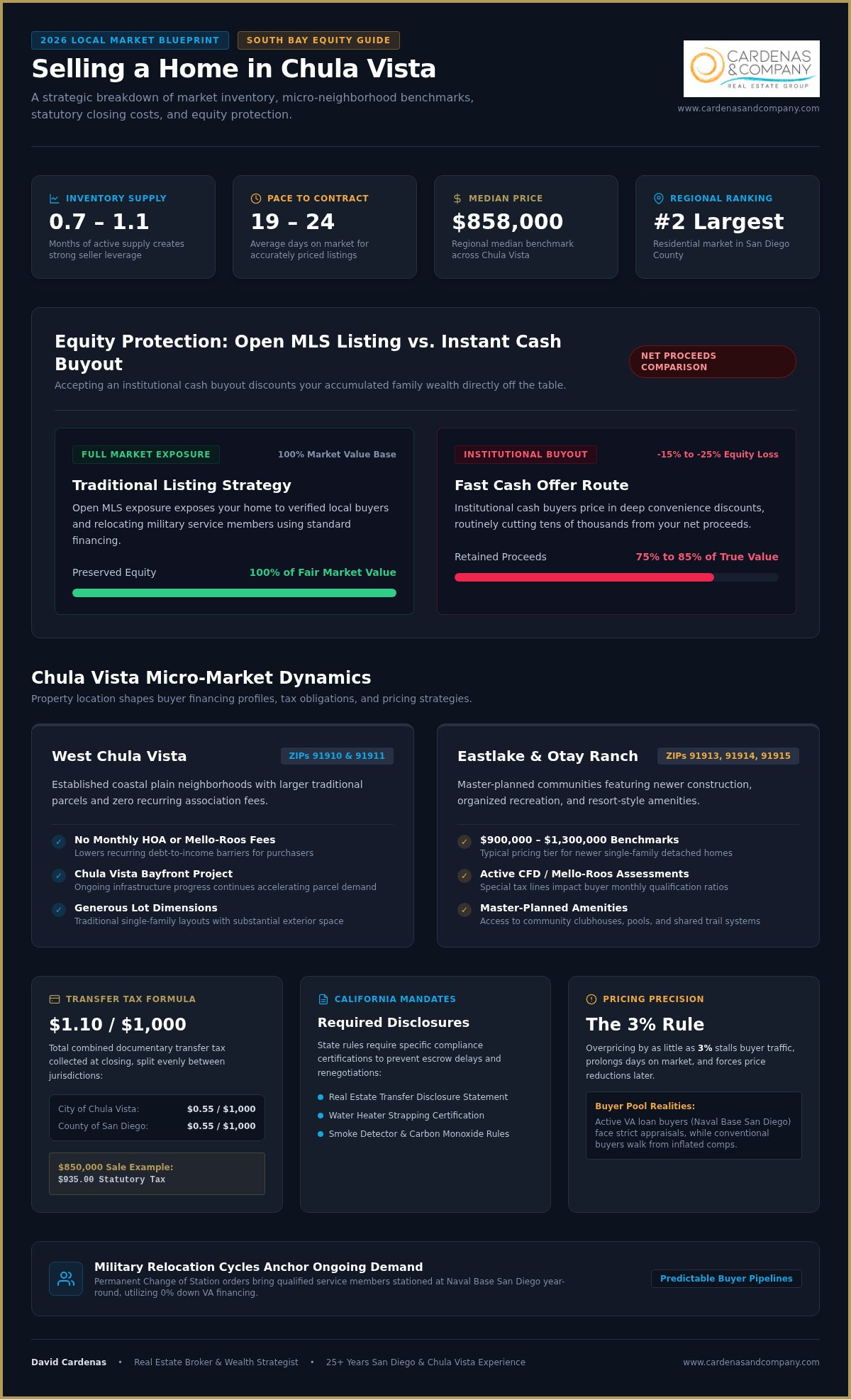
Chula Vista stands as San Diego County's second-largest residential market, functioning as an essential engine for regional housing. With a tight inventory hovering between 0.7 and 1.1 months of supply, sellers retain substantial leverage during contract negotiations. Homes priced accurately to market conditions move rapidly, seeing an average of 19 to 24 days on market before going under contract.
A continuous influx of service members stationed at Naval Base San Diego and nearby installations creates steady demand throughout the calendar year. Permanent Change of Station orders bring well-qualified military buyers who need dependable housing quickly. When selling a home in Chula Vista, aligning your marketing schedule with these predictable relocation cycles yields serious, pre-approved interest from day one.
West Chula Vista vs. Eastlake and Otay Ranch Micro-Markets
Your property's exact location dictates your pool of prospective buyers. As noted in the Chula Vista, California community profile, the city spans older coastal plains and sprawling eastern master developments. Established neighborhoods in West Chula Vista (ZIP codes 91910 and 91911) offer larger, traditional single-family lots without monthly HOA dues or Mello-Roos fees. Ongoing progress on the Chula Vista Bayfront project continues accelerating buyer interest in these western parcels.
Communities like Eastlake and Otay Ranch (ZIP codes 91913, 91914, and 91915) deliver newer construction and resort-style amenities. These eastern enclaves routinely see single-family sale benchmarks between $900,000 and $1,300,000. You must account for active Community Facilities District assessments when pricing here, because additional tax line items directly affect a buyer's monthly debt-to-income qualification ratio.
How Buyer Financing and Interest Rates Impact Your Price Point
Financing terms shape how buyers structure their purchase contracts. A substantial portion of South Bay offers rely on VA loans, which require zero down payment and strict appraisal guidelines regarding property condition. Conventional buyers face elevated monthly mortgage payments, making them quick to walk away from listings that do not align with recent comparable sales.
A well-maintained property listed at the median price of $858,000 attracts clean offers with minimal repair contingencies. Overpricing by even 3% can stall your momentum and trigger price cuts later. Partnering with an experienced Chula Vista real estate advisor ensures you price your asset using verified comps rather than automated internet estimates.
How Much Does It Actually Cost to Sell Your Home in Chula Vista?
Your gross contract price is not what lands in your bank account on closing day. In California, sellers bear specific statutory closing costs, title obligations, and municipal assessments that reduce total proceeds. Reviewing these line items early ensures you make informed financial decisions rather than facing surprises during the final escrow reconciliation.
State compliance rules also carry hard costs. California mandates that sellers complete a comprehensive Real Estate Transfer Disclosure Statement and certify that water heaters are strapped and smoke detectors are compliant. You can review the full statutory requirements outlined in the California Department of Real Estate disclosure guidelines. Overlooking these items up front invites buyer renegotiations that cut into your bottom line.
San Diego County Transfer Taxes and Local Escrow Fees
The City of Chula Vista collects a combined documentary transfer tax of $1.10 per $1,000 of the final sale price. This rate is split evenly between the municipal treasury ($0.55 per $1,000) and San Diego County ($0.55 per $1,000). On a home selling at $850,000, this fee amounts to exactly $935.00, which is customarily paid by the seller.
Escrow and title policies protect all parties against deed defects and ensure clear ownership transfers. In South Bay transactions, customs call for the following fee distributions:
- The seller customarily pays for the owner's title insurance policy.
- Escrow processing and wire settlement fees are split evenly between buyer and seller.
- The seller covers natural hazard disclosure reports and municipal recording fees.
Understanding HOA Resale Disclosures and Mello-Roos Payoffs
If your property is situated within a planned development in Eastlake, Otay Ranch, or Rancho del Rey, you must budget for association document demands. HOA management companies charge between $350 and $750 to provide bylaws, financial statements, and reserve studies to prospective buyers. Order these packages immediately upon listing to eliminate contract contingency bottlenecks.
Mello-Roos Community Facilities District bonds run with the land rather than requiring a mandatory payoff at closing. However, sellers must disclose the remaining bond lifespan and annual assessment amounts accurately. Buyers evaluate these payments when computing total monthly housing costs, making clean disclosures essential to preserve agreed pricing.
Calculating Your Net Equity Sheet Before Going Live
Building an accurate net sheet begins by subtracting your outstanding mortgage balance, property taxes prorated to the day of closing, and transfer fees from your target sale price. Post-settlement real estate guidelines mean buyer-broker compensation cannot be advertised on local MLS systems, meaning concession credits are frequently negotiated directly inside purchase offers. Detailed planning around these credits lets you evaluate incoming offers based solely on true net proceeds.
You can study our detailed guide on selling your home in Chula Vista to model your numbers accurately. If you want a tailored closing cost worksheet based on your exact parcel and mortgage balance, connect with our team at Cardenas & Company Real Estate Group for a clear financial assessment.
Traditional MLS Listing vs. Cash Investor Offers: What Protects Your Equity?
Speed comes at a measurable price. Instant cash buyers and institutional iBuyers pitch convenience, but they extract their profit margin directly from your accumulated home equity. When selling a home in Chula Vista, public market representation exposes your property to motivated buyers willing to pay full market value rather than a wholesale discount.
A fiduciary listing partner negotiates on your behalf to protect your proceeds and keep your timeline secure. Off-market buyers operate with their own bottom line in mind, not yours. Understanding how these transaction models compare helps you avoid surrendering tens of thousands of dollars for conveniences you can secure on the open market.
The Real Financial Tradeoff of As-Is Cash Buyers
Wholesale investors and institutional cash platforms do not buy real estate to settle down; they purchase properties to secure resale margins. In the South Bay market, institutional cash buyers routinely discount acquisition offers by 15% to 25% below fair market value. What starts as a firm cash offer often unravels during the physical inspection window, where buyers demand steep repair allowances or threaten cancellation.
Cash buyouts serve a purpose for sellers facing urgent financial distress or severe property neglect, but suburban home sellers rarely benefit from them. Sacrificing your equity undermines your purchasing power for your next home. When reviewing your bottom line, consider that the IRS home sale capital gains exclusion rules permit qualified homeowners to shelter up to $250,000 in gain for single filers and $500,000 for married couples. Handing that profit over to an investor discount defeats the tax advantages built into your primary residence.
Why Maximum Market Exposure Creates Multiple Offer Leverage
Placing your home on the open MLS system creates genuine buyer competition that works in your favor. Across Chula Vista, accurately priced properties command a sale-to-list ratio of 100.1%, with 50.7% of homes selling above list price. Open-market distribution connects your property with qualified military transferees, conventional buyers, and households seeking long-term stability.
Multiple offers provide concrete leverage that cash buyers simply cannot match:
- You establish firm inspection timelines and eliminate speculative price renegotiations.
- You dictate closing dates and negotiate post-closing occupancy to coordinate your next move smoothly.
- You secure backup offers that keep primary buyers committed to the contract terms.
A polished presentation paired with professional distribution safeguards your home's equity, giving you the upper hand throughout escrow. Showcasing your property with premium visual media from HMBD Real Estate Marketing helps capture buyer attention immediately and drives maximum competitive interest.
What Steps Must You Take to Prepare Your Home for Top Dollar?
Maximizing your equity does not mean pouring tens of thousands of dollars into structural redesigns. Over-improving a property frequently burns cash without lifting the appraisal ceiling of your immediate street. When selling a home in Chula Vista, your preparation must focus on high-visibility cosmetic updates and eliminating deferred maintenance before the first showing.
Buyers looking in the South Bay are disciplined and sensitive to condition. Ordering a pre-listing home inspection pinpoints plumbing leaks, roof wear, or electrical panel flaws early. Resolving those punch-list items on your own terms prevents buyers from submitting inflated repair requests once escrow opens.
High-ROI Repairs Versus Wasted Renovation Dollars
Strategic preparation targets high-impact visual touchpoints. Applying neutral paint throughout living areas brightens interior spaces and removes personal color preferences that distract potential buyers. Upgrading exterior front entry lighting, refreshing mulch beds, and replacing worn door hardware create immediate curb appeal that translates directly into strong initial offers.
Full kitchen gut jobs or primary bathroom overhauls rarely pencil out on a net-equity sheet. You risk tying up liquid capital that you will not fully recover at closing. Focus your capital where it yields immediate dividends:
- Apply fresh interior paint to eliminate scuffs and brighten darker rooms.
- Install modern LED fixtures to eliminate dated brass or fluorescent lighting.
- Complete deep professional cleaning, decluttering, and architectural staging to maximize room proportions.
Completing California Seller Disclosures With Total Transparency
California law enforces strict statutory disclosure mandates through the Real Estate Transfer Disclosure Statement and the Natural Hazard Disclosure report. You must disclose past roof repairs, seasonal water intrusion, neighborhood noise patterns, and known unpermitted additions. Complete honesty shields you from costly post-closing arbitration and keeps buyers committed through their inspection contingency.
Natural hazard reports also identify whether your property sits within designated flood paths or high-severity wildfire zones. Presenting a complete disclosure package up front builds trust and keeps the escrow timeline on track.
Strategic Pricing: Positioning Your Home to Spark Bidding
A successful sale relies on accurate pricing grounded in hyper-local sales closed within the past 90 days. Setting an aspirational price beyond current market comps causes your listing to linger past 45 days, ultimately forcing price cuts that signal seller distress. Accurate pricing sparks competitive foot traffic that drives offers to match or exceed market value.
Aligning your listing debut with your relocation goals ensures a smooth transition into your next purchase. Review our detailed guide on buying a home in San Diego to coordinate both transactions smoothly.
Request your personalized Chula Vista home valuation and equity analysis
How Does Smart Asset Protection Safeguard Your Home Sale Proceeds?
Liquidating real estate converts physical equity into substantial liquid capital in your bank accounts. When selling a home in Chula Vista, long-term homeowners routinely walk away with $400,000 to $500,000 or more in net proceeds. Without a deliberate asset protection strategy in place, leaving those liquid funds sitting in standard individual accounts leaves your family wealth exposed to probate friction and unnecessary tax burdens.
A successful closing represents the preservation of your financial legacy, not merely a retail transaction. Aligning your sale with an experienced wealth strategist ensures those hard-won funds transition cleanly into your next life stage.
Shielding Sale Equity From California Probate Court
Under California probate code, estates with gross assets exceeding $184,500 trigger formal statutory probate proceedings if an owner passes away without an estate plan. Statutory fees consume 4% of the first $100,000, 3% of the next $100,000, and 2% of the next $800,000 based on gross estate value. On an $850,000 estate, mandatory legal and executor fees easily surpass $40,000 before court costs, money taken straight from your heirs.
Establishing a revocable living trust before you close escrow ensures both your real estate and liquid proceeds bypass the public probate system entirely. You can explore dedicated estate planning structures directly through our partners at TrustSanDiego.com. Protecting your family's future requires securing your physical assets and your cash proceeds alike: A Trust Is a Must.
Structuring 1031 Exchanges and Move-Up Replacement Purchases
If your sale involves an investment property rather than a primary residence, you face immediate state and federal tax liabilities unless you execute a 1031 tax-deferred exchange. Section 1031 allows you to defer capital gains and depreciation recapture taxes by rolling all net proceeds into like-kind replacement properties. The federal clock starts immediately upon close of escrow, giving you exactly 45 calendar days to formally identify replacement properties and 180 calendar days to complete the new purchase.
Successfully selling a home in Chula Vista while orchestrating an exchange demands a disciplined wealth mentor who understands strict IRS deadlines and local contract contingencies. Moving deliberately keeps your investment proceeds fully sheltered and working toward your long-term financial independence.
The Bottom Line on Protecting Your Hard-Earned Equity
Successfully selling a home in Chula Vista comes down to preparation, pricing discipline, and deliberate capital preservation. When you rely on verified neighborhood data rather than predatory investor buyouts, you maintain total leverage over contract timelines and contingency terms. Taking control of your closing costs and establishing proactive estate structures ensures your hard-earned proceeds directly benefit your family's future.
Backed by over 25 years of local San Diego County advisory experience, Cardenas & Company pairs wealth management principles with the expansive listing distribution of Realty ONE Group Pacific. We believe clear financial math beats aggressive sales pitches every single time. Our team is here to help you model your net sheet and coordinate your transaction with complete clarity.
Connect with David Cardenas for a Clear Chula Vista Equity Consultation
Take your next step with clarity, knowing your transition and wealth remain fully protected. We look forward to helping you achieve an exceptional result.
What You Must Know Before Selling a Home in Chula Vista
How long does it take to sell a home in Chula Vista?
Accurately priced properties typically secure an accepted offer within 19 to 24 days on the open market. Standard escrow periods require approximately 30 days to complete buyer underwriting, property inspections, and title recording. Listings positioned above local comps or burdened by unresolved deferred maintenance frequently linger past 45 days, which often forces price reductions to regain buyer momentum.
Do I have to pay capital gains tax when selling my Chula Vista home?
You can exclude up to $250,000 in capital gains as an individual filer or up to $500,000 as a married couple filing jointly if the property serves as your primary residence. To qualify under federal rules, you must have owned and lived in the property for at least two of the five years preceding the sale date. Profit generated beyond those limits or through investment property sales faces standard state and federal capital gains taxes.
What is the California Transfer Disclosure Statement and why is it required?
The California Transfer Disclosure Statement is a mandatory statutory disclosure form where sellers legally document all known material defects and physical conditions of the property. California law requires this disclosure to protect prospective buyers from undisclosed structural, environmental, or mechanical issues. Completing this paperwork thoroughly shields you from post-escrow legal disputes and prevents buyers from canceling transactions late in the escrow process.
Should I sell to an instant cash homebuyer or list on the open MLS?
Listing on the open market consistently delivers superior net proceeds compared to an off-market cash buyout. Instant institutional buyers build steep profit margins into their underwriting, discounting offers by 15% to 25% below fair market value. When selling a home in Chula Vista, open MLS exposure generates legitimate buyer competition, allowing you to secure true fair market value while dictating your closing timeline.
What are Mello-Roos fees and do they affect the sale of my Eastlake home?
Mello-Roos assessments are annual Community Facilities District taxes used to finance public infrastructure such as schools, parks, and regional roads. These assessments are common across master-planned areas like Eastlake and Otay Ranch and appear directly on annual county property tax bills. While you do not need to pay off the bond balance to sell, the added monthly cost affects buyer purchasing power and must be factored into your pricing strategy.
Can I sell my Chula Vista home while stationed overseas on military orders?
You can execute your entire sale remotely while stationed overseas or deployed on active military duty. Secure electronic document platforms, remote online notarization, and military-specific Powers of Attorney enable you to review offers, sign escrow instructions, and authorize deed transfers from any global location. We coordinate transactions around Permanent Change of Station orders regularly, ensuring your sale closes smoothly without requiring you to return to San Diego.
What happens to my home equity if the property is currently held in a living trust?
Your equity remains fully secure and transfers directly to your dedicated trust bank account at the close of escrow. Holding your home inside a revocable living trust prevents the property from passing through costly California probate proceedings and maintains family privacy. If you want to protect your home proceeds and secure your family legacy, connect with TrustSanDiego.com; remember that A Trust Is a Must.
Disclaimer
The information provided on this blog is for educational and informational purposes only and does not constitute legal, financial, or investment advice. While we strive for accuracy, real estate markets and insurance regulations (including Living Trusts and IUL strategies) are subject to change. David Cardenas (DRE 01862173) is a licensed real estate salesperson; however, this content does not create an agency relationship. Please consult with a qualified attorney or tax professional regarding your specific situation.