
What if the offer you accept looks strong, but the amount you take home is much lower than expected?
The sale price is only the starting point. For sellers researching “closing costs for sellers San Diego,” the real question is which charges will reduce their proceeds and how those amounts will appear on the settlement statement.
An online estimate can be a useful starting point, but your final costs depend on details such as the property’s location, your contract, and any existing mortgage or homeowners association. Some charges are negotiable; others are tied to the transaction or local requirements. A single average won’t capture every seller’s situation.
This guide explains the line items that may affect your net proceeds, including commissions, property tax prorations, escrow and title charges, and possible seller credits. You’ll also learn how local charges can differ and what to review before closing. With a realistic estimate in hand, you can compare an offer with your next housing or financial plans more confidently.
Key Takeaways
- Closing costs and loan or lien payoffs can reduce your proceeds, so distinguish your sale price from the amount you may actually receive.
- Closing costs for sellers San Diego aren’t one fixed percentage; your property, contract terms, and account balances shape the estimate.
- Sort estimated costs by how they’re calculated, including negotiated charges, prorations, fixed fees, and payoff amounts.
- Build a preliminary net proceeds worksheet and label each figure as an estimate, seller-provided balance, contract term, or escrow calculation.
- Reviewing estimated proceeds as part of your listing plan can help you prepare for closing and make informed decisions about your next move.
Table of Contents
What closing costs can reduce your San Diego home sale proceeds?
Your accepted offer sets the gross sale price, not the amount you’ll take away. Seller closing costs are transaction charges and obligations paid, credited, or settled as the sale closes. Depending on your property and agreement, they may include brokerage compensation, escrow and title charges, taxes, prorations, and credits you’ve agreed to provide the buyer.
Closing costs are transaction expenses settled at closing; a mortgage payoff is the amount required to satisfy your loan, not a closing cost. Both can reduce the funds you receive. When estimating net proceeds, start with the sale price, then account separately for costs, payoffs, and other adjustments. The general overview of Closing costs provides useful context, but your figures depend on the specific transaction.
What does a seller’s settlement statement show?
Your settlement statement itemizes the money moving through closing. It records credits, debits, loan payoffs, and the funds due to you or required from you. Escrow coordinates documents, funds, and closing instructions between the parties. The statement reflects your specific sale, not a universal estimate, so review it alongside the purchase agreement and the figures used to prepare it.
Which charges may appear on a San Diego sale?
Common categories may include brokerage compensation, escrow and title charges, property-tax prorations, mortgage or recorded-lien payoffs, and association-related fees. Whether an item applies and who pays it can depend on your contract, property, and location. Brokerage compensation is based on the terms agreed for the transaction, not a rate you should assume.
- Brokerage compensation: Based on the compensation terms agreed for the transaction.
- Escrow and title: Charges associated with coordinating closing and addressing title matters.
- Taxes and prorations: Amounts allocated according to the transaction details and ownership period.
- Payoffs and association items: Balances or fees that may apply to your loan, other recorded liens, or property association.
San Diego County and city location can affect which local charges apply, so a broad estimate may not capture every line item. The purchase agreement and final settlement statement show how costs are allocated and calculated for your sale. Reviewing those entries helps clarify which amounts reduce your proceeds and which obligations are paid separately through closing.
Which San Diego seller costs depend on your property and contract?
Some settlement items are common in home sales, but their amounts and allocation vary. Your mortgage balance, recorded liens, closing date, property location, association status, and purchase agreement all shape the final calculation. Two San Diego sellers with similar sale prices can receive different proceeds: one may have a larger loan payoff, a different tax-proration period, an HOA assessment, or contract terms that allocate charges differently.
For a useful estimate, separate costs that may apply broadly from figures tied to your circumstances. Don’t assume a fee or tax applies just because it appears on a general checklist. The closing statement and transaction documents determine which items apply and how they’re handled.
How do mortgage payoff and prorations change your estimate?
Your lender’s payoff amount can differ from the balance shown on a recent statement. The payoff is calculated for a specific date and may account for interest that accrues between payments and closing, along with other amounts required to satisfy the loan. If closing moves, the payoff figure may need updating. Other recorded liens have their own balances, so use current payoff information rather than an older estimate.
Property taxes and, where relevant, HOA dues may be prorated. This means the closing statement allocates charges between buyer and seller based on timing and transaction terms. The closing date and settlement calculations affect the allocation. Association assessments or other property-specific charges may also appear when applicable, so review the property’s account and transaction documents rather than assuming every home has the same obligations.
Can San Diego location affect transfer-tax charges?
Documentary transfer tax is associated with transferring real property. The applicable treatment may depend on the county and, in some places, the city where the property is located. Don’t assume a general San Diego estimate accounts for every local rule or that one city’s treatment applies across the county. The transaction figures should reflect the property’s specific location, expected closing date, and the purchase agreement’s allocation of any charge.
As you review the closing costs for sellers San Diego homeowners may encounter, label each figure by its source: lender payoff, tax or association proration, local charge, or negotiated contract term. That makes changes easier to spot as the sale progresses. For a broader look at how a sale plan and estimated proceeds fit together, explore San Diego home-selling guidance and consider how the numbers support your next move.
Are San Diego closing costs a fixed percentage of your sale price?
No. One universal percentage can’t predict what you’ll receive. Some charges may be calculated as a percentage, while others are fixed, prorated, based on a current payoff, or negotiated in your agreement. A broad estimate can offer a starting point, but it may miss the contract terms and property details that shape your closing statement.
Your sale price alone can’t determine your net proceeds because each deduction follows its own calculation, timing, or agreement. For closing costs for sellers San Diego homeowners may encounter, sort the line items by calculation type to make estimates easier to review:
| Cost type |
How it’s determined |
Examples |
| Percentage-based |
Calculated using a transaction value or other stated basis |
Some transfer-related charges or agreed compensation |
| Fixed or service-based |
Set for a particular service or document |
Applicable escrow, title, or recording charges |
| Prorated |
Allocated according to dates and settlement details |
Property taxes or relevant association dues |
| Payoff-based |
Based on the amount needed to satisfy an account |
Mortgage or recorded-lien payoff |
| Negotiated |
Set by the written transaction agreement |
Brokerage compensation or seller credits |
Which costs are negotiated, calculated, or tied to your balance?
Brokerage compensation and seller credits depend on the written agreement. Use the terms you actually agreed to rather than a presumed standard rate. A mortgage payoff, by contrast, comes from the lender’s calculation for a particular closing date and can change with timing and account details. Prorations and transfer-related charges rely on documented dates, property location, and transaction details. Each item has a different source, so track it accordingly.
How should you compare a cost estimate with your final statement?
Give every estimate a source, calculation basis, and applicable date. Then compare it with the executed purchase agreement and the figures used for escrow’s closing statement. If an amount changes, trace it to an updated payoff, revised timing, contract term, or calculation instead of assuming the earlier estimate was guaranteed. Estimates help you plan, but the final figures reflect the completed transaction.
This review is practical, not a reason to expect every early number to match exactly. Keep track of what is agreed, what is calculated, and what still depends on closing details. That distinction helps you assess projected proceeds with greater confidence as the sale moves toward closing.
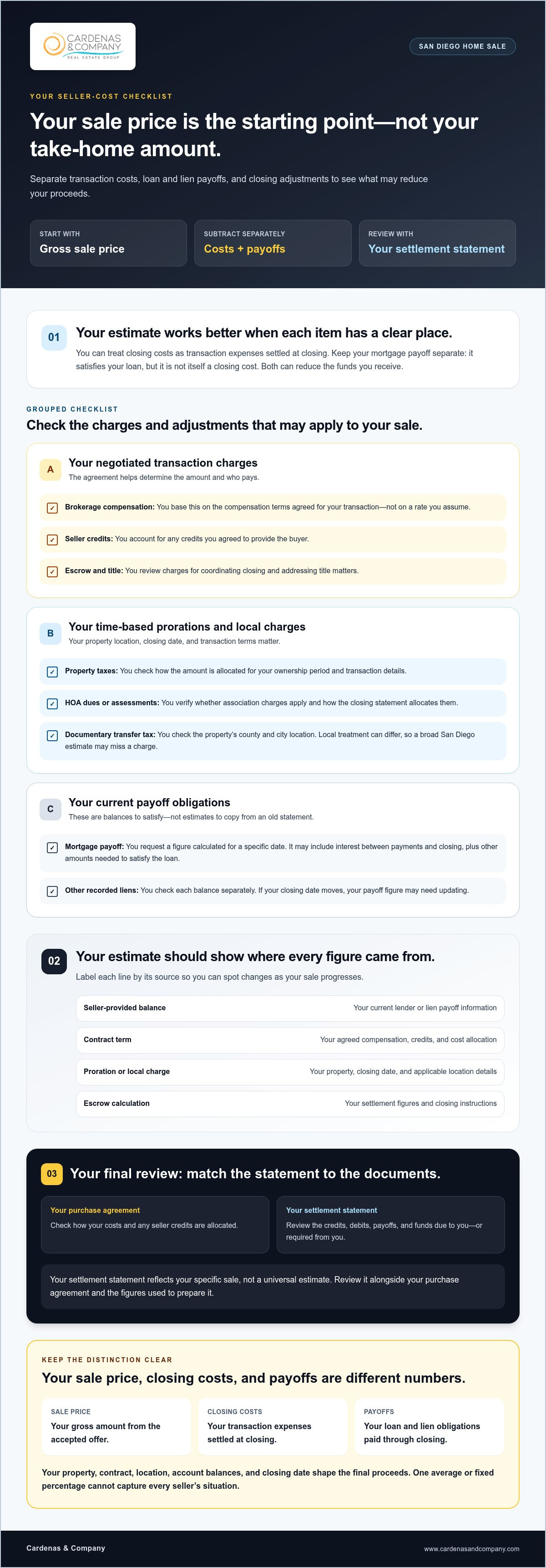
How can you estimate your San Diego net proceeds before closing?
A line-by-line worksheet gives you a more useful planning figure than a broad percentage. Start with the expected sale price, subtract transaction expenses and payoffs, then account for credits and prorations. The result is an estimate, not a promise of the funds you’ll receive. For closing costs for sellers San Diego homeowners are planning around, note where each number comes from so you can update it as the sale progresses.
What information should you gather for a proceeds estimate?
Use the expected price and signed transaction terms as your foundation. Gather current mortgage payoff information and relevant association statements if the property has an HOA. Keep credits, repair agreements, prorations, and transfer-related items on separate lines rather than folding them into one general cost figure.
Label each entry by its source. That makes it easier to distinguish an early estimate from a written obligation or a figure calculated for closing.
- Estimated sale price: Enter the expected price as an estimate.
- Agreement costs and credits: Record agreed compensation, seller credits, and repair terms from the signed agreement as a contract term. These items can reduce proceeds.
- Loan and lien payoffs: Use current amounts provided for your mortgage or other recorded liens, labeled seller-provided balance. A statement balance may not equal the final payoff.
- Prorations and other closing items: List applicable taxes, association charges, and transfer-related items separately. Mark figures prepared for settlement as an escrow calculation.
- Expected net: Subtract estimated costs and payoffs, then apply credits and prorations as shown in the estimate. Label the result estimated net proceeds.
How do you review the estimate as closing approaches?
Compare the latest settlement statement with your worksheet line by line. Match entries to the executed agreement, current payoff statements, relevant account information, and escrow calculations. If a figure has changed, check whether its source, timing, or agreed terms changed too. Refresh payoff and escrow figures as closing approaches because early numbers can become outdated.
Have your transaction team explain unfamiliar entries in plain English, and update your expected net before making firm plans for a move or purchase. A clearer estimate can help you plan the transition, including selling your home in Chula Vista, without treating projected proceeds as guaranteed funds.
Plan your San Diego home sale
How can Cardenas & Company guide your San Diego sale planning?
A sale plan is more useful when it connects likely proceeds to the choices you’ll make next. Cardenas & Company Real Estate Group provides residential listing guidance for San Diego and South Bay sellers, helping you organize pricing decisions, agreement terms, estimated expenses, and projected proceeds as parts of one plan. The team’s percentage-based real estate sales commissions are based on the final sale price, with compensation terms agreed for the transaction. Reviewing those terms alongside other estimated expenses helps you understand how closing costs for sellers San Diego homeowners face may affect your next step, without treating an early estimate as final.
Cardenas & Company serves residential clients in San Diego, Chula Vista, Bonita, Del Mar, La Jolla, Otay Ranch, Carlsbad, Coronado, El Cajon, Santee, La Mesa, Lemon Grove, Encinitas, Imperial Beach, Oceanside, Poway, San Marcos, and Escondido. Your priorities may include coordinating a relocation, preparing for another home purchase, or timing a sale around family or property needs. A realistic net estimate can help you assess timing and next-home decisions while leaving room for figures that may change as the transaction develops.
How does clear cost planning support your next move?
Reviewing projected proceeds alongside your sale timeline gives you a more grounded basis for planning a move or considering another purchase. Family needs, relocation plans, and your property’s condition or ownership details can all shift what matters most. We can help keep the discussion centered on your goals and distinguish planning estimates from transaction figures that will be finalized closer to closing.
For more context on preparing for a sale, read our San Diego home-selling strategy guidance. It can complement a cost review as you consider how pricing, timing, and your next housing decision fit together.
Bottom Line
Your net proceeds depend on documented charges, written contract terms, current loan or lien payoffs, prorations, and location-specific items. No single percentage can capture every seller’s situation. Reviewing the figures as they develop can help you make decisions with greater clarity and prepare for the transition ahead.
If you’re considering a San Diego sale, reach out to Cardenas & Company Real Estate Group to discuss your plans and the questions you want to work through. The conversation can focus on your priorities and the next chapter you’re preparing for.
Plan your next move with a clearer picture
Your sale price is only one part of the proceeds you can plan around. The closing costs for sellers San Diego homeowners face depend on documented charges, written agreement terms, payoff balances, prorations, and property location. A line-by-line estimate helps you see how those pieces fit together, while an updated settlement statement brings the figures closer to closing.
Cardenas & Company Real Estate Group supports residential sellers across San Diego and the South Bay with listing guidance grounded in homeownership education and long-term wealth considerations. Affiliated with Realty ONE Group Pacific, the team can help connect pricing, transaction details, and estimated proceeds to the decisions ahead, whether you’re planning a move or considering another home.
Talk through your San Diego home sale with our team
You don’t have to map every next step at once. A thoughtful plan can help you move forward with greater clarity and confidence.
Frequently Asked Questions
How much are closing costs for sellers in San Diego?
There’s no single amount that applies to every sale. The closing costs for sellers San Diego homeowners may pay depend on the purchase agreement, property, location, and transaction details. Possible items include agreed brokerage compensation, escrow and title charges, taxes, prorations, seller credits, and association-related charges. Mortgage or lien payoffs also affect your proceeds, but they’re separate from closing costs. Use a transaction-specific estimate rather than assuming one percentage.
What closing costs does a seller usually pay in California?
California sellers may have transaction expenses such as agreed brokerage compensation, escrow or title charges, applicable transfer-related taxes, prorated property taxes, and credits or repair costs specified in the agreement. Loan and recorded-lien payoffs may also be deducted from proceeds. Which items apply, and how the parties allocate them, depends on the property and contract. Your settlement statement shows the actual debits, credits, and payoffs for your sale.
Are real estate commissions included in San Diego seller closing costs?
Yes, agreed brokerage compensation can appear as a seller expense on the closing statement. The amount and structure depend on the written agreement, so don’t assume a standard percentage or that a seller automatically pays compensation for every party. Review the compensation terms alongside any other negotiated credits or costs. Your estimate should reflect the agreement you signed, not a general online assumption.
Can San Diego city transfer taxes change my seller costs?
They may. Documentary transfer tax is associated with transferring real property, and the applicable county or city treatment can depend on the property’s exact location and closing date. A sale in San Diego, Chula Vista, or another local community may involve different local requirements, so the transaction figures should reflect the property’s location. The applicable charge should appear in the settlement statement.
What happens if my mortgage payoff is higher than expected?
A payoff can exceed the balance on an older mortgage statement because the lender calculates the amount for a specific date and may include amounts that accrue before closing. Use an updated payoff figure as closing approaches, then compare it with the amount in your proceeds estimate. If the revised figure changes the funds expected from the sale, review the updated settlement numbers with your transaction team.
Do sellers pay property taxes at closing in San Diego?
Property taxes may be prorated at closing, which means the settlement statement allocates the applicable amount between buyer and seller based on timing and transaction details. Your share may appear as a debit or credit, depending on what has already been paid and the closing calculation. Review the statement’s dates and tax entries carefully. Local assessments or other property-specific charges may also affect the final figures.
How can I calculate my net proceeds from a San Diego home sale?
Start with your expected sale price, then subtract agreed transaction expenses and current mortgage or lien payoffs. Add or subtract applicable credits and prorations according to the agreement and settlement calculations. Label each number as an estimate, seller-provided balance, contract term, or escrow calculation, and update figures as closing approaches. The result is a planning estimate; your final settlement statement reflects the completed transaction.
Disclaimer
The information provided on this blog is for educational and informational purposes only and does not constitute legal, financial, or investment advice. While we strive for accuracy, real estate markets and insurance regulations (including Living Trusts and IUL strategies) are subject to change. David Cardenas (DRE 01862173) is a licensed real estate salesperson; however, this content does not create an agency relationship. Please consult with a qualified attorney or tax professional regarding your specific situation.