
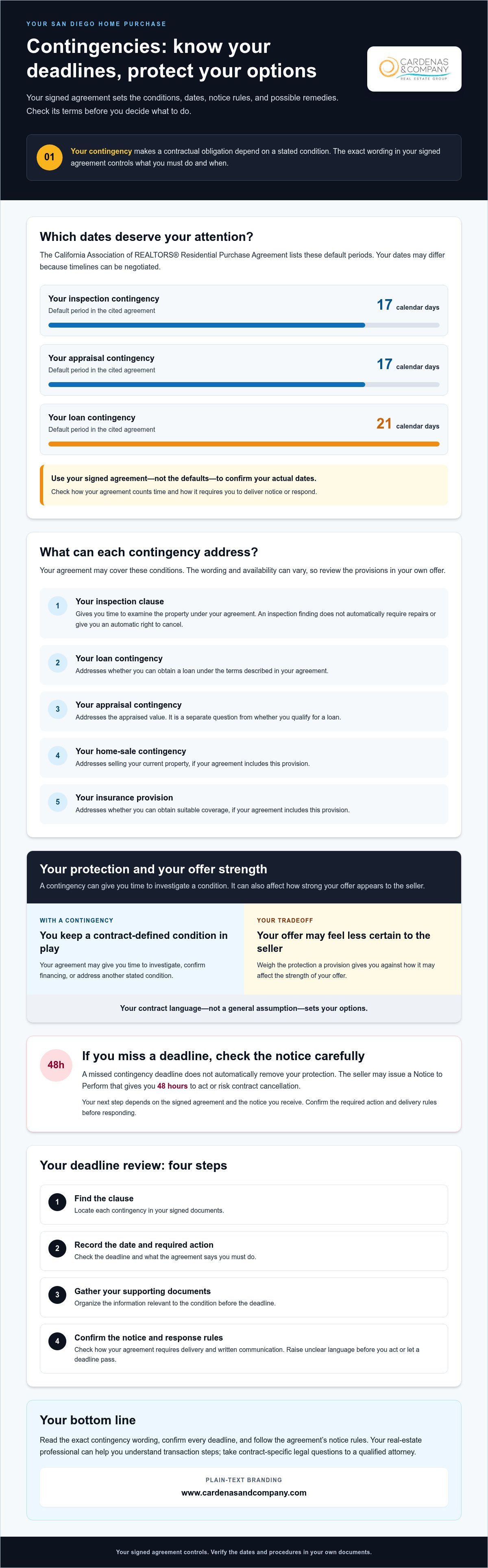
A contingency deadline passing doesn’t automatically remove your protection, but it can put your next move on a short clock. In California, contingencies are generally removed in writing. If you miss a deadline, the seller may issue a Notice to Perform that gives you 48 hours to act or risk contract cancellation.
San Diego real estate contingency clauses involve a practical tradeoff: you need time to investigate the property and confirm financing, while the seller wants confidence that your offer will close. The California Association of REALTORS® Residential Purchase Agreement lists default periods of 17 calendar days for inspection and appraisal contingencies and 21 calendar days for a loan contingency. These timelines can be negotiated, so check the dates in your signed agreement rather than relying on defaults.
This guide explains how inspection, financing, appraisal, insurance, and other common contingencies can affect your choices. You’ll learn what deadlines, documents, and written communications to review, along with focused questions to raise with your real-estate professional or, for contract-specific legal interpretation, an attorney.
Key Takeaways
- San Diego real estate contingency clauses make a contractual obligation depend on a stated condition. Check the signed agreement for exact wording, deadlines, notice rules, and possible remedies.
- Review inspection, loan, appraisal, home-sale, and insurance-related provisions as they appear in your agreement. Their availability and terms can vary.
- Weigh the protection a contingency provides against how it may affect the strength of your offer.
- Before each deadline, locate the relevant clause, record the date, gather supporting documents, and confirm how the agreement requires you to deliver notice or respond.
- Ask your real-estate professional about transaction steps. Bring contract-specific legal questions to a qualified attorney.
Table of Contents
What do San Diego real estate contingencies actually do?
A contingency makes a contractual obligation depend on a stated condition. For example, your agreement might make your purchase depend on completing an inspection or obtaining a loan under specified terms. The clause’s wording determines what you must do, when you must do it, and what options may follow.
A contingency ties your contractual obligation to a stated condition, but the signed agreement controls its deadlines, notice requirements, and possible remedies. San Diego real estate contingency clauses aren’t informal assurances or general requests for an inspection. A request asks the other party to agree to something. A promise made in conversation doesn’t replace a written contract term.
How does a contingency work in a home purchase?
Imagine buying a home in San Diego with a written inspection contingency. The clause identifies the condition you can investigate, sets a deadline, and may require written notice or another specified action. You review the available information and decide what to do within the contract’s terms.
Depending on the signed agreement, you might proceed, seek a negotiated change, or use an option the contract provides if the condition isn’t satisfied. None of these outcomes is automatic. The exact language matters, and forms or negotiated terms can set different procedures.
Use a simple review sequence: identify the condition, find its deadline, confirm the required action, and check what the agreement says can happen next. A verbal assurance that “you’ll have time to decide” doesn’t change a deadline unless the parties document an agreement in the required way.
Why do contingency deadlines matter?
A deadline can affect the options available to you and the other party. If you miss a date or send notice incorrectly, you may create a dispute about whether you followed the agreement or changed your contractual position. Don’t rely on a calendar reminder alone. Check how the agreement counts time and requires notice to be delivered.
- Locate each contingency in your signed documents.
- Record its deadline and the action it requires.
- Confirm how the agreement defines notice, delivery, and written responses.
- Raise unclear language before you act or let a deadline pass.
Your real-estate professional can help you understand transaction steps, organize dates, and prepare questions. An attorney can interpret your legal rights and the legal effect of contract language. If a clause leaves you unsure what you can do, get legal guidance before deciding how to respond. For buyers who are also exploring commercial ventures and hospitality business opportunities, click here to search restaurants and bars for sale throughout California.
Which contingency clauses should you understand before making an offer?
Your agreement may include conditions related to the property’s condition, your loan, the home’s appraised value, the sale of your current home, or whether you can obtain suitable insurance. These are examples, not clauses that appear with identical wording or deadlines in every offer. Review the specific agreement before you sign.
Inspection provisions focus on property condition, loan contingencies on approval, appraisal contingencies on value, home-sale contingencies on selling your current property, and insurance provisions on obtaining coverage. The California Department of Real Estate guidance gives homebuyers state-specific information about purchase offers and contingencies. Use it as a reference, then check how your own contract handles each condition.
What does an inspection contingency let you evaluate?
An inspection provision may give you time to examine the property under the terms of your signed agreement. If an inspection identifies a concern, use the report to clarify what needs follow-up and what questions to raise. A finding doesn’t automatically require the seller to make repairs.
Repair negotiations depend on the contract and what you and the seller agree to. Don’t assume an inspection finding gives you an automatic right to cancel. Confirm the clause’s language, deadlines, and available options.
How do financing and appraisal contingencies differ?
A financing contingency addresses whether you can obtain a loan under the terms described in the agreement. Satisfying this condition requires submitting extensive financial paperwork quickly, with many independent mortgage brokers utilizing DocChaser to automate document collection from borrowers. An appraisal contingency addresses the appraised value of the property. These are separate questions: you might qualify for a loan and still need to understand what happens if the appraisal comes in below the agreed purchase price.
Your offer may also address selling your current home before completing the purchase. An insurance-related provision, if included, raises another property-specific question: can you obtain coverage on terms that work for you? Don’t assume insurance concerns affect every San Diego property in the same way.
For more context on preparing an offer and the broader purchase process, read this San Diego home-buying guide. A real-estate professional can help you understand transaction steps and identify questions to raise. You can also connect with Cardenas & Company Real Estate Group about buyer representation. Ask a qualified attorney to interpret contract-specific legal rights.
How do contingency choices balance protection with offer strength?
Keeping a contingency can give you time to review a specific issue under the agreement. It can also affect how a seller views your offer. Removing one may make your offer appear more straightforward, but it doesn’t guarantee acceptance or a particular outcome.
San Diego real estate contingency clauses don’t provide automatic protection regardless of what you do next. Your rights and options depend on the signed agreement, including its deadlines, notice requirements, and any changes the parties put in writing.
What are the tradeoffs of keeping or waiving a contingency?
Keeping a condition may preserve a contractual review option while leaving an open question for the seller. Waiving or removing it may reduce that option and leave you with less room to respond if an issue arises. Neither choice fits every transaction.
Before agreeing to remove a condition, make sure you understand what the signed language requires and what options may remain. Ask your real-estate professional to explain the transaction process. Direct questions about the legal consequences of a waiver to an attorney familiar with your agreement.
| Provision |
Purpose |
Question to investigate |
Deadline source |
Tradeoff to consider |
| Inspection |
Review property condition |
What needs further inspection or evaluation? |
The signed agreement |
More review time may leave property questions open for the seller. |
| Loan |
Address loan approval |
Can you obtain financing under the stated terms? |
The signed agreement |
Retaining the condition preserves a loan-related review option; removing it may limit that option. |
| Appraisal |
Address the property’s appraised value |
What does the agreement say if the valuation raises a concern? |
The signed agreement |
You keep a defined valuation-related option, but the offer may appear less certain to the seller. |
| Sale of your current home |
Connect your purchase to selling your property |
Can you proceed if your home hasn’t sold? |
The signed agreement |
The seller may weigh the added condition when comparing offers. |
| Insurance-related |
Address obtaining coverage for the property |
Can you obtain coverage that works for this specific home? |
The signed agreement |
Keeping time to investigate may preserve an option while leaving coverage unresolved. |
How can San Diego property details shape your questions?
For a hypothetical condo in La Jolla, you might focus on the unit’s condition, your financing, insurability, and the disclosures provided for that property. For a home in Chula Vista, those categories may also matter, but the relevant questions come from the home and its documents, not its city alone.
Review each issue individually rather than assuming one contingency covers every concern. For more local purchase context, see this South Bay home-buying guide.
What should you review before a contingency deadline arrives?
Use the signed agreement as your source of truth, then organize the documents and decisions around each open condition. A calendar reminder helps, but it can’t tell you what notice the contract requires, who must receive it, or what evidence you still need.
For San Diego real estate contingency clauses, track the specific terms in your transaction instead of relying on a general timeline or someone else’s experience. Use this checklist for each condition:
- Step 1: Locate the clause in your signed purchase agreement and any addenda. Note what condition it addresses and whether the parties changed its terms.
- Step 2: Record the deadline shown in the transaction documents and identify who is responsible for the next action.
- Step 3: Gather relevant evidence, such as disclosures, lender updates, inspection findings, or appraisal materials.
- Step 4: Ask what remains open, what information is needed, and who must receive any notice or response.
Which documents and questions belong on your review checklist?
Keep your signed agreement, addenda, seller disclosures, lender communications, and inspection or appraisal materials together. Then check the contract for how it defines notice and delivery, including any required written response, recipient, or method.
For each open condition, note the relevant document, deadline, responsible person, and next step. If you’re unsure whether a report or lender update answers the question raised by the clause, ask your real-estate representative to clarify the transaction process before you act.
What if you need more time or find a concern?
Contact your real-estate representative promptly if a report raises a concern or you need more time. Any extension or change must follow the agreement and be documented in the way the contract requires. Don’t treat a verbal conversation as a confirmed change, and don’t wait until the last minute to ask what options you have.
Your real-estate representative can help identify process questions and coordinate transaction communications. For legal interpretation, including questions about cancellation, deposits, or a potential dispute, speak with an attorney who can review your signed agreement.
Discuss your transaction questions with Cardenas & Company
Bottom Line: Make San Diego contingency clauses fit your transaction
Your next step is to identify the condition, verify the deadline in your signed agreement, gather relevant evidence, and understand the options the contract provides. San Diego real estate contingency clauses don’t offer the same protection in every transaction. The exact wording and your actions matter.
What should you do before signing or responding?
Read the complete agreement, including addenda, before signing or responding to a contingency notice. Mark each condition, its deadline, the required action, and the method for delivering notice. If a term doesn’t make sense, ask your representative to explain the transaction process and take legal questions to a qualified attorney.
If you’re selling in Chula Vista, consider how a buyer’s conditions and deadlines fit into your transaction planning. This Chula Vista home-selling strategy offers seller-side context, but your signed agreement controls the terms of your specific sale.
No single contingency choice fits every buyer, seller, or property. Your priorities, the property details, and the contract language shape the questions worth asking. A real-estate professional can help you understand transaction steps and prepare those questions, but won’t interpret your legal rights.
Who can help you evaluate your next step?
If you want to talk through the process, you can reach out to Christian Cardenas through Cardenas & Company Real Estate Group. There’s no pressure to make a decision before you understand the terms in front of you. For contract-specific legal interpretation, speak with an attorney familiar with your agreement.
Contact the San Diego real-estate team
Cardenas & Company Real Estate Group is affiliated with Realty ONE Group Pacific. The team provides residential buyer and seller representation, not legal advice.
Make your next contingency decision with clarity
Review the signed agreement and connect each contingency to its condition, deadline, required notice, and supporting documents. The terms and your actions shape the options available to you.
Before you sign or respond, ask your real-estate representative to explain transaction steps and direct contract-specific legal questions to a qualified attorney. If you’re selling in Chula Vista, this Chula Vista home-selling strategy offers additional seller-side context.
Bottom Line
No single contingency choice fits every buyer, seller, or property. If you’d like to discuss transaction-process questions without pressure, contact Christian Cardenas through Cardenas & Company Real Estate Group, affiliated with Realty ONE Group Pacific. The team represents residential buyers and sellers in San Diego, Chula Vista, South Bay, and nearby communities. It doesn’t provide legal advice.
Reach out to Cardenas & Company Real Estate Group
Frequently Asked Questions
What are real estate contingency clauses in California?
A contingency makes a contractual obligation depend on a stated condition, such as obtaining a loan or reviewing a property. San Diego real estate contingency clauses rely on the signed agreement, which sets the condition, deadline, notice requirements, and available options. A contingency doesn’t automatically give you the right to cancel in every situation. Before signing, identify what you must do and by when. Consult an attorney for legal interpretation.
Which contingencies are common in a San Diego home purchase?
Your agreement may include inspection, financing, appraisal, sale-of-current-home, or insurance-related conditions. Each addresses a different issue, and no list applies to every offer. Whether you’re buying in San Diego, Chula Vista, Bonita, Del Mar, La Jolla, Otay Ranch, Carlsbad, Coronado, El Cajon, Santee, La Mesa, Lemon Grove, Encinitas, Imperial Beach, Oceanside, Poway, San Marcos, or Escondido, check your agreement’s exact wording and dates. Your representative can explain transaction steps; an attorney provides legal advice.
Can you make an offer without contingencies in San Diego?
Your offer can omit a contingency, depending on the terms you and the other party agree to. Removing a condition can reduce a review option or change your contractual position, but it doesn’t guarantee the seller will accept your offer. Before considering a waiver, understand what the condition covers, what evidence you have, and what the agreement says about its removal. Discuss transaction considerations with your representative and legal effects with an attorney.
What happens if you miss a contingency deadline?
The result depends on the signed agreement, the specific clause, and any valid written changes or notices. Don’t assume a missed date automatically cancels the agreement or determines what happens to a deposit. Check the contract right away, contact your real-estate representative about the transaction process, and seek legal advice if your rights or obligations aren’t clear. Keep copies of relevant documents and communications so you can refer to the actual record.
Does an inspection contingency guarantee that the seller will make repairs?
No. An inspection can identify issues for you to review, but it doesn’t by itself guarantee repairs, a price change, or a right to cancel. Your contract and any later written agreement determine which options may be available. Before responding to inspection findings, read the applicable clause and follow its stated process. If you need to understand your legal rights or the effect of a particular response, consult an attorney.
Is an appraisal contingency the same as a financing contingency?
No. An appraisal contingency concerns the appraisal condition described in your agreement; a financing contingency concerns loan approval under the agreement’s terms. One issue can affect your choices without resolving the other. Read both clauses and their deadlines together. Ask your lender about loan-process questions and your real-estate representative about transaction steps. If you need to understand the legal consequences of either clause, ask an attorney to review your signed contract.
Can you extend a contingency deadline after signing?
You may be able to extend a deadline if the parties agree and document the change as your contract requires. Don’t rely on a verbal understanding or assume the other party has approved an extension. Contact your real-estate representative before the deadline to discuss the transaction process, and ask an attorney about legal requirements or consequences. Keep the signed agreement and any written amendments with your records so you can verify the terms.
Disclaimer
The information provided on this blog is for educational and informational purposes only and does not constitute legal, financial, or investment advice. While we strive for accuracy, real estate markets and insurance regulations (including Living Trusts and IUL strategies) are subject to change. David Cardenas (DRE 01862173) is a licensed real estate salesperson; however, this content does not create an agency relationship. Please consult with a qualified attorney or tax professional regarding your specific situation.