
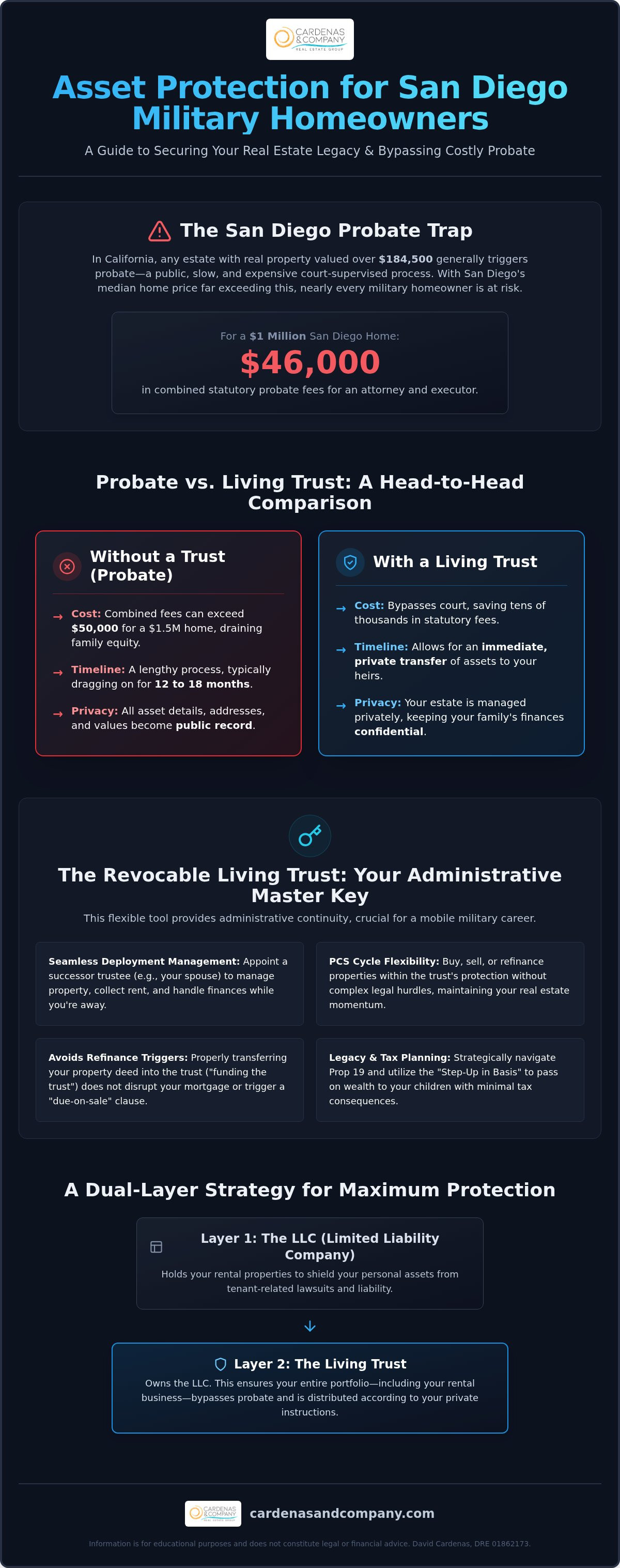
Did you know that for a $1 million home in San Diego, the combined statutory probate fees for an attorney and executor can reach approximately $46,000? For families serving our country, the financial stakes of homeownership extend far beyond the monthly mortgage payment. Securing effective asset protection for military homeowners San Diego is not just about today's equity; it's about ensuring your hard-earned real estate portfolio isn't consumed by the California court system. Before we move forward, it's vital to understand a few technical terms. Probate is the lengthy court-supervised process of distributing an estate. Escrow refers to a neutral third party holding funds during a transaction. Amortization is the schedule of paying off debt over time, while basis points are units used to measure interest rate changes, where one point equals 0.01%.
We understand that managing property from out of state or during a deployment feels like a constant juggling act. You likely worry about the privacy of public records or how Prop 19 might impact your children's ability to inherit your home's tax basis. This guide provides a clear strategy to secure your portfolio, bypass the costly probate process, and build a multi-generational legacy tailored for San Diego military families. We'll explore how a living trust serves as your administrative master key, shielding your assets from tax hikes and court delays while you focus on your mission and your family's future.
Key Takeaways
- Identify why high-value homes in Imperial Beach or Coronado face a public and expensive probate process that can consume significant equity without a trust in place.
- Understand how a Revocable Living Trust empowers your spouse or successor trustee to manage your real estate portfolio seamlessly while you're deployed.
- Learn to combine LLCs for tenant liability protection with trusts for comprehensive asset protection for military homeowners San Diego.
- Discover the correct way to "fund your trust" by moving property deeds without disrupting your mortgage amortization or triggering a refinance.
- Navigate the impact of Prop 19 on your real estate legacy and utilize the "Step-Up in Basis" to pass on wealth with minimal tax consequences.
Table of Contents
The San Diego Probate Trap: Why Military Homeowners Need Protection
Securing asset protection for military homeowners San Diego requires understanding the administrative hurdles that follow a property owner's passing. In California, any estate with real property valued over $184,500 generally triggers probate. Probate is the court-supervised process of distributing a deceased person’s assets. It's a public, slow, and expensive procedure. Because the median home price in San Diego County reached $925,000 in early 2026, nearly every military homeowner in Imperial Beach or Coronado is at risk. Without a trust, these properties automatically enter the San Diego Superior Court system. To navigate this, you must understand a few key terms. Escrow is a neutral third party holding funds during a transaction. Amortization is the process of paying off debt over time. Basis points are units of measure equal to 1/100th of 1 percent, which courts use to calculate statutory fees that can strip $30,000 to $50,000 in equity from your family.
The Financial Impact of Probate on Your Real Estate Portfolio
For a $1.5M property in La Jolla, the California statutory fee schedule is aggressive. The law allows attorneys and executors to each collect fees based on the gross value of the estate. On a $1.5M home, these combined fees can easily exceed $50,000. This doesn't include court filing fees, which in San Diego are $435 plus surcharges for 2026. Beyond the money, the timeline is a major factor. Probate typically drags on for 12 to 18 months. During this time, rental income might be frozen and property maintenance often suffers. Contrast these staggering costs and delays with the one-time education and setup of a living trust, which allows for an immediate, private transfer of assets.
Privacy Concerns for Service Members in South Bay
Service members stationed at Naval Base San Diego face unique security risks when their personal information becomes public. Probate records are entirely accessible to the public, exposing your personal assets, home address, and even tenant information to anyone with a computer. For investors with portfolios in Bonita or Otay Ranch, this lack of anonymity is a liability. Understanding what a living trust is and how it functions as a private contract is the first step toward true security. By holding your property in a trust, you stay off public "owner of record" lists, ensuring your family's financial footprint remains confidential. We focus on Living Trust Education to help you maintain this crucial layer of privacy.
Revocable vs. Irrevocable Trusts: Securing Your Property During Deployment
Deployment often occurs with little warning, leaving families to manage complex logistics from thousands of miles away. For those owning property in Santee or El Cajon, a sudden move often turns a primary residence into an "accidental" rental. Establishing robust asset protection for military homeowners San Diego ensures these properties remain assets rather than liabilities. A Revocable Living Trust serves as the standard tool for active duty families because it provides the administrative continuity necessary for a mobile career. Unlike more rigid structures, this trust allows you to name a successor trustee, such as a spouse or trusted family member, who can manage the home seamlessly while you're deployed.
The Revocable Trust: Flexibility for the PCS Cycle
The primary advantage of a revocable trust is its adaptability. You can buy, sell, or refinance a Chula Vista condo or a South Bay home without ever removing the property from the trust's protection. Because you retain full control, lenders generally view these trusts favorably when processing VA or conventional financing. This flexibility is vital during the Permanent Change of Station (PCS) cycle. It allows you to maintain your real estate momentum without the bureaucratic friction of a more permanent legal entity. If you're beginning this process, reviewing Military OneSource Estate Planning resources can provide additional context on how these tools integrate with your overall military benefits.
Irrevocable Trusts: When to Consider Higher Protection
While revocable trusts focus on probate avoidance and management, irrevocable trusts are designed for high-level asset protection and tax mitigation. Moving a property into an irrevocable trust means you're effectively giving up ownership and control. For high-net-worth investors in Del Mar or Carlsbad, this trade-off is often worth the benefit of shielding assets from creditors or reducing a taxable estate. However, these structures are rigid. They require separate tax filings and a unique Employer Identification Number (EIN). Because you can't easily alter an irrevocable trust once it's established, we typically recommend these only for specific, long-term wealth preservation goals rather than for families who may need to sell or refinance frequently. If you're unsure which structure aligns with your goals, a tailored strategy session can help you navigate these technical choices with confidence.
Living Trust vs. LLC: A Dual Layer Strategy for San Diego Portfolios
For active-duty investors, the conversation often centers on liability. You might use an LLC to shield personal assets from tenant-related lawsuits or property-specific debts. While this is effective for daily operations, it doesn't address the transfer of wealth. Robust asset protection for military homeowners San Diego requires a more comprehensive approach. An LLC protects you while you're alive. A trust protects your family after you're gone. Combining these tools creates a resilient shield for your growing real estate interests.
During property acquisition, you'll encounter escrow. Escrow is a neutral third party that holds funds and documents during a real estate transaction to ensure all conditions are met before the title transfers. Managing this process correctly is the first step in building a secure portfolio, especially when diversifying into niche markets with the Assisted Living Real Estate Group.
We often recommend a "Hybrid Strategy." This involves holding your LLC membership interests inside your Living Trust. This structure provides the liability shield of the LLC while ensuring the entity itself bypasses probate. Financially, consider the long-term impact. California mandates an $800 annual Franchise Tax fee for most LLCs. In contrast, a living trust usually involves a one-time educational and setup cost. This makes it a highly efficient vehicle for long-term legacy planning without the recurring administrative burden of a business entity alone.
Imagine owning a profitable rental in Oceanside or even looking abroad to explore Croatian Real Estate Sales to diversify your portfolio. If you pass away holding that property in an LLC without a trust, your membership interest becomes a probate asset. The San Diego Superior Court must then intervene to determine who inherits the business. This often leads to frozen business bank accounts. Rent checks can't be deposited. Mortgages can't be paid. A trust ensures a successor trustee steps in immediately. They keep your family receiving rent checks without a single day of interruption from the court system.
For military families looking to expand into other high-demand regions, such as the Mexican Caribbean, blog.exprealtyrivieramaya.com offers insights into luxury residential opportunities that should be similarly protected within your family trust.
This global perspective on wealth often extends to other premium lifestyle investments; for example, collectors and enthusiasts in the Central American region frequently turn to Artesanos Car Club for high-end automotive acquisitions that complement a luxury real estate portfolio.
As your portfolio grows in areas like Eastlake or Otay Ranch, your strategy must scale. Managing multiple properties requires a cohesive plan that links your business entities to your family's future. We help you integrate these tools so that every new acquisition strengthens your legacy rather than complicating it. For those looking to expand their holdings, our South Bay Real Estate Guide offers insights into local market trends for future purchases. Aligning your legal framework through professional strategy sessions ensures your wealth-building efforts remain protected through every phase of your career.
Transferring San Diego Property: Funding Your Trust Without Refinance Risk
Many families hesitate to move their homes into a trust because they fear triggering the "due-on-sale" clause in their mortgage. This hesitation often stalls essential asset protection for military homeowners San Diego, leaving their most valuable assets exposed to probate. However, the physical act of moving your San Diego deed into the trust name, known as "funding the trust," is legally protected. The Garn-St. Germain Depository Institutions Act of 1982 specifically prevents lenders from calling your loan due when you transfer a residential property into a revocable living trust where you remain the beneficiary. We understand the weight of these financial decisions, and we're here to ensure your transition is seamless and secure.
This transfer does not disrupt your amortization, which is the process of paying off a debt over time through regular installments. Your monthly payments, interest rate, and payoff schedule remain exactly the same. For homeowners in Mira Mesa or Serra Mesa, it's also important to coordinate with your title insurance company. You want to ensure your existing policy continues to cover the property after the name on the deed changes to your trust. This administrative step ensures that your asset protection for military homeowners San Diego remains robust from every angle, shielding your equity from both legal and procedural risks.
Step-by-Step Property Transfer Process
Funding your trust requires a few specific administrative steps that must be handled with meticulous care. First, you must prepare a Grant Deed and a Preliminary Change of Ownership Report (PCOR). This report is crucial because it informs the Assessor that the transfer is a "proportional interest" move, which prevents an unintended property tax hike. Once signed and notarized, these documents are recorded at the San Diego County Recorder’s Office in Downtown San Diego. After the deed is recorded, it's essential to update your homeowners insurance policy to list the trust as an "additional insured." If you have a property manager, notify them immediately so they can update lease agreements and rent collection accounts to reflect the trust as the owner of record.
Managing Mortgages and VA Loans Within a Trust
Holding property in a trust doesn't prevent you from utilizing your equity or pursuing new opportunities. Whether you're looking to pull funds for a new investment in Chula Vista or refinancing in a competitive North County market, most modern lenders are comfortable with trust-held assets. You'll simply need to keep your "Certification of Trust" document ready for bank reviews. This short, legally recognized summary of your trust's key terms allows financial institutions to verify your authority as trustee without needing to review your entire private estate plan. If you're ready to align your real estate portfolio with your long-term legacy, our team can help you navigate these residential listing and wealth strategies with precision.
Strategic Planning for Prop 19 and Estate Tax Law in 2026
As we approach 2026, the landscape of wealth preservation is shifting beneath the feet of California property owners. This year is a critical juncture because significant provisions of the federal Tax Cuts and Jobs Act are scheduled to sunset, potentially lowering the current $15 million estate tax exemption. For families focused on asset protection for military homeowners San Diego, this federal change coincides with the ongoing impact of California’s Proposition 19. While federal laws dictate how much of your total estate is taxed, Prop 19 determines how much your children will pay in property taxes every single year. We believe that proactive education is the best defense against these compounding costs.
Despite these tax hurdles, San Diego remains a land of opportunity. Projects like the Chula Vista Bayfront are expected to drive significant appreciation in the South Bay region. Securing your interest in these high-growth areas requires a plan that accounts for the "Step-Up in Basis." This is perhaps the most powerful tax-free wealth tool available to your heirs. It adjusts the cost basis of an inherited property to its fair market value at the time of your passing, effectively wiping out the capital gains tax on decades of appreciation. Without a trust to facilitate this transition, your family could lose this benefit to the friction of a public probate court.
Mitigating the Prop 19 Tax Hike
Proposition 19 fundamentally changed the rules for inheriting property in California by eliminating the tax basis transfer for most investment properties. If you own rentals in Imperial Beach, your heirs will likely face a massive property tax reassessment to current market values upon inheritance. The only significant exception applies to a primary residence, and even then, the child must move into the home within one year. We help military families use trusts to plan for the liquidity needed to cover these higher taxes, ensuring that a legacy property doesn't become a financial burden that forces an unwanted sale.
The Long-Term Wealth Strategy for San Diego Families
If you're exploring ways to transition out of management-intensive properties while deferring taxes, you can check out Cornerstone Real Estate Investment Services to see how DSTs compare to direct ownership.
The math of San Diego real estate tells a compelling story of growth. A property purchased in the South Bay in 2010 for $350,000 might be valued at $900,000 or more in 2026. If you sold that property today, the capital gains tax would be substantial. However, by holding that asset in a trust, your heirs can utilize the step-up in basis to sell the property or enter a 1031 exchange completely tax-free at the new $900,000 valuation. Integrating your estate plan with our Comprehensive Guide to Military Relocation ensures that every move you make during your service years contributes to a permanent, protected family legacy.
Securing Your Military Legacy in San Diego
Your service involves discipline; your estate plan should reflect those same values. By implementing a living trust, you bypass the public San Diego probate process, which can strip significant equity from your family. This strategy provides administrative continuity for deployment while ensuring heirs benefit from tax tools like the step-up in basis. Effective asset protection for military homeowners San Diego isn't a one-time event, but a shield that adapts to your career and the shifting legislative landscape. We're honored to serve those who serve and look forward to helping you secure a future of enduring stability.
With 25 years of local expertise, our top-rated brokerage and wealth strategist team provides specialized Living Trust Education for military families. We invite you to Schedule a Wealth Strategy Session with Cardenas & Company to align your real estate portfolio with your long-term vision. Our collaborative approach ensures your technical strategy serves your human goals.
Bottom Line: A living trust is the essential administrative tool for San Diego military families to avoid probate, protect privacy, and preserve wealth across generations.
Disclaimer: Cardenas & Company Real Estate Group provides real estate listing services and Living Trust Education. We do not provide legal real estate advice. Please consult with a qualified attorney for your specific legal and estate planning needs.
Frequently Asked Questions
Do I need a separate living trust for each investment property in San Diego?
No, you generally don't need a separate trust for each San Diego property. A single revocable living trust can hold your entire real estate portfolio, including your primary residence and rentals. This centralized structure simplifies management and ensures all assets bypass probate simultaneously. If you're seeking liability protection from tenants, you might combine the trust with separate LLCs for each property. This creates a robust framework for asset protection for military homeowners San Diego without duplicating your estate planning documents.
Will moving my house into a trust trigger a property tax reassessment?
Transferring your home into a revocable living trust does not trigger a property tax reassessment in California. As long as the transfer doesn't change the proportional interest of the owners, it's considered a "non-event" by the County Assessor. You'll file a Preliminary Change of Ownership Report (PCOR) during the recording process to confirm this status. This protection allows you to secure your legacy without the fear of an immediate, unexpected tax hike on your family home.
Can I still use my VA loan benefits if my home is held in a living trust?
You can absolutely use your VA loan benefits when your home is held in a living trust. Most lenders and the VA allow this, provided the trust is revocable and you remain the primary beneficiary. You'll need to provide your lender with a Certification of Trust to verify the trust's terms. This ensures you maintain your hard-earned military benefits while simultaneously shielding your equity from the delays and costs of the San Diego Superior Court system.
What is the difference between a land trust and a revocable living trust?
A land trust is primarily designed for privacy and anonymity by keeping your name off public title records. In contrast, a revocable living trust is a comprehensive estate planning tool focused on probate avoidance and the management of assets during incapacity. While a land trust offers a layer of confidentiality, it doesn't provide the same robust legacy protections as a living trust. Most military investors find that a living trust is the more essential foundation for their portfolio.
How much does it cost to set up a living trust for a San Diego real estate investor?
The cost of establishing a living trust varies based on the complexity of your real estate portfolio and your specific legacy goals. While we don't quote specific fees for legal services, it's helpful to view this as a one-time investment in your family's future. When you compare this setup to the $46,000 or more in statutory probate fees for a median-priced San Diego home, the long-term savings are undeniable. Professional education and strategy sessions ensure your trust is funded correctly to avoid these massive back-end costs.
Does a living trust protect my rental properties from tenant lawsuits?
A revocable living trust does not provide liability protection from tenant lawsuits or creditors. Its primary purpose is to bypass probate and manage your assets. To shield your personal wealth from property-related lawsuits, you should utilize a combination of high-limit umbrella insurance and LLCs. This creates the "dual layer" strategy we recommend for comprehensive asset protection for military homeowners San Diego, ensuring that your legacy is protected from both court costs and legal claims.
Can I be my own trustee while I am stationed overseas or deployed?
You can remain your own trustee while stationed overseas or deployed. However, the true power of a trust lies in the successor trustee you name. This individual, often a spouse or professional fiduciary, can step in and manage property decisions, sign documents, or handle emergencies if you are unreachable. This ensures your real estate interests in the South Bay or North County remain operational and secure, regardless of your physical location or current duty assignment.
What happens to my living trust if I decide to sell my home in Chula Vista?
Selling your home in Chula Vista is a straightforward process when it's held in a trust. You simply sign the listing and closing documents as the trustee of your trust. The proceeds from the sale are then paid to the trust, allowing you to reinvest in a new property or hold the cash within the trust's protection. This continuity ensures that your wealth remains within the established legal framework, even as your specific real estate holdings change over time.
Disclaimer
The information provided on this blog is for educational and informational purposes only and does not constitute legal, financial, or investment advice. While we strive for accuracy, real estate markets and insurance regulations (including Living Trusts and IUL strategies) are subject to change. David Cardenas (DRE 01862173) is a licensed real estate salesperson; however, this content does not create an agency relationship. Please consult with a qualified attorney or tax professional regarding your specific situation.