
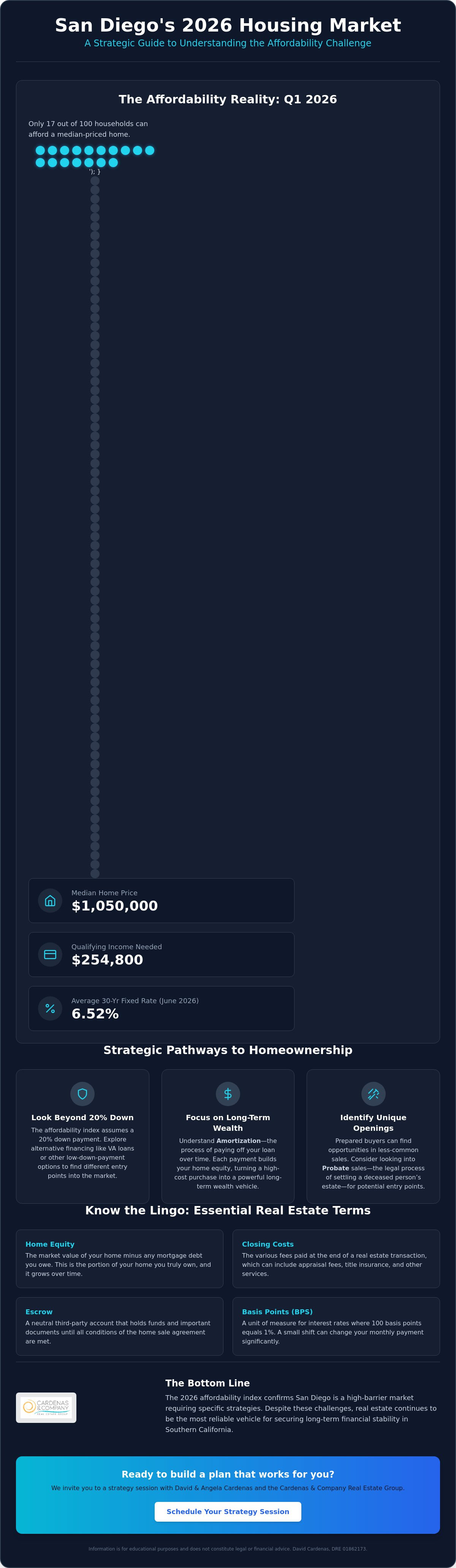
Only 17% of San Diego households can afford a median-priced home in the first quarter of 2026, a statistic that often creates a sense of paralysis for local families. We recognize the weight of this reality, especially when a qualifying income of $254,800 is now the baseline for a $1,050,000 property. The current San Diego housing affordability index paints a challenging picture, but these numbers don't tell your entire story.
You might feel that high interest rates, currently averaging 6.52%, make monthly payments feel unsustainable or fear that you're buying at the absolute peak. We agree that the barrier to entry is steep, yet waiting for a market crash often results in missing out on building home equity, which is the market value of your home minus any mortgage debt. This guide provides a clear analysis of the California Association of Realtors (C.A.R.) data and a strategic roadmap to secure your financial future through real estate.
We'll examine how new 2026 housing laws and inventory shifts in Chula Vista and San Diego create unique openings for prepared buyers. You will learn how to move past the noise of conflicting economic reports, manage closing costs (the fees paid at the end of a real estate transaction), and execute a plan that builds wealth despite the high-cost environment.
Key Takeaways
- Interpret the current San Diego housing affordability index to understand why only 17% of households qualify for a median-priced home in 2026.
- Discover how low inventory levels continue to drive prices upward, even as high interest rates challenge traditional monthly budgets.
- Learn to identify strategic entry points through Probate sales, which is the legal process of settling a deceased person’s estate.
- Master the mechanics of Amortization, the process of paying off your home loan over time, to transform a high-cost purchase into a long-term wealth vehicle.
- Develop a strategy for Residential Listing Services that focuses on precise pricing to protect your equity in a low-affordability environment.
Table of Contents
What the San Diego Housing Affordability Index Means for Your Family
The San Diego housing affordability index serves as a vital pulse check for families looking to plant roots in our community. It measures the percentage of households that earn enough to qualify for a mortgage on a median-priced home. In the first quarter of 2026, this figure hit 17%, indicating a remarkably tight market where high income is a prerequisite for traditional ownership. Entering a contract means you will eventually move into Escrow, which is a neutral third-party account that holds funds and documents until all conditions of the home sale are met.
While these numbers suggest a significant barrier, they also reflect the high demand for Southern California real estate, which remains a premier long-term wealth vehicle. We view these metrics not as a deterrent, but as a data point that requires a more sophisticated entry strategy. Success in this environment depends on moving beyond emotional reactions to the data and focusing on technical realities that impact your family's bottom line.
How the California Association of Realtors Calculates Affordability
The California Association of Realtors uses a specific formula to determine the What is a Housing Affordability Index (HAI)? by weighing median home prices against prevailing mortgage rates and regional income. For the first quarter of 2026, only 17% of San Diego County households could afford the median-priced single-family home of $1,050,000. This calculation assumes a 20% down payment, which often misleads first-time buyers who don't realize they can enter the market with much less. Programs like VA loans or low-down-payment options allow for different entry points, meaning the index is a benchmark rather than a final verdict on your personal ability to buy.
The Role of Interest Rates and Basis Points
Interest rates are the primary lever that shifts the affordability needle for most buyers. Lenders often discuss these movements in Basis Points, which is a unit of measure for interest rates where 100 basis points equal 1%. Even a shift of 25 or 50 basis points can change your monthly buying power by hundreds of dollars. In June 2026, the average 30-year fixed rate sits at 6.52%. While this is higher than the record lows of a few years ago, it remains competitive when compared to the double-digit rates seen in historical San Diego market cycles. Understanding these technicalities helps you stay grounded when economic reports feel overwhelming.
Bottom Line: The 2026 affordability index confirms that San Diego remains a high-barrier market requiring specific income and equity strategies. Despite these challenges, real estate continues to be the most reliable vehicle for securing long-term financial stability in Southern California.
We invite you to a strategy session with David & Angela Cardenas and the Cardenas & Company Real Estate Group to discuss your unique path to homeownership. Visit cardenasandcompany.com or TrustSanDiego.com to begin your journey with a dedicated partner.
Information is for educational purposes and does not constitute legal or financial advice. David Cardenas, DRE 01862173.
2026 San Diego Housing Market: Prices, Inventory, and Realities
Inventory levels in San Diego remain significantly lower than historical averages, which keeps prices elevated even as the San Diego housing affordability index sits at 17%. We define Amortization as the process of paying off your home loan over time through regular monthly payments of principal and interest. This structured repayment ensures you build equity steadily, even when the initial entry price feels daunting for many families.
Many current homeowners remain in their properties due to the "lock-in effect." They secured 3% mortgage rates years ago and feel hesitant to trade those for current 6.52% rates. This lack of movement restricts supply, forcing the median price for a single-family home in San Diego County to $1,050,000 in the first quarter of 2026. While list prices in the city can reach $1,349,000, the actual median sales price in San Diego County was $925,000 in May 2026.
Supply vs. Demand in the South Bay
The South Bay provides a different narrative for families seeking value. New construction in neighborhoods like Otay Ranch and Millenia provides more options for those who find the coastal market out of reach. Check out our guide on South Bay San Diego homes for sale to see how these inventory levels compare. According to C.A.R.'s latest San Diego affordability data, regional income growth is struggling to keep pace with these price increases. You must also factor in specific property taxes and Mello-Roos assessments common in these newer developments when calculating your monthly obligation.
The Chula Vista Bayfront Impact
The Chula Vista Bayfront project is a massive infrastructure shift that will influence property values for decades. Commercial investments often precede residential appreciation, making this a key area for long-term wealth strategies. You can track progress and availability at chulavistabayfrontcondos.com. If you're considering a move, discussing your wealth strategy with a professional can help you identify which neighborhoods offer the best long-term stability in a high-cost environment.
Bottom Line: Inventory remains the primary driver of high prices in 2026, as the lock-in effect prevents many homeowners from selling. Strategic buyers are looking toward the South Bay and infrastructure projects like the Chula Vista Bayfront to find value in a low-affordability market.
We invite you to a strategy session with David & Angela Cardenas and the Cardenas & Company Real Estate Group to discuss your unique path to homeownership. Visit cardenasandcompany.com or TrustSanDiego.com to begin your journey with a dedicated partner.
Information is for educational purposes and does not constitute legal or financial advice. David Cardenas, DRE 01862173.
Strategic Entry Points: How to Buy When Affordability is Low
Buying in San Diego during 2026 requires a "Wealth Strategist" mindset rather than a simple "home hunter" approach. Radical transparency dictates that we admit the San Diego housing affordability index at 17% is a high hurdle for any family. However, this index is a snapshot of the current environment, not a permanent barrier to your financial future. We focus on long-term equity growth because San Diego real estate has historically rewarded those who find a way into the market and stay there.
We often look for unique inventory channels like Probate, which we define as the legal process of settling a deceased person’s estate. These situations sometimes provide opportunities to acquire property at a more approachable price point because the sellers are motivated by legal settlement timelines. By viewing the market through a technical lens, you can find entry points that others overlook while they wait for prices to drop.
VA Loans and Military Advantages
San Diego's status as a premier military hub provides specific advantages that bypass typical affordability hurdles. The VA Loan allows eligible service members to purchase with zero down payment, effectively neutralizing the "20% down" assumption used in the San Diego housing affordability index calculations. Check our San Diego Military Relocation Guide for a detailed breakdown of these benefits. Maximizing your BAH (Basic Allowance for Housing) transforms a monthly expense into a tangible real estate asset that builds wealth over time.
Alternative Financing and House Hacking
If you aren't military-affiliated, FHA options and state-level down payment assistance programs still offer pathways into San Diego County. We also advocate for "house hacking," a strategy where you rent out a room or an Accessory Dwelling Unit (ADU) to offset your mortgage payment. This approach directly improves your personal affordability regardless of regional statistics. A personalized strategy session at TrustSanDiego.com is the first step toward determining which of these financial structures fits your family's narrative.
Bottom Line: Low affordability requires moving beyond traditional buying methods to leverage specialized loan programs and unique inventory like probate. Success in 2026 depends on viewing your home as a long-term wealth vehicle rather than a short-term expense.
We invite you to a strategy session with David & Angela Cardenas and the Cardenas & Company Real Estate Group to discuss your unique path to homeownership. Visit cardenasandcompany.com or TrustSanDiego.com to begin your journey with a dedicated partner.
Information is for educational purposes and does not constitute legal or financial advice. David Cardenas, DRE 01862173.
Download
The Seller’s Perspective: Managing Equity in a Low-Affordability Market
Sellers in San Diego face a specific psychological hurdle in 2026. While you might see record-high median prices, the San Diego housing affordability index at 17% means your pool of qualified buyers is smaller than in previous cycles. We use professional Residential Listing Services to target this specific group with precision. You can't afford to let your property sit on the market and become stale. A home that doesn't sell within the first few weeks often requires price cuts that erode your hard-earned equity.
Correct pricing isn't just about looking at recent sales; it's about understanding the current income requirements for buyers. We help you leverage your existing equity to transition into your next phase of life, whether you're looking to upsize or downsize. Our Selling Your Home in Chula Vista Strategy provides a technical roadmap for maximizing your net proceeds in this environment.
Asset Protection and Living Trusts
Owning a home in San Diego County is only half the battle. You must protect that asset from Probate, which is the legal process of settling a deceased person's estate. Without a Living Trust, your family could face years of court delays and thousands in unnecessary fees. We host regular community educational events to teach families how to secure their financial strategies through proper title holding. Protecting your equity is just as important as building it.
Maximizing Sale Price in a Competitive Market
In a high-price environment, buyers expect perfection. We utilize professional staging and high-definition video tours on our YouTube channel to ensure your home makes a powerful first impression. You also need a clear understanding of closing costs, which are the various fees and taxes paid at the end of a real estate transaction. These typically include title insurance, escrow fees, and transfer taxes. If you want to see how these factors impact your specific situation, request a custom equity analysis today.
Bottom Line: Sellers must price homes strategically to account for the limited pool of buyers qualified under current affordability standards. Protecting your home's equity through a living trust ensures that your real estate wealth remains a legacy for your family.
We invite you to a strategy session with David & Angela Cardenas and the Cardenas & Company Real Estate Group to discuss your unique path to homeownership. Visit cardenasandcompany.com or TrustSanDiego.com to begin your journey with a dedicated partner.
Building Generational Wealth Through San Diego Real Estate
Real estate in San Diego is more than a place to live; it's a sophisticated financial asset that requires a long-term perspective. While the San Diego housing affordability index creates headlines about market barriers, it doesn't account for the historical resilience of our region. We've seen San Diego County home prices withstand economic shifts over 25-year cycles, consistently rewarding those who prioritize time in the market over trying to time the market perfectly.
Waiting for a "market crash" is a strategy that has historically cost local families hundreds of thousands in lost equity. Fundamental inventory shortages in Southern California prevent the deep price collapses seen in other parts of the country. Transitioning from a "homeowner" to a "wealth builder" means looking past current Basis Points (units of measure for interest rates where 100 points equal 1%) and focusing on the asset's ability to hedge against inflation.
The Power of Compounding Equity
A conservative 3% annual appreciation on a median San Diego home priced at $1,050,000 generates over $31,500 in equity growth in a single year. This wealth accumulation often outpaces what most families can save after paying rent to a landlord. The "cost of waiting" for lower rates frequently exceeds the actual expense of current mortgage payments. We use our strategy sessions to map out 10-year wealth plans that factor in Amortization, the process of paying off your home loan through regular monthly payments, to ensure your debt decreases as your asset value grows.
Your Trusted Advisor in San Diego and Chula Vista
Cardenas & Company operates on a philosophy that is relationship-driven rather than transaction-driven. We've spent over 25 years helping families in Chula Vista and San Diego protect their assets from Probate, the legal process of settling a deceased person's estate. Follow our journey on Instagram for daily insights into how local market shifts impact your personal net worth. Now is the time to audit your financial strategy, regardless of what the current affordability index suggests.
Bottom Line: San Diego real estate remains a premier vehicle for generational wealth because its long-term appreciation consistently outpaces short-term market fluctuations. Waiting for a significant price drop often results in missing the compounding equity that secures a family's financial future.
We invite you to a strategy session with David & Angela Cardenas and the Cardenas & Company Real Estate Group to discuss your unique path to homeownership. Visit cardenasandcompany.com or TrustSanDiego.com to begin your journey with a dedicated partner.
Information is for educational purposes and does not constitute legal or financial advice. David Cardenas, DRE 01862173.
Securing Your Future in the San Diego Market
The San Diego housing affordability index highlights a significant technical challenge, but it's a benchmark that you can manage with the right financial structure. We've shown that inventory scarcity and the "lock-in effect" keep prices resilient, making strategic entry a vital part of building long-term wealth. By focusing on specialized programs like VA loans or unique inventory like Probate, you move past the noise of conflicting economic reports and focus on tangible results.
Real estate remains the most reliable vehicle for generational stability in Southern California. We focus on your individual narrative, ensuring your transition into homeownership is grounded in expert reliability and deep market knowledge. You don't have to face these complex bureaucratic processes alone when you have a dedicated partner to guide your decisions.
Bottom Line: The 2026 housing market requires a shift from a "home hunter" mindset to that of a wealth strategist to overcome current affordability constraints. By focusing on long-term equity growth and specialized entry points, families can still secure a stable financial future in Southern California.
Ready to stop guessing and start building? We invite you to a warm, zero-pressure strategy session with David & Angela Cardenas and the Cardenas & Company Real Estate Group. Visit cardenasandcompany.com or TrustSanDiego.com to begin your journey with over 25 years of local expertise and specialized military relocation support.
Frequently Asked Questions
Is San Diego housing affordability at an all-time low in 2026?
The San Diego housing affordability index reached a significant low of 17% in the first quarter of 2026. This means only a small fraction of local households earn the income necessary to qualify for a median-priced home. While these numbers are challenging, they reflect a market driven by high demand and chronically low inventory levels rather than a lack of long-term value.
How much income do I need to buy a home in San Diego right now?
You need a minimum annual income of $254,800 to qualify for a median-priced home in San Diego County as of early 2026. This requirement is based on a median home price of $1,050,000 and current interest rates. We specialize in helping families identify alternative financing and equity strategies to make these requirements more approachable for their specific financial situation.
Should I wait for interest rates to drop before buying a house in Chula Vista?
Waiting for interest rates to drop often results in paying a higher purchase price because lower rates typically trigger increased buyer competition. In Chula Vista, property appreciation frequently outpaces the potential savings from a slightly lower rate. We often recommend securing the property at today's price and planning for a future refinance if rates shift downward later in the year.
What is the difference between the Case-Shiller Index and the Housing Affordability Index?
The Case-Shiller Index tracks the actual change in the value of residential real estate over time, while the San Diego housing affordability index measures the ability of a typical family to qualify for a mortgage. One indicates how much an asset is worth; the other indicates if the local population can afford to buy it. Understanding both metrics helps us determine the overall health and sustainability of the local market.
Can military families still afford to buy in San Diego with current BAH rates?
Military families can still afford to buy by leveraging the zero-down benefit of the VA loan to bypass high entry costs. While Basic Allowance for Housing (BAH) might not cover the entire monthly obligation for a median-priced home, it serves as a substantial subsidy for building a real estate asset. We are specialized Military Relocation Professionals who help service members maximize their benefits in high-cost areas.
What are the closing costs for a typical home sale in San Diego County?
Closing costs, which are the various fees and taxes paid at the end of a real estate transaction, generally range from 2% to 5% of the purchase price. These costs include title insurance, Escrow fees (a neutral third-party account that holds funds), and property taxes. We provide our clients with a detailed net sheet early in the process to ensure there are no surprises when it's time to sign final documents.
How does a Living Trust protect my home from Probate in California?
A Living Trust allows your home to transfer directly to your beneficiaries without entering Probate, which is the public and expensive legal process of settling a deceased person's estate. In San Diego, avoiding the court system saves your family significant time and preserves the equity you have worked hard to build. We consider this an essential step for every homeowner in California to secure their family's future.
What neighborhoods in the South Bay offer the best value for families?
Master-planned communities in Chula Vista like Otay Ranch and Millenia continue to offer the best balance of price and infrastructure for families. These neighborhoods provide modern amenities and newer schools that are often unavailable in older coastal areas. Additionally, the Chula Vista Bayfront project is expected to drive long-term value for residential properties throughout the South Bay region.
Bottom Line: The 2026 San Diego market requires a technical understanding of affordability metrics to make informed wealth-building decisions. We help you look past the headlines to execute a strategy that secures your family's long-term stability.
Ready to stop guessing and start building? Schedule a zero-pressure strategy session with David & Angela Cardenas and the Cardenas & Company Real Estate Group at cardenasandcompany.com or TrustSanDiego.com.
Information is for educational purposes and does not constitute legal or financial advice. David Cardenas, DRE 01862173.
Disclaimer
The information provided on this blog is for educational and informational purposes only and does not constitute legal, financial, or investment advice. While we strive for accuracy, real estate markets and insurance regulations (including Living Trusts and IUL strategies) are subject to change. David Cardenas (DRE 01862173) is a licensed real estate salesperson; however, this content does not create an agency relationship. Please consult with a qualified attorney or tax professional regarding your specific situation.