
Selling your home in 2026 represents a high-stakes wealth transfer where a single disclosure oversight triggers a three-year window of legal vulnerability. With the San Diego County median home price reaching $1.02 million in July 2026, the financial stakes are higher than ever for homeowners in Chula Vista and the South Bay. You've likely felt the weight of the San Diego home selling process, wondering if you're truly prepared for the new January 1, 2026, disclosure mandates or the updated FinCEN reporting rules for all-cash buyers. It's natural to feel anxious about leaving money on the table or getting stuck in a confusing timeline.
We understand that the complexity of California’s regulatory environment is daunting when your financial legacy is on the line. This guide provides a professional roadmap to help you manage these technicalities, ensuring you maximize your equity while maintaining total legal protection. We'll walk through the entire timeline, from managing Escrow, which is a neutral third-party process that handles funds and documents, to finalizing your transition into your next investment. You'll gain the clarity needed to move forward with confidence and secure your long-term stability.
Key Takeaways
- Analyze South Bay and Chula Vista inventory levels to identify the optimal window for listing your property based on real-time supply data.
- Master the San Diego home selling process by utilizing a CMA-a professional evaluation of your home based on similar recently sold properties-to avoid the financial risks of aspirational pricing.
- Protect your equity by following a digital-first marketing strategy and complying with updated 2026 disclosure requirements for Probate, which is the legal settlement of an estate.
- Streamline your 30-to-45-day closing timeline by understanding the technical role of Escrow, the neutral third-party service that manages funds and documents until all sale conditions are met.
- Secure your financial legacy by applying the Section 121 capital gains exclusion and using a Living Trust to shield your newly liquidated assets from future legal hurdles.
Table of Contents
Preparing Your San Diego Property for a 2026 Market
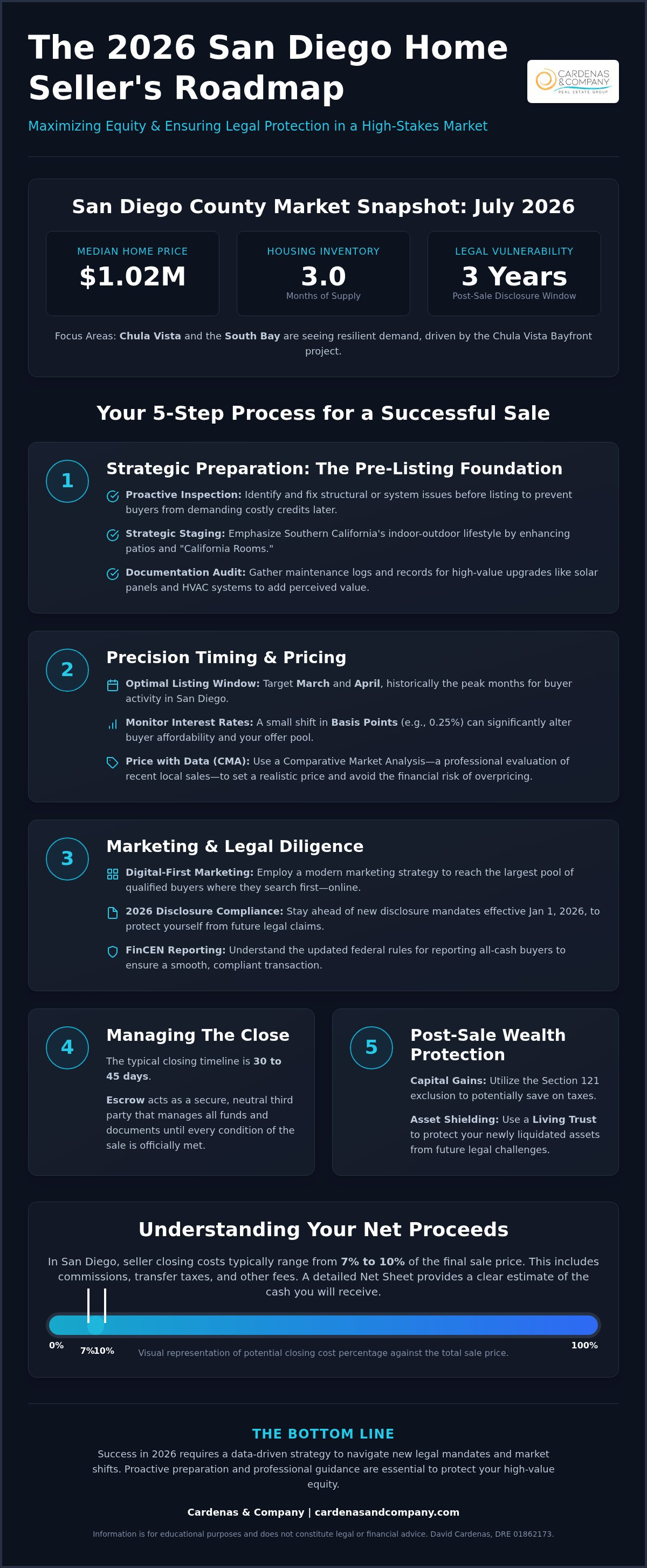
Success in the San Diego home selling process begins with a cold, hard look at current supply. As of July 2026, inventory levels across the county remain tight at 3.0 months of supply, though the market is showing signs of a shift after the median home price hit $1.02 million. In Chula Vista and the broader South Bay, demand stays resilient due to the ongoing progress of the Chula Vista Bayfront project. This massive redevelopment has moved from a future promise to a tangible driver of property values, attracting buyers who want proximity to the new shoreline amenities. To capitalize on this, you must first understand your Amortization, which is the process of paying off your mortgage debt over time through scheduled payments. Knowing your exact principal balance is the first step in calculating the equity you'll walk away with after the sale.
The Pre-Listing Checklist for San Diego Sellers
Don't wait for a buyer's inspector to find deal-killers. We recommend a proactive approach to protect your timeline and your price point. Start with these essential steps:
- Professional Inspection: Hire an inspector before listing to identify structural or system issues. Fixing these now prevents buyers from demanding heavy credits during the understanding the closing process phase.
- Strategic Staging: Buyers in Southern California prioritize the indoor-outdoor lifestyle. Enhance your patio or "California Room" to show how the home functions as a year-round retreat.
- Documentation Audit: Gather all records for high-value upgrades. In a market where energy costs are a concern, having clear maintenance logs for solar panels and HVAC systems adds significant perceived value.
Strategic Timing in a 2026 Landscape
Timing your entry into the market requires more than just picking a date on the calendar. Data shows that March and April remain the peak months for listing in San Diego, as buyers rush to settle before the new school year. However, you must also monitor Basis Points, which are units of measurement for interest rates where one basis point equals 0.01%. Even a shift of 25 or 50 basis points can significantly alter what a buyer can afford, directly impacting your pool of offers. If your property is near Naval Base San Diego, we also factor in military PCS (Permanent Change of Station) cycles. These relocation windows create predictable surges in demand from service members looking for stable housing in the South Bay. Staying ahead of these cycles ensures your home hits the market when buyer urgency is at its highest.
Strategic Pricing: Moving Beyond Guestestimates to Real-World Value
Pricing your home requires a surgical approach rather than a hopeful guess. We rely on a CMA, or Comparative Market Analysis, which is a professional evaluation of your home's value based on similar properties that have recently sold in your immediate area. This data-driven method grounds the San Diego home selling process in reality, preventing the common pitfall of overpricing. In neighborhoods like Rancho San Diego, micro-location factors such as proximity to top-rated schools can shift value by several percentage points regardless of broader county trends.
Transparency is vital when calculating your final walkaway number. We prepare a detailed Net Sheet to determine the actual cash you take home after all closing costs, which are the various fees and taxes paid at the end of a real estate transaction. In San Diego, these costs typically range from 7% to 10% of the sale price, including commissions and transfer taxes. Understanding these figures early allows you to plan your next investment with precision. If you need a clear picture of your potential proceeds, requesting a custom equity report is a smart first step.
The Danger of Overpricing in San Diego
Aspirational pricing often backfires in a market where buyers are highly sensitive to interest rate shifts. If your home doesn't attract serious interest within the first 14 days, the market has spoken. This usually triggers a Price Correction timeline, where the initial excitement of a new listing fades and buyers begin to question the property's condition. In East County, where inventory levels can fluctuate more than in coastal pockets, staying competitive is essential. A strategically priced home creates urgency, often sparking multiple-offer scenarios that drive the final price above the original ask.
Leveraging Appraisal Data Early
Some sellers choose to invest in a pre-listing appraisal to justify a premium price point, especially for unique luxury estates. This helps bridge the Appraisal Gap, which is the difference between the fair market value determined by a lender and the price agreed upon in a contract. By identifying potential valuation hurdles early, we can negotiate from a position of strength. For a broader perspective on current competition, you can browse South Bay San Diego Homes for Sale to see how similar properties are positioned. This real-world context ensures your pricing strategy aligns with the current 2026 market appetite.
Marketing and Disclosures: Protecting Your Equity from Legal Risk
Marketing a home in 2026 requires more than a sign in the yard; it demands a defensive strategy against future litigation. In the San Diego home selling process, your disclosures act as your primary shield. If you are handling an inherited property, you may encounter Probate, which is the court-supervised legal settlement of an estate to ensure assets are distributed correctly. Selling during this phase requires specific documentation to remain compliant with California law. We prioritize radical transparency by providing a comprehensive TDS (Transfer Disclosure Statement) and an NHD (Natural Hazard Disclosure) to identify fire and flood zones common in our local canyons.
California's Strict Disclosure Requirements
The SPQ (Seller Property Questionnaire) is where most sellers feel the pressure of the law. We advise our clients that "over-disclosing" is always the safer path to protect your equity. Omitting a known defect, like a past slab leak or a neighbor's boundary dispute, can lead to a lawsuit up to three years after the sale. For condo owners in Chula Vista, we ensure all HOA documents and balcony inspection reports are delivered early. This prevents last-minute surprises that could cause a buyer to back out or demand a price reduction during the contingency period.
Maximizing Exposure via Realty ONE Group Pacific
A digital-first marketing strategy is no longer optional for high-value San Diego real estate. We implement high-definition video and immersive 3D tours to capture the attention of out-of-area buyers and military families relocating to South Bay. Our affiliation with Realty ONE Group Pacific allows us to tap into an extensive agent-to-agent network. This often uncovers "off-market" buyers who are ready to move before the listing even hits the MLS. By showcasing your property on the Cardenas & Company YouTube channel, we reach a global audience of investors and families.
Professional photography remains the cornerstone of our approach. High-quality imagery significantly increases click-through rates on major search portals, ensuring your home stands out against the July 2026 inventory. We use these visual tools to tell your home's unique story, focusing on the practical benefits that matter to modern buyers. This meticulous attention to detail ensures we attract serious offers quickly while maintaining the highest professional standards.
Download
Download as HTML
Managing the Escrow Process and Closing Logistics
Once you accept an offer, the San Diego home selling process enters the technical phase known as Escrow. This is a neutral third party that holds funds and documents until all sale conditions are met. In San Diego, a typical residential transaction follows a 30-to-45-day timeline. During this window, we meticulously track the buyer’s loan commitment to ensure the deal doesn't collapse at the last minute. This period requires constant communication between the escrow officer, the lender, and both agents to maintain the schedule and protect your interests.
Navigating the Inspection and Appraisal Hurdles
The 'Inspection Contingency' period is often the most stressful part of the sale. Buyers will conduct their due diligence and likely issue a 'Request for Repair' based on the findings. We help you evaluate these requests without compromising your net equity, often suggesting closing cost credits instead of performing physical repairs. Simultaneously, the 'Appraisal Contingency' protects the buyer's financing by ensuring the property value meets the lender's requirements. If you find yourself managing complex offers or unique property conditions, you can book a strategy session at TrustSanDiego.com to review your options with an expert.
The Final Walkthrough and Signing Day
As we approach the finish line, the buyer performs a final walkthrough to confirm the property is in the agreed-upon condition. You'll meet with a mobile notary to sign your grant deed and other closing documents. We'll carefully review the settlement statement to calculate final property taxes and prorated expenses for the 2026 tax year. Remember that while the base tax rate is 1% per Proposition 13, most San Diego County homeowners see an effective rate between 1.1% and 1.25% due to local voter-approved bonds.
The final step is the 'Recording' process. This is when the County of San Diego officially transfers ownership and the recorder's office logs the deed. Once we receive confirmation of recording, the sale is officially closed and funds are disbursed to your account. To ensure your transition is handled with this level of precision, contact our team today to start your listing journey with a professional roadmap.
The Wealth Transition: Turning Home Equity into Long-Term Stability
The recording of your grant deed marks the end of the San Diego home selling process, but it simultaneously opens a critical window for wealth management. With the median home price in the county holding at $1.02 million in July 2026, many sellers face substantial capital gains. We help you leverage the Section 121 exclusion, which allows individuals to exclude up to $250,000 (and married couples up to $500,000) of gain from their primary residence sale. Protecting this liquidated equity requires a proactive strategy that extends far beyond the closing table.
With the Chula Vista Bayfront project nearing its next phase of completion, property values in the South Bay have seen a unique boost, making this an ideal time to capture that growth. We coordinate with your tax professionals to ensure your net proceeds are reinvested according to your specific family goals. This transition period is the most important phase of the entire transaction because it dictates your financial security for years to come.
Asset Protection for San Diego Homeowners
A successful sale provides the liquidity needed to solidify your estate plan. We strongly recommend placing your proceeds into a Living Trust, which is a legal arrangement that holds your assets for your benefit during your lifetime and transfers them to beneficiaries without the need for Probate. Probate is the court-supervised legal settlement of an estate that can be both costly and time-consuming for your heirs. For those with inherited properties in Southern California, understanding the 'Step-up in Basis' is vital; this is the readjustment of the value of an appreciated asset for tax purposes upon inheritance. For more on protecting your return, see our guide on Selling Your Home in Chula Vista.
Planning Your Next Move
If you are selling an investment property in Chula Vista, you may want to utilize a '1031 Exchange'. This is a tax-deferred transaction that allows you to reinvest the proceeds from your sale into a "like-kind" investment property, deferring capital gains taxes to a later date. For many of our clients, the next step involves a 'Simultaneous Closing', where we coordinate the sale of your current home and the purchase of your next residence on the same day. This requires a high level of coordination to ensure you don't end up with a gap in housing or unnecessary storage costs. Whether you are transitioning into retirement or a larger family estate, your home equity is the engine for that change.
Bottom Line: The San Diego home selling process requires meticulous preparation and a focus on long-term wealth. By prioritizing transparency and strategy, you turn a simple sale into a foundation for financial freedom.
If you are ready to turn your home equity into a legacy, we invite you to a strategy session with David & Angela Cardenas and the Cardenas & Company Real Estate Group. Visit cardenasandcompany.com or TrustSanDiego.com to secure your financial future with a dedicated partner.
Information is for educational purposes and does not constitute legal or financial advice. David Cardenas, DRE 01862173.
Securing Your Financial Future Beyond the Sale
Mastering the San Diego home selling process is about more than just finding a buyer; it's about executing a high-level wealth strategy. We've explored how 2026 regulatory shifts and hyper-local inventory levels in Chula Vista dictate your final outcome. Success depends on proactive disclosures and a clear understanding of your net equity before you ever hit the market. You're now equipped with the roadmap to move from uncertainty to a position of strength.
Whether you're coordinating a military relocation or transitioning into a retirement estate, your equity is the foundation for what comes next. Take these steps with confidence, knowing that meticulous planning today secures your family's legacy tomorrow. We are here to ensure every technical detail aligns with your personal narrative and long-term stability.
Bottom Line: The San Diego home selling process requires a sophisticated blend of market data and legal precision to protect your equity. By treating your property sale as a strategic wealth event, you ensure a stable transition into your next investment or life phase.
Ready to turn your home equity into a lasting legacy? Schedule a zero-pressure strategy session with David & Angela Cardenas and the Cardenas & Company Real Estate Group. Connect with us at cardenasandcompany.com or TrustSanDiego.com to leverage over 25 years of specialized expertise in wealth strategy and military relocation.
Information is for educational purposes and does not constitute legal or financial advice. David Cardenas, DRE 01862173.
Frequently Asked Questions
What is the first step to selling a house in San Diego?
The first step is a hyper-local market analysis to determine your property's current value and your net equity. We examine inventory levels in neighborhoods like Chula Vista to see how local developments, such as the Bayfront project, impact demand. This data-driven approach ensures you don't leave money on the table. It also allows us to calculate your Amortization, which is the process of paying off debt over time, so you know exactly what you'll net at closing.
How long does the San Diego home selling process take in 2026?
You should plan for a 30-to-45-day San Diego home selling process once you enter Escrow, which is the neutral third party that holds funds and documents until all sale conditions are met. Total time from preparation to closing usually spans 60 to 90 days. In July 2026, the median days to pending was just 18 days, meaning correctly priced homes move quickly. Preparing your documents early helps avoid technical delays during the final closing phase.
How much are the typical closing costs for a seller in San Diego?
Sellers in San Diego County typically pay between 7% and 10% of the final sale price in total closing costs. This includes the real estate commission and the county transfer tax of $1.10 per $1,000 of value. You also split Escrow fees with the buyer, which generally range from $450 to $1,000 per side. We provide a detailed Net Sheet early on to prevent any financial surprises at the signing table.
Do I need to fix everything in my home before listing it?
You don't need to fix every minor flaw, but you must address high-ROI items that impact a buyer's financing or safety. While California allows "As-Is" sales, this doesn't exempt you from disclosing material defects. We recommend focusing on the "big three": roofing, electrical, and plumbing. Addressing these before listing prevents buyers from demanding heavy credits during the inspection period and keeps your equity protected throughout the transaction.
What disclosures are mandatory for California home sellers?
California requires several mandatory documents, including the Transfer Disclosure Statement (TDS) and the Natural Hazard Disclosure (NHD). As of January 1, 2026, you must also disclose nicotine residue and any AI-generated listing photos that materially change the property's appearance. If the home is inherited, you may need to navigate Probate, which is the legal settlement of an estate. Failing to provide these disclosures can lead to lawsuits for up to three years after closing.
How do interest rates in 2026 affect my ability to sell?
Interest rates directly impact buyer purchasing power and the number of offers you receive. In early 2026, 30-year fixed rates fluctuated between 6.0% and 6.8%. Even a shift of 50 Basis Points, which are units of measurement where one point equals 0.01%, can disqualify some buyers from your price range. We monitor these shifts daily to adjust your pricing strategy and ensure your home remains accessible to the most qualified buyer pool.
What is a Living Trust and do I need one after I sell my home?
A Living Trust is a legal tool that holds your assets for your benefit and allows them to pass to heirs without going through Probate. After selling your home, you'll likely have a significant cash asset that needs protection. Placing these funds into a trust ensures your wealth stays within your family and avoids the public, costly court process of settling an estate. It's a vital step in securing your long-term financial stability.
Bottom Line: The San Diego home selling process requires a blend of technical expertise and strategic timing to maximize your final return. By following a professional roadmap, you protect your equity and ensure a smooth transition into your next investment.
We invite you to a zero-pressure strategy session with David & Angela Cardenas and the Cardenas & Company Real Estate Group to discuss your unique goals. Visit cardenasandcompany.com or TrustSanDiego.com to start planning your successful sale today.
Information is for educational purposes and does not constitute legal or financial advice. David Cardenas, DRE 01862173.
Disclaimer
The information provided on this blog is for educational and informational purposes only and does not constitute legal, financial, or investment advice. While we strive for accuracy, real estate markets and insurance regulations (including Living Trusts and IUL strategies) are subject to change. David Cardenas (DRE 01862173) is a licensed real estate salesperson; however, this content does not create an agency relationship. Please consult with a qualified attorney or tax professional regarding your specific situation.