
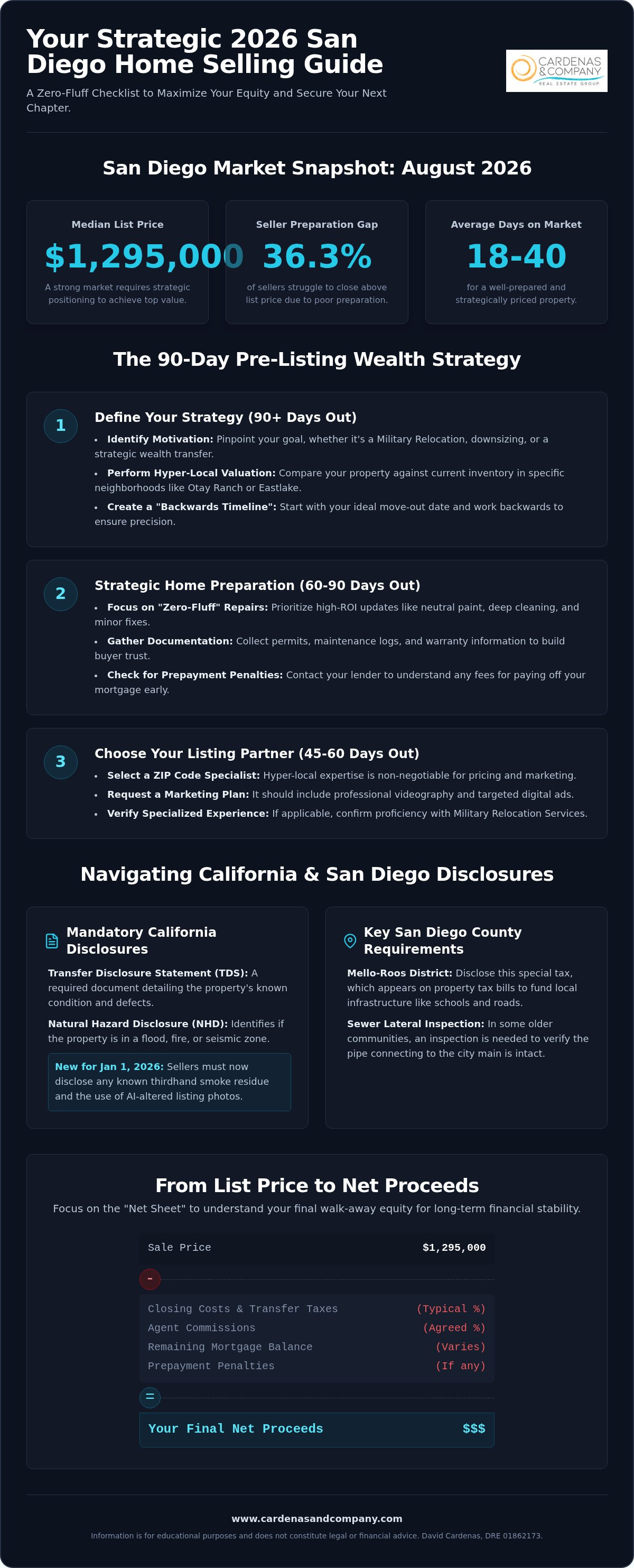
Did you know that as of August 1, 2026, the median list price for a home in San Diego reached $1,295,000, yet approximately 36.3% of sellers still struggle to close above list price because of poor preparation? We recognize that managing a San Diego home selling checklist while facing closing costs, or the various fees paid at the end of a transaction, creates significant stress. It's a high-stakes moment where technical errors in your Transfer Disclosure Statement, which is a required document detailing the property's condition, can lead to years of legal liability.
We're here to offer a transparent strategy that transforms a complex transaction into a clear path for building wealth. You'll learn how to handle the latest California mandates, such as the January 1, 2026 thirdhand smoke disclosures and new rules regarding AI-altered listing photos. This guide outlines a precise timeline to help you secure your equity and move confidently toward your next chapter, regardless of how local developments like the Chula Vista Bayfront impact your neighborhood's inventory levels, which represents the total number of homes currently available for sale.
Key Takeaways
- Identify your primary motivation and perform a hyper-local valuation against current San Diego inventory to set a realistic baseline for your wealth transfer.
- Utilize our comprehensive San Diego home selling checklist to manage mandatory California disclosures, including 2026 updates regarding thirdhand smoke and AI-altered listing photos.
- Prioritize "zero-fluff" cosmetic repairs and professional deep cleaning to maximize your home's equity without overspending on unnecessary renovations.
- Calculate your exact net proceeds by accounting for San Diego County transfer taxes and typical closing costs, which are the various fees paid at the end of the transaction.
- Shift from looking at headline prices to analyzing a "Net Sheet" during the offer phase to ensure your final walk-away figure supports your long-term financial stability.
Table of Contents
Planning Your 2026 San Diego Home Sale Timeline
Selling your home in 2026 requires more than a simple listing; it demands a calculated wealth strategy. Your first step involves defining your primary motivation. Whether you're planning a Military Relocation, downsizing for retirement, or executing a strategic wealth transfer, your specific goal dictates your entire timeline. As of August 1, 2026, the median list price in San Diego sits at $1,295,000. However, achieving that figure depends on how your property compares to active inventory in specific neighborhoods like Otay Ranch or Eastlake.
A vital part of your San Diego home selling checklist involves understanding local growth drivers. For instance, the Chula Vista Bayfront project continues to influence property values across the South Bay. Buyers are increasingly analytical in 2026. They look for homes that offer both lifestyle and long-term stability. To stay ahead, we recommend establishing a "Backwards Timeline." Start with your ideal move-out date and work toward the present. This ensures every step of the real estate transaction process is handled with precision rather than haste.
The 90-Day Pre-Listing Strategy
Preparation begins roughly three months before your home hits the market. We suggest a detailed walk-through to separate high-ROI repairs from unnecessary expenses. Focus on "zero-fluff" updates like neutral paint and deep cleaning. During this phase, gather all historical records, including permits and maintenance logs. Transparency builds buyer trust and helps avoid delays during the closing process. You should also contact your lender to check for Prepayment Penalties. These are specific fees some banks charge if you pay off your mortgage before the loan term ends. Knowing this figure early helps us calculate your true net proceeds.
Choosing Your Listing Partner
The agent you choose should be a specialist in your ZIP code, not just a generalist for the county. In a balanced market where homes average 18 to 40 days on market, hyper-local expertise is non-negotiable. Ask for a marketing plan that utilizes professional videography and targeted digital ads to reach qualified buyers. If you're a service member, verify their experience with Military Relocation Services. Handling the logistics of a military move requires a partner who understands the urgency and technical requirements of the San Diego naval and marine communities.
Managing California Disclosures and San Diego Requirements
Transparency is your primary legal shield in the 2026 market. A core component of your San Diego home selling checklist is the Transfer Disclosure Statement (TDS). This is a mandatory form where you list every known property defect, from a previous roof leak to a faulty electrical outlet. As of January 1, 2026, you must also disclose any known residue from smoking tobacco or nicotine products. Being radically honest here prevents future litigation and builds immediate trust with high-intent buyers.
You must also order a Natural Hazard Disclosure (NHD) Report. This technical document identifies if your property is located in zones prone to floods, fires, or seismic activity. In 2026, buyers are increasingly sensitive to these reports as they directly impact home insurance availability and premiums. Reviewing California Association of Realtors consumer resources can help you understand how these disclosures protect your equity during the real estate transaction process.
Many homes in San Diego County sit within a Mello-Roos district. This is a special tax district used to fund local infrastructure like schools and roads, which appears as a line item on your property taxes. If you're selling in an older coastal community, you might also need a Sewer Lateral inspection. This involves a plumber using a camera to verify that the pipe connecting your home to the city main is free of cracks or root intrusions. If these requirements feel complex, our team can help you organize your documentation through a tailored listing strategy session.
Mandatory Seller Disclosures
Federal law requires a Lead-Based Paint disclosure if your home was built before 1978. If your property is in a planned community like Otay Ranch, you must provide a full HOA Document Package. This includes the association's bylaws, financial reserves, and recent meeting minutes. We also recommend clarifying the status of Solar Leases or power purchase agreements. Buyers need to know if they're assuming a monthly payment or if the system is owned outright, as this significantly impacts their debt-to-income ratio.
San Diego Specific Compliance
Local building codes require specific safety installations before a sale can officially close. You must verify that smoke detectors and carbon monoxide alarms are installed on every level and in every bedroom. California law also mandates that you brace your water heater with double metal straps to prevent tipping during an earthquake. For those selling in the South Bay, our guide to selling your Chula Vista home provides deeper insights into localized compliance and market trends.
Maximizing Equity Through Strategic Home Preparation
Buyers in 2026 aren't just looking for a house; they're looking for a turn-key asset. We recommend prioritizing "Zero-Fluff" cosmetic repairs that offer the highest return on investment. Fresh, neutral paint and a professional deep cleaning are non-negotiable items on your San Diego home selling checklist. These simple steps eliminate visual distractions, allowing potential buyers to focus on the home's structural value rather than its perceived maintenance needs.
Significant decluttering is the next logical step for any serious seller. You want to create a sense of space that invites buyers to visualize their own lives within the property. In neighborhoods like Rancho San Diego or Del Cerro, first impressions start at the curb. High curb appeal signals that the home has been meticulously cared for, which can justify a higher asking price even when inventory levels, or the total number of homes for sale, begin to rise.
We often suggest a pre-listing home inspection to identify potential issues before you enter Escrow. Escrow is the neutral third-party process that handles the exchange of funds and documents to ensure both buyer and seller meet their contractual obligations. Discovering a roof leak or electrical issue early allows you to address it on your own terms. This prevents stressful renegotiations or requests for repair credits that would otherwise eat into your final equity.
High-ROI Cosmetic Updates
Small changes often yield the biggest impact on your bottom line. Replace dated cabinet hardware in your kitchen and bathrooms to provide a modern feel without the cost of a full remodel. Refresh your landscaping with drought-tolerant plants that thrive in the Southern California climate. This reduces future utility burdens for the new owner and aligns with 2026 eco-efficiency trends. For more localized advice, see our staging tips for Chula Vista homes.
Professional Presentation Standards
Digital first impressions are vital in a market where 36.3% of homes sell above list price. Schedule your professional photography during the "Golden Hour" to capture your home in the best possible light. We also utilize 3D virtual tours to filter for serious, high-intent buyers, which minimizes the disruption of unnecessary physical showings. Finally, remove personal photos and highly specific decor. Your goal is to provide a blank canvas where a buyer can see their future, not your past.
Download
Download as HTML
Calculating Closing Costs and Net Proceeds in San Diego
Understanding your actual walk-away number is the most critical part of the San Diego home selling checklist. We don't want you to focus on the gross sale price alone. Radical transparency requires looking at the closing costs, which are the various fees paid at the end of the transaction. In San Diego County, these typically range from 6% to 8% of the final sale price. This percentage covers commissions, title insurance, and various administrative requirements that ensure a clean transfer of ownership.
A significant portion of these costs includes the County Transfer Tax. This tax is currently set at $1.10 per $1,000 of the sale price. For a median-priced home of $1,295,000, this amounts to approximately $1,424.50. While a proposal to increase this tax was canceled in January 2026, stay aware that "mansion taxes" for high-value properties remain a topic of discussion for future ballots. You must also account for Escrow fees. Escrow is the neutral third-party service that manages funds and documents to ensure a secure transaction; these fees are usually split between the buyer and seller.
If you're selling an investment property, consider a 1031 Exchange. A 1031 Exchange is a tax-deferred strategy that allows you to swap one investment property for another to delay capital gains taxes. This tactic is essential for long-term wealth building in the Southern California market, as it keeps your equity working for you rather than losing a portion to immediate taxation. To see how these numbers fit into your specific situation, request a personalized net proceeds estimate from our team.
The Seller’s Net Sheet
We use a Net Sheet to subtract mortgage payoffs, liens, and commission fees from your gross price. This document also includes prorated property taxes based on your specific closing date. It's the only way to see your actual profit before the check is cut. For a deeper look at how to coordinate these financials with your next move, review our strategic guide to buying and selling in San Diego.
Asset Protection and Wealth Strategy
Selling a home is often the largest financial event in a family's history. We strongly recommend selling within a Living Trust to protect your heirs from Probate. Probate is the expensive and lengthy court-supervised process of distributing assets after someone passes away. You can learn why San Diego homeowners need a living trust before they list to ensure their hard-earned equity remains within the family. We view your sale proceeds as a vital component of your overall financial portfolio, ensuring your transition is grounded in long-term stability.
Executing the Strategic Sale: Showings to Closing
Executing the final phase of your sale requires disciplined focus. Once your home is active, we manage showings by prioritizing high-intent buyers who provide verified pre-approval letters. This step is a vital part of your San Diego home selling checklist because it prevents wasted time with unqualified parties. In a market where 36.3% of homes still sell above list price, you'll likely face multiple offers that require careful analysis.
Don't just look at the headline number. We use a Net Sheet to compare the actual bottom line of each offer after accounting for closing costs and potential credits. This radical transparency ensures you choose the buyer most likely to reach the finish line without demanding mid-transaction price cuts. We then move into Escrow, which is the neutral third-party process that manages the exchange of funds and documents, where we meticulously track every contingency deadline.
Negotiating the Best Terms
Successful negotiation looks beyond the sales price. We evaluate the buyer’s down payment, loan type, and the length of their contingency periods. A major hurdle in 2026 is the Appraisal, which is an expert’s estimate of the property’s value required by the lender. If a "low appraisal" occurs, we've already prepared a strategy to bridge the gap or negotiate a resolution that keeps your equity intact. Using radical transparency to address buyer concerns early is the most effective way to keep the deal on track.
The Final Transition
The final days of the sale involve logistical precision. Coordinate with professional movers at least four weeks before your closing date to avoid the high demand in San Diego. During the final walkthrough, we ensure all agreed-upon repairs are documented and that the home is delivered in the promised condition. Organize all keys, garage openers, and appliance manuals for the new owner to facilitate a smooth handoff. Finally, secure your final settlement statement; it's a vital document for your tax records and future wealth planning.
Bottom Line: Selling a San Diego home in 2026 requires a blend of rigorous technical compliance and strategic market positioning. By following this structured approach, you ensure your equity is protected and your transition to the next phase of life is seamless.
We invite you to a warm, zero-pressure strategy session with David & Angela Cardenas and the Cardenas & Company Real Estate Group. Visit cardenasandcompany.com or TrustSanDiego.com to begin your journey toward a successful sale.
Information is for educational purposes and does not constitute legal or financial advice. David Cardenas, DRE 01862173.
Securing Your Financial Legacy Through Strategic Listing
A successful sale in 2026 relies on a blend of hyper-local data and meticulous legal compliance. By prioritizing high-ROI cosmetic updates and adhering to the San Diego home selling checklist, you position your property as a premier asset in a balanced market. We believe that protecting your equity requires looking beyond the sale price to the long-term impact on your family's financial health. Our wealth-first approach ensures that every decision, from handling 2026 disclosure updates to managing closing costs, serves your ultimate goal of stability.
Bottom Line: A successful San Diego home sale in 2026 demands a proactive strategy that balances technical accuracy with expert market positioning. It's not just about the transaction; it's about securing the financial foundation for your next phase of life.
We invite you to schedule your zero-pressure strategy session with David & Angela Cardenas and the Cardenas & Company Real Estate Group. Visit cardenasandcompany.com or TrustSanDiego.com to learn how our 10+ years of local expertise and specialized Military Relocation support can work for you. We're here to provide the specialized attention your unique situation deserves.
Information is for educational purposes and does not constitute legal or financial advice. David Cardenas, DRE 01862173.
Frequently Asked Questions
How much are seller closing costs in San Diego in 2026?
Seller closing costs, which are the various fees paid at the end of a real estate transaction, typically range from 6% to 8% of the final sale price. In San Diego County, this includes the real estate commission and the mandatory county transfer tax of $1.10 per $1,000 of value. These costs are deducted directly from your gross proceeds at the close of Escrow.
What is the best month to sell a house in Chula Vista for maximum profit?
Historically, listing your home in March or April yields the highest net profit for sellers in Chula Vista. This window aligns with peak buyer demand before the summer surge and often results in fewer days on market. Capitalizing on lower inventory levels during the spring allows you to maintain stronger leverage during negotiations.
Do I need to disclose a death in the home in California?
California law requires sellers to disclose any death that occurred on the property within the last three years. This information must be provided in writing to the buyer during the disclosure period. If a death occurred more than three years ago, you generally do not have to volunteer the information unless the buyer asks you directly.
How long does the escrow process typically take in San Diego County?
A standard Escrow period in San Diego usually lasts between 30 and 45 days. Escrow is a neutral third-party process that handles funds and documents to ensure all contractual obligations are met before the title transfers. This timeline allows sufficient time for the buyer’s appraisal, home inspections, and final loan approval.
Should I get a home inspection before listing my house?
We strongly recommend a pre-listing home inspection to identify potential "deal-killers" before you find a buyer. Identifying structural or mechanical issues early allows you to address them on your own timeline and budget. This proactive approach prevents buyers from demanding large repair credits or price reductions once you are already under contract.
What are the mandatory disclosures for selling a home in San Diego?
Your San Diego home selling checklist must include the Transfer Disclosure Statement (TDS) and a Natural Hazard Disclosure (NHD) report. As of January 1, 2026, you must also disclose known residue from tobacco or nicotine products and any AI-altered listing photos. These documents are vital for protecting you from future legal liability after the sale is finalized.
How does the Chula Vista Bayfront project affect my home value?
The Chula Vista Bayfront project acts as a significant value catalyst for residential property throughout the South Bay. This multi-billion dollar development increases local desirability by adding world-class amenities and job opportunities. Sellers in nearby ZIP codes can often leverage this growth to justify a premium list price compared to inland neighborhoods.
Can I sell my San Diego home if it is currently in a Living Trust?
Selling a home held in a Living Trust is a standard procedure that helps your family avoid Probate. Probate is the expensive and lengthy court-supervised process of distributing assets after someone passes away. As the trustee, you have the authority to sign all listing and closing documents, ensuring a seamless wealth transfer to your next investment or phase of life.
Bottom Line: Maximizing your equity in 2026 requires a precise understanding of technical disclosures and hyper-local market timing. Following a data-driven checklist ensures a stable transition while protecting your financial legacy.
We invite you to a warm, zero-pressure strategy session with David & Angela Cardenas and the Cardenas & Company Real Estate Group. Visit cardenasandcompany.com or TrustSanDiego.com to begin your journey toward a successful sale.
Information is for educational purposes and does not constitute legal or financial advice. David Cardenas, DRE 01862173.
Disclaimer
The information provided on this blog is for educational and informational purposes only and does not constitute legal, financial, or investment advice. While we strive for accuracy, real estate markets and insurance regulations (including Living Trusts and IUL strategies) are subject to change. David Cardenas (DRE 01862173) is a licensed real estate salesperson; however, this content does not create an agency relationship. Please consult with a qualified attorney or tax professional regarding your specific situation.