
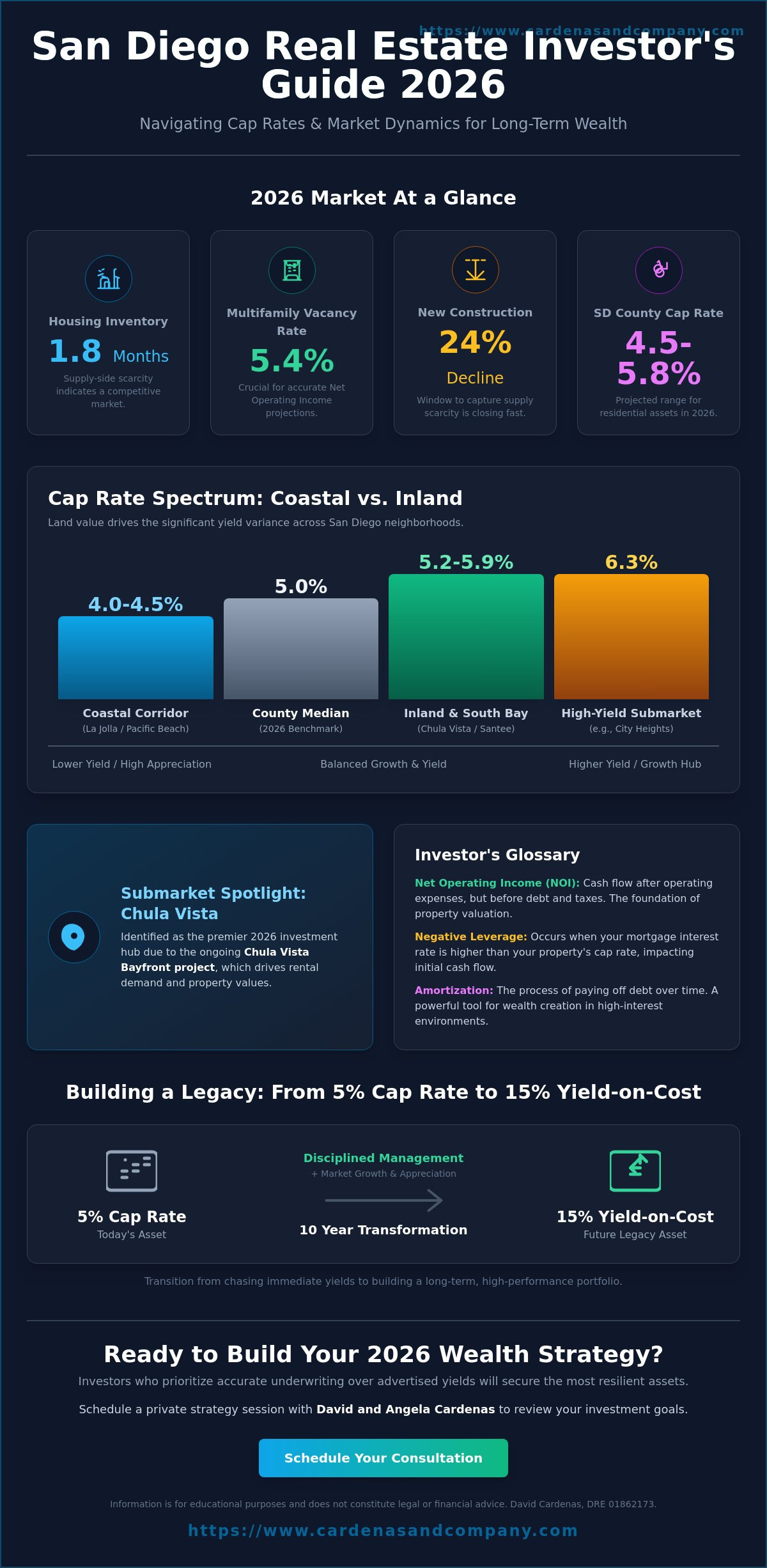
While many investors are sidelined by 5.4% vacancy rates, the 24% decline in new multifamily construction means the window to capture supply-side scarcity is closing fast. Investing for cash flow in a market with only 1.8 months of inventory requires a level of precision that goes beyond basic spreadsheets. Our San Diego cap rate analysis 2026 reveals that while average multifamily yields hover between 4.8% and 5.1%, the real wealth is being built in submarkets like City Heights where cap rates still touch 6.3%. You've likely noticed that compressed yields are making traditional cash flow difficult to find in our coastal corridors.
We agree that the gap between gross yield and actual Net Operating Income, which is the cash left after paying all operating expenses but before debt or taxes, is wider than ever. This guide provides the hard data you need to identify high-performance assets without falling into the common expense traps of older San Diego inventory. We'll walk through specific 2026 benchmarks for neighborhoods from La Jolla to Chula Vista and provide a clear underwriting framework to secure your family's long-term security. Our team is here to help you move from identifying a challenge to implementing a strategic solution for your portfolio.
San Diego Cap Rate Analysis 2026: Key Takeaways
Benchmark your portfolio against our San Diego cap rate analysis 2026, which projects residential yields to stabilize between 4.5% and 5.8% despite inventory levels remaining low at 1.8 months of supply. Understanding these benchmarks allows you to filter out overpriced assets and focus on properties with genuine growth potential.
Identify why Chula Vista is the premier 2026 investment hub. The ongoing Chula Vista Bayfront project continues to drive rental demand and property values, making the South Bay a critical component of any diversified San Diego portfolio.
Learn to manage negative leverage, which happens when your mortgage interest rate is higher than your cap rate. We explain how Amortization, the process of paying off debt through regular principal and interest payments, affects your long term returns in a high interest rate environment.
Protect your equity during Escrow, which is a neutral third party that holds funds until all conditions are met, by verifying the gap between advertised and actual expenses. We help you account for property taxes and maintenance costs that often surprise investors in older inventory.
Transition from chasing immediate yields to building a 10 year legacy through strategic appreciation. Our framework shows how a property with a 5% cap rate today can transform into a 15% yield-on-cost asset through disciplined management and market growth.
Bottom Line: San Diego real estate in 2026 requires a shift from paper cap rates to deep underwriting of future density and submarket growth. Investors who prioritize accuracy over advertised yields will secure the most resilient assets in this supply-constrained market.
We invite you to a private strategy session with David and Angela Cardenas to review your 2026 investment goals. Visit cardenasandcompany.com or TrustSanDiego.com to schedule your consultation.
Table of Contents
San Diego Cap Rate Benchmarks for 2026
Investors often ask what a "good" yield looks like in the current market. Our San Diego cap rate analysis 2026 shows a significant shift in how we value residential assets. A capitalization rate, or cap rate, is the Net Operating Income (NOI) divided by the purchase price, expressed as a percentage. In 2026, residential assets across the county typically fall between 4.5% and 5.8%. We use this metric to evaluate the unleveraged return on a property before accounting for debt or taxes.
Market shifts are often measured in Basis Points, which is a unit of measure for interest rates and other percentages in finance, where one basis point equals 1/100th of 1%. If a cap rate moves from 5.0% to 5.25%, that is a 25 basis point increase. We're currently seeing a "Density Premium" where properties with Accessory Dwelling Unit (ADU) potential trade at lower initial cap rates. Buyers accept a lower day-one yield because the future income from adding units significantly boosts the long-term pro-forma return.
Coastal vs. Inland Yield Variance
Land value drives the variance between neighborhoods. In La Jolla and Pacific Beach, yields remain compressed near 4.0% to 4.5%. Investors accept these lower returns because of high historical appreciation and tenant quality. For those seeking luxury coastal assets in international markets, kingestates.es specializes in premier properties across Spain's Costa del Sol. Conversely, Chula Vista and Santee offer higher yields in the 5.2% to 5.9% range. The current 2026 median cap rate for San Diego County is 5.0%.
The Residential 1-4 Unit Market Snapshot
While institutional firms chase large complexes, local families build legacy wealth through duplexes and triplexes. These 1-4 unit properties are the primary vehicles for San Diego investors seeking to secure their family's future. You must account for a 5.4% vacancy rate in your 2026 projections, as this directly reduces your NOI. Accurate rental comps in neighborhoods like Serra Mesa and Del Cerro are vital to ensure your underwriting reflects reality rather than optimistic marketing. Relying on inflated pro-forma numbers is a common trap that we help our clients avoid through radical transparency and hard data.
Bottom Line: Successful San Diego investing in 2026 requires balancing immediate yield with the long-term density potential of the lot. While coastal yields are tighter, the South Bay continues to offer the most competitive cash-on-cash returns for residential buyers.
We invite you to a private strategy session with David and Angela Cardenas to review your 2026 investment goals. Visit cardenasandcompany.com or TrustSanDiego.com to schedule your consultation.
The 2026 Interest Rate vs. Cap Rate Equation
In our current San Diego cap rate analysis 2026, we must address the friction between borrowing costs and property yields. Many investors are facing "negative leverage," which happens when your mortgage interest rate is higher than your cap rate. While this sounds discouraging on paper, savvy strategists focus on the long term wealth created through Amortization. This is the process of paying off a debt over time through regular payments of principal and interest. In a high appreciation market, the principal paydown and tax benefits often outweigh the lack of immediate monthly cash flow.
Rental stability near our local military installations relies heavily on BAH (Basic Allowance for Housing). This is a monthly stipend provided to service members to cover their housing costs. This allowance acts as a floor for rental income, providing a safety net for investors even when San Diego's economic outlook faces broader affordability challenges. We often see properties in the South Bay outperform coastal assets because of this consistent, government backed demand.
Financing Strategy in a High-Rate Environment
Financing requires more than just a standard 20% down payment. We recommend using seller buy-downs to lower your interest rate for the first 24 to 36 months, which effectively raises your day-one yield. For military families, the VA loan remains a powerful tool to acquire up to four units with zero down payment. These strategies are essential because 2026 interest rates have tightened Debt Service Coverage Ratios (DSCR). Lenders use this ratio to determine if a property's income can cover its debt payments. If you want to see how these rates impact specific neighborhood valuations, review our San Diego County Home Prices & Market Analysis.
2026 San Diego Yield Comparison Table
Understanding the difference between "Pro-Forma" (projected) and "Actual" cap rates is vital. Pro-forma numbers often ignore the 5.4% vacancy rate currently seen in the market. The table below compares typical returns across three tiers of San Diego property.
- Coastal Luxury (La Jolla): 4.2% Actual Cap Rate | -1.5% to 0.5% Cash-on-Cash Return
- Urban Value-Add (City Heights): 5.1% Actual Cap Rate | 1.0% to 2.5% Cash-on-Cash Return
- South Bay Multi-Unit (Chula Vista): 5.8% Actual Cap Rate | 3.0% to 4.5% Cash-on-Cash Return
We invite you to explore our investment consulting services to see which tier fits your legacy goals.
Bottom Line: San Diego real estate in 2026 requires a shift from chasing monthly checks to prioritizing principal paydown and tax advantages. Investors who underwrite for negative leverage today will be best positioned for massive equity gains when the interest rate cycle eventually turns.
We invite you to a private strategy session with David and Angela Cardenas to review your 2026 investment goals. Visit cardenasandcompany.com or TrustSanDiego.com to schedule your consultation.
Chula Vista has emerged as the 2026 epicenter for residential investment in San Diego. While the county median cap rate rests at 5.0%, our San Diego cap rate analysis 2026 shows that Chula Vista is currently averaging 5.4%. This performance is driven by a massive shift in infrastructure and employment. The Chula Vista Bayfront Project is the primary catalyst, transforming the coastline into a world-class destination. The Chula Vista Bayfront project will add 3,000+ jobs to the local economy, creating a permanent surge in rental demand that supports higher yields.
If you are considering selling your home in Chula Vista, the 2026 strategy requires pricing for this future density. Investors are actively seeking properties that offer direct access to these new employment hubs. We see a clear trend where buyers are willing to accept slightly lower initial yields in exchange for the long-term security provided by this massive public-private investment.
Neighborhood Analysis: Eastlake vs. West Chula Vista
Yields vary significantly between the eastern and western corridors. In Eastlake, you will find lower cap rates, often near 4.8%, because of high owner-occupant stability and intense school-driven demand. Families pay a premium for the established neighborhood character, which compresses yields but offers lower tenant turnover. Conversely, West Chula Vista provides higher cap rates and significant value-add potential. Older inventory here allows for renovations that can push a pro-forma yield well above 6.0%. Specific developments like Amara Bay act as market drivers, lifting the floor for property values across the entire South Bay region as the area modernizes.
The South Bay Supply Constraint
The 1.8 months of supply in the South Bay acts as a protective barrier for your investment. This inventory level is far below the 4 to 6 months required for a balanced market, ensuring that well-located properties rarely sit vacant. In San Ysidro and Imperial Beach, rental rate trends for 2026 remain resilient, with 3% to 5% annual increases expected as workers seek proximity to the border and the coast. During Escrow, which is a neutral third party that holds funds and documents during a real estate transaction until all conditions are met, we verify that the income potential of these units matches the current market scarcity. This supply-constrained environment protects your San Diego cap rate analysis 2026 projections from the volatility seen in other overbuilt markets.
Bottom Line: Chula Vista currently offers the strongest balance of yield and growth potential in the county due to the Bayfront expansion. Investors who secure South Bay assets now are positioning themselves for significant equity gains as 3,000+ new jobs enter the local economy.
We invite you to a private strategy session with David and Angela Cardenas and the Cardenas & Company Real Estate Group to review your 2026 investment goals. Visit cardenasandcompany.com or TrustSanDiego.com to schedule your consultation.
Information is for educational purposes and does not constitute legal or financial advice. David Cardenas, DRE 01862173.
Avoiding the San Diego Expense Trap
Most advertised yields in a San Diego cap rate analysis 2026 are purely aspirational. Brokers often present a pro-forma cap rate that ignores the reality of operating costs in Southern California. When you enter Escrow, which is a neutral third party that holds funds and documents during a real estate transaction until all conditions are met, your primary objective is to verify every expense. We see many investors fail because they rely on the seller's historical tax bill rather than projecting their own.
Under Proposition 13, your property taxes will reset to approximately 1.2% of the new purchase price. If the current owner has held the asset for twenty years, their tax basis is significantly lower than yours will be. This single line item can swing your Net Operating Income (NOI) by thousands of dollars annually. San Diego's housing stock is also aging. Much of the inventory in neighborhoods like North Park or Clairemont was built between the 1950s and 1970s. You must budget at least 1% of the property value for annual maintenance reserves to handle aging sewer lines and electrical panels.
Underwriting Like a Pro
Successful investors budget for a 5.0% to 7.0% management fee from day one. Even if you plan to manage the units yourself, your time is an expense that must be accounted for in a professional wealth strategy. To protect your yields, we recommend implementing a Ratio Utility Billing System (RUBS). This system allows you to pass a portion of water, trash, and sewage costs back to the tenants based on occupancy or square footage. Implementing RUBS is a critical step in offsetting the rising utility costs we see in 2026. For more on protecting your real estate holdings, explore our asset protection resources at Trust San Diego.
Due Diligence Checklist
During your contingency period, demand the Schedule E from the seller's tax returns rather than a simple spreadsheet. This document provides a verified look at what was actually spent on the property. We focus on the "Basis" of your investment, which is the total cost including the purchase price and closing costs. We often find high-yield opportunities in Probate, which is the legal process of distributing a deceased person's assets. Properties in probate may require more renovation, but they often provide the "Basis" needed for a high-performance portfolio.
If you want to ensure your next acquisition is a high-performance asset, schedule a real estate investment consultation with our team today.
Bottom Line: Never accept a pro-forma cap rate at face value because advertised expenses rarely account for the post-sale property tax reset. Accurate underwriting of maintenance reserves for aging inventory is the difference between a legacy asset and a financial liability.
We invite you to a private strategy session with David and Angela Cardenas and the Cardenas & Company Real Estate Group to review your 2026 investment goals. Visit cardenasandcompany.com or TrustSanDiego.com to schedule your consultation.
Building a Wealth Strategy Beyond the Cap Rate
Securing this wealth for the next generation is just as important as the acquisition itself. We strongly recommend utilizing a Living Trust to protect your investment assets. A Living Trust is a legal document that allows you to manage your assets while you are alive and ensures they transfer to your heirs without the delay or expense of court. For a deeper look at these wealth-building mechanics, see our San Diego Real Estate Investment Guide.
The ADU Strategy for 2026
Adding a junior Accessory Dwelling Unit (ADU) is the fastest way to force appreciation in 2026. This move can jump your effective cap rate from 5% to 8% almost instantly by adding a second or third revenue stream to a single lot. San Diego's current "Bonus ADU" laws allow for additional units on multi-family lots, providing a pathway to density that was previously impossible. We recently guided a client through a Chula Vista single-family home conversion that resulted in a high-yield triplex, which significantly outperformed standard market returns.
Next Steps for Your Strategy Session
Mastering the Chula Vista and South Bay micro-markets requires more than just access to the MLS. You need a partner with a 25-year perspective who has seen interest rate cycles come and go. We focus on the individual story behind every portfolio, treating your financial future with the meticulous advocacy it deserves. Our group provides the stable anchor you need in a shifting landscape, ensuring your pathway to long-term security is grounded in hard data and expert reliability.
Bottom Line: San Diego remains a primary appreciation market where long-term wealth is built through principal paydown and the strategic addition of density. Investors who utilize ADU laws and protect their assets with a Living Trust will secure the strongest legacy for the next generation.
We invite you to a warm, zero-pressure strategy session with David and Angela Cardenas and the Cardenas & Company Real Estate Group. Visit cardenasandcompany.com or TrustSanDiego.com to begin your journey toward long-term wealth.
Securing Your 2026 Investment Pathway
Success in the current market requires moving past surface-level pro-formas to understand the underlying mechanics of Southern California real estate. Our San Diego cap rate analysis 2026 highlights that while yields are tight, the combination of 1.8 months of inventory and the 3,000+ new jobs from the Chula Vista Bayfront project creates a unique window for long-term growth. We've seen how identifying actual Net Operating Income and exploiting ADU density can transform a modest purchase into a high-performance legacy for your family.
As active members of the San Diego military support community with over 25 years of local experience, we provide the meticulous advocacy needed to protect your future. We specialize in the Chula Vista and South Bay micro-markets where these specific wealth-building strategies are most effective. Our team acts as a stable anchor, helping you move from identifying a challenge to implementing a strategic solution with expert reliability.
Bottom Line: The 2026 market rewards investors who prioritize accurate expense underwriting and future density potential over simple advertised yields. Disciplined buyers who secure supply-constrained assets today will see the most significant equity gains as the Chula Vista coastline continues its transformation.
We invite you to Book a 2026 Investment Strategy Session with David & Angela Cardenas to discuss your specific goals. Visit cardenasandcompany.com or TrustSanDiego.com to schedule a zero-pressure consultation with the Cardenas & Company Real Estate Group.
Frequently Asked Questions
What is considered a good cap rate in San Diego for 2026?
A good cap rate in 2026 is one that exceeds the current cost of debt by at least 50 to 100 Basis Points, which is a unit of measure where one basis point equals 1/100th of 1%. While the county median is 5.0%, a "good" rate for value-add properties in the South Bay often hits 5.8% or higher. You must weigh this yield against the property's potential for future density and long term appreciation.
How do interest rates affect San Diego property cap rates?
Interest rates and cap rates typically move in the same direction, though San Diego's supply constraints often delay this reaction. When interest rates rise, buyers demand higher yields to maintain their debt coverage, leading to cap rate expansion. Our San Diego cap rate analysis 2026 shows that even as rates fluctuate, the lack of inventory keeps prices from dropping as sharply as in other national markets.
Is it better to buy for appreciation or cash flow in the South Bay?
The South Bay currently offers a balance of both, but we advise prioritizing appreciation through the strategic addition of units. Cash flow is often thin in year one due to high entry costs, but the 3,000+ jobs coming to the Chula Vista Bayfront ensure long term demand. We focus on properties where you can force appreciation by adding an ADU, turning a standard yield into a high performance legacy.
What are the average operating expenses for a San Diego rental property?
You should budget between 35% and 45% of your gross income for operating expenses in the 2026 market. This includes property taxes, which reset to roughly 1.2% of the purchase price, and a 1% maintenance reserve for older inventory. Failing to account for these costs during Escrow, which is a neutral third party holding funds until conditions are met, is a common mistake that impacts your actual yield.
How does the Chula Vista Bayfront project impact local investment yields?
The Bayfront project increases yields by driving up rental demand and reducing vacancy risk in the surrounding neighborhoods. As 3,000+ permanent jobs enter the local economy, the competition for housing in West Chula Vista will intensify. This infrastructure investment provides a "floor" for your investment, ensuring that your 2026 projections remain grounded in real world economic growth rather than speculation.
Can I use a VA loan to buy an investment property with a high cap rate?
You can use a VA loan to acquire a 1-4 unit property as long as you occupy one of the units as your primary residence. This strategy allows for 100% financing, which can lead to an infinite cash-on-cash return if the units are managed correctly. We help military families understand the Amortization schedule, which is the process of paying off debt through regular principal and interest payments, to build equity quickly.
What is the difference between a cap rate and a cash-on-cash return?
A cap rate measures the property's yield as if you paid all cash, while cash-on-cash return measures the actual profit on the money you invested. In a high interest rate environment, your cash-on-cash return might be lower than your cap rate due to the cost of your mortgage. We use both metrics to ensure your wealth strategy accounts for both the asset's performance and your personal financing costs.
How often should I perform a cap rate analysis on my San Diego portfolio?
We recommend performing a comprehensive San Diego cap rate analysis 2026 at least once a year or during shifts in interest rates of more than 50 basis points. Regular audits allow you to identify underperforming assets that may be better suited for a 1031 exchange or a renovation project. This is vital if you are managing a property currently in Probate, which is the legal process of distributing a deceased person's assets, to ensure the valuation remains accurate.
Bottom Line: San Diego real estate in 2026 requires a disciplined approach to underwriting that accounts for both current debt costs and future density potential. Investors who verify every expense during the due diligence period will secure the most resilient assets for their family legacy.
We invite you to a private strategy session with David and Angela Cardenas to review your 2026 investment goals. Visit cardenasandcompany.com or TrustSanDiego.com to schedule your consultation.
Disclaimer
The information provided on this blog is for educational and informational purposes only and does not constitute legal, financial, or investment advice. While we strive for accuracy, real estate markets and insurance regulations (including Living Trusts and IUL strategies) are subject to change. David Cardenas (DRE 01862173) is a licensed real estate salesperson; however, this content does not create an agency relationship. Please consult with a qualified attorney or tax professional regarding your specific situation.