
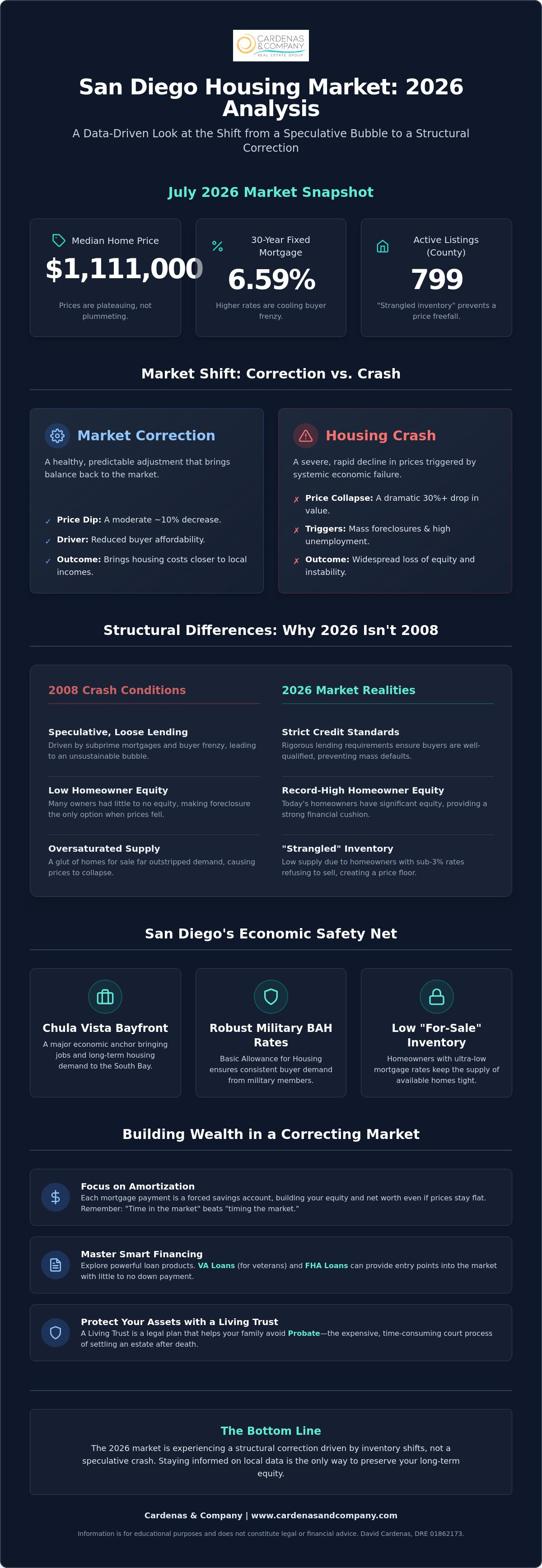
Waiting for a 2008-style collapse in the local market isn't a strategy; it's a gamble that could cost you years of equity growth. You've likely seen the conflicting headlines about a San Diego housing bubble 2026 and felt the anxiety of a $1,111,000 median price tag for single-family homes. It's frustrating to watch mortgage rates hover around 6.59% as of July 2026 while wondering if you're buying at the absolute peak.
We agree that the current market feels heavy with uncertainty. That's why we're providing this transparent, data-driven analysis to help you protect your equity and make a move that actually makes sense for your family. We'll break down the difference between a price correction and a total crash. You'll see how inventory levels, with 799 active listings recorded in July 2026, are shifting in areas like the Chula Vista Bayfront, and we'll look at the real-world impact of new housing laws like SB 79.
Bottom Line: The 2026 market is experiencing a structural correction driven by inventory shifts rather than a speculative crash. Staying informed on local data is the only way to preserve your long-term equity.
Key Takeaways
- Distinguish between speculative growth and the current price leveling across San Diego County to gain clarity on market stability.
- Analyze how low inventory levels in South Bay and the Chula Vista Bayfront project act as economic anchors for your property value.
- Identify the structural differences that prevent a San Diego housing bubble 2026 from mirroring the 2008 crash, focusing on high equity and strict credit.
- Master strategies for using VA Loans—mortgages for veterans with no down payment—or FHA products to enter the market effectively.
- Protect your home by establishing a Living Trust, which is a legal plan that manages your assets to help your family avoid Probate, the expensive court process of settling an estate.
Table of Contents
Defining the San Diego Housing Bubble in 2026
To understand the current market, we must first answer a fundamental question: What is a housing bubble? A bubble occurs when home prices rise at an unsustainable pace, driven by speculation and buyer frenzy rather than economic reality. In July 2026, the San Diego housing bubble 2026 narrative looks less like a pop and more like a plateau. Prices across San Diego County are leveling off, with the median single-family home price holding steady at $1,111,000.
We are currently witnessing a "strangled inventory" phenomenon. Many homeowners secured mortgage rates below 3% years ago and refuse to sell now that the 30-Year Fixed Mortgage Rate sits at 6.59%. This creates a firm floor for prices. Unlike a true bubble, where supply eventually outstrips demand, inventory levels remain tight, preventing a freefall in value. Buyers are cautious, but they aren't absent.
Correction vs. Crash: Why the Distinction Matters
A market correction is a healthy, 10% dip that brings housing costs closer to local income levels. In contrast, a crash involves a 30% or greater collapse, usually triggered by high unemployment and mass foreclosures. Today, San Diego homeowners hold record-high equity, and lending standards remain rigorous. Even a shift of 25 Basis Points (a unit of measure equal to 1/100th of a percentage point) in interest rates impacts purchasing power; however, it doesn't force a market-wide liquidation.
The Role of Amortization in 2026 Equity
Wealth preservation depends on Amortization, which is the process of paying off home debt over time through a fixed schedule. Each monthly payment acts as a forced savings account, increasing your ownership stake even when market prices stay flat. In neighborhoods like Chula Vista, homeowners who focus on "time in the market" rather than "timing the market" continue to build significant net worth. Choosing to wait for a crash that may never come often results in missed equity gains through Amortization.
Bottom Line: The 2026 market is a period of price normalization driven by restricted supply rather than a speculative collapse. Focus on long-term equity growth through consistent debt reduction to protect your family's financial future.
We invite you to schedule a zero-pressure strategy session with David & Angela Cardenas and the Cardenas & Company Real Estate Group. Visit us at cardenasandcompany.com or TrustSanDiego.com to secure your personalized wealth-preservation plan.
Key 2026 Market Indicators for San Diego and Chula Vista
Understanding the San Diego housing bubble 2026 requires looking past the noise at the hard data. In South Bay San Diego, inventory levels remain near historic lows despite a slight county-wide uptick to 799 active listings as of July 2026. This scarcity keeps competition high for well-maintained homes, even as buyers become more selective. We are seeing a market that rewards patience and precise pricing over the frantic bidding wars of previous years.
Several local factors act as a safety net for property values in our region:
- The Chula Vista Bayfront project: This massive development serves as a major economic anchor. It brings jobs and infrastructure that support long-term demand for housing in the immediate area.
- 2026 San Diego BAH rates: Basic Allowance for Housing is the monthly stipend provided to military members to cover their housing costs. These rates have remained robust, ensuring that military buyer demand stays consistent regardless of broader economic shifts.
- Days on Market: In neighborhoods like Rancho San Diego and Serra Mesa, homes are still moving quickly. The median Days on Market in San Diego is 23 days, while Chula Vista is even tighter at 21 days.
If you are curious about how these metrics impact your specific neighborhood, you can view our latest local market reports for a deeper look at recent sales.
Mortgage Rates and Buyer Purchasing Power
As of July 5, 2026, the 30-Year Fixed Mortgage Rate in California sits at 6.59%. These rates create a "lock-in effect" because homeowners with 3% loans from years ago are hesitant to trade them for a higher rate. This keeps supply low. When calculating affordability, you must also account for property taxes and closing costs. We define closing costs as the various fees and expenses, such as title insurance and transfer taxes, that buyers and sellers pay at the end of a real estate transaction. Even a slight dip in rates could trigger a massive wave of pent-up demand from buyers waiting on the sidelines.
New Construction Lag in the South Bay
New housing starts in Chula Vista still lag behind our population growth. While the new state law SB 79 encourages higher density near transit stops, much of this new construction focuses on multi-family rentals. There is a persistent shortage of new single-family homes. This supply-side shortfall provides a significant level of protection against a total price collapse, as the number of people needing homes continues to outpace the number of homes being built.
Bottom Line: San Diego's market is supported by strong military demand and significant infrastructure projects like the Chula Vista Bayfront. Low supply continues to be the primary driver preventing the price crash many fear.
We invite you to schedule a zero-pressure strategy session with David & Angela Cardenas and the Cardenas & Company Real Estate Group. Visit us at cardenasandcompany.com or TrustSanDiego.com to secure your personalized wealth-preservation plan.
Why 2026 is Not 2008: A Structural Comparison
Many people fear a repeat of the 2008 financial crisis, but the structural foundations of the San Diego housing bubble 2026 are fundamentally different. The 2008 crash was fueled by predatory lending and "ninja" loans that required no proof of income or assets. Today, strict federal regulations ensure that only "Qualified Mortgages"—loans that meet specific ability-to-repay standards—receive approval. This shift ensures that homeowners in San Diego County actually have the financial capacity to keep their homes.
Modern transactions also rely on the security of Escrow. We define Escrow as a neutral third party that holds funds and documents during a real estate transaction to ensure both buyer and seller fulfill their contractual obligations before the sale closes. This process adds a layer of professional oversight and transaction security that was often bypassed or manipulated during the subprime era. It protects your capital and ensures the legal integrity of your investment.
Lending Standards and Foreclosure Risk
Current delinquency rates in San Diego County remain near historic lows. Unlike the "Adjustable Rate" traps of the past, the vast majority of current homeowners are protected by a "Fixed-Rate" shield. Since they aren't facing sudden, massive payment spikes, they have no incentive to walk away from their properties. This stability prevents the mass foreclosure wave required to trigger a 30% price crash. We are seeing a market defined by stability rather than the "irrational exuberance" that preceded the Great Recession.
The Equity Cushion in Southern California
Between 2020 and 2026, the average San Diego homeowner saw their net worth explode through home appreciation. With the median price reaching $1,111,000 for single-family homes, most residents possess a massive equity buffer. Even if the market experienced a 10% correction, most owners would still remain significantly above their original Basis. We define Basis as the original purchase price of your property plus certain capital improvements, which determines your taxable gain when you sell.
This equity acts as a powerful shock absorber. Homeowners in Southern California will "stay put" and wait out a cooling market rather than selling at a loss. Because they have so much to lose, they won't panic. In San Diego, real estate remains a long-term wealth vehicle, and the current data shows that owners are better positioned to weather economic shifts than at any point in the last two decades.
Bottom Line: The 2026 market is built on a foundation of rigorous lending and record homeowner equity that was entirely absent in 2008. These structural safeguards make a catastrophic price collapse highly unlikely despite current economic headwinds.
We invite you to schedule a warm, zero-pressure strategy session with David & Angela Cardenas and the Cardenas & Company Real Estate Group. Visit us at cardenasandcompany.com or TrustSanDiego.com to secure your personalized wealth-preservation plan.
Strategic Moves: Selling or Buying in a Cooling Market
Making a move in a market that feels like a San Diego housing bubble 2026 requires a departure from the "post-and-pray" tactics of the past. Success today depends on matching your strategy to current data rather than sensational headlines. Whether you're cashing out equity or finally stepping onto the property ladder, you need a plan that accounts for inventory levels and the reality of 6.59% mortgage rates. We believe in radical transparency: the market isn't easy right now, but it is functional for those who are prepared.
Pricing your home correctly in July 2026 is the difference between a successful sale and a stagnant listing. We recommend a comprehensive Chula Vista home valuation to establish a realistic starting point based on actual closed sales rather than neighborhood gossip. Professional Residential Listing Services provide the visibility you need, but you must earn a buyer's attention through superior presentation and data-backed pricing.
For Sellers: Maximizing Equity in the South Bay
Staging and high-end photography are non-negotiable in this environment. Buyers are looking for reasons to say "no" to current rates, so your home must look flawless to justify the investment. Expect to see more contingent offers, which are offers where the buyer must sell their current home before they can finish the purchase of yours. We help you evaluate these carefully to ensure your timeline and equity remain protected. For a deeper look at our specific approach, read our guide on Selling Your Home in Chula Vista: The 2026 Strategy.
For Buyers: Finding Value in Neighborhoods like Santee and Allied Gardens
For buyers, the cooling market has created unique opportunities in "value pockets" like Santee, CA and Allied Gardens. These neighborhoods offer stability and strong community roots without the extreme price tags of the coastal corridor. We specialize in Military Relocation Services and often guide our clients toward VA Loans. We define VA Loans as mortgage options for veterans and service members that require no down payment and often feature lower interest rates. You can also explore FHA products, which are loans backed by the Federal Housing Administration that allow for lower credit scores and down payments as low as 3.5%.
In a balanced market, you have the leverage to negotiate for repairs and closing costs. We define closing costs as the various fees paid at the end of the transaction, such as title insurance, appraisal fees, and taxes. Don't be afraid to ask for a seller credit to buy down your interest rate, which can significantly lower your monthly payment. Learn more in our Buying a Home in San Diego: The 2026 Strategic Guide.
If you want to know exactly what your property is worth in today's market, request a custom market analysis here to get started.
Bottom Line: Success in 2026 requires sellers to be aggressive with presentation and buyers to be aggressive with negotiations. Both sides must rely on hyper-local data to avoid the pitfalls of a normalizing market.
We invite you to schedule a warm, zero-pressure strategy session with David & Angela Cardenas and the Cardenas & Company Real Estate Group. Visit us at cardenasandcompany.com or TrustSanDiego.com to secure your personalized wealth-preservation plan.
Building Wealth in 2026 with a Strategic Asset Plan
Real estate serves as the premier vehicle for building generational wealth in San Diego. While the noise surrounding a San Diego housing bubble 2026 might cause hesitation, savvy investors look at the 10-year horizon rather than the 10-month headline. Your home isn't just a place to live; it's a significant portion of your net worth that requires active management and protection. We view our role as more than just brokers; we are wealth strategists who have spent over 25 years helping families in Chula Vista and San Diego secure their futures.
Protecting your home means looking beyond the purchase price. We define Probate as the expensive and time-consuming court-supervised legal process of distributing a deceased person's estate. In California, this process can strip away a significant percentage of your equity through legal fees and court costs. To avoid this, we strongly recommend a Living Trust. We define a Living Trust as a legal document that allows you to place your assets into a trust during your lifetime, ensuring they pass directly to your heirs without the need for court intervention. You can learn more about this essential protection at What is a Living Trust & Why San Diego Homeowners Need One.
Asset Protection and Estate Planning
Success in real estate requires a blend of market knowledge and legal foresight. A Living Trust secures your family's future in San Diego by keeping your financial affairs private and out of the public record. This intersection of real estate and overall financial strategy ensures that your equity remains within your family. We help you look at inventory levels and property taxes not just as monthly costs, but as variables in a larger wealth-preservation plan.
Your Next Steps: The Strategy Session
Our "Trusted Advisor" approach focuses on your long-term success rather than a single transaction. We integrate your real estate decisions with your broader financial goals, ensuring your home remains an asset and not a liability. Whether you are managing a luxury property sale or entering the market for the first time, having a dedicated partner makes the difference. We invite you to start this journey with a clear, data-driven perspective by visiting cardenasandcompany.com.
Bottom Line: The 2026 San Diego market is a period of normalization that rewards those who prioritize asset protection and long-term equity growth over market timing. By securing your property in a trust and focusing on sustainable financial strategies, you can manage the San Diego housing bubble 2026 cycle with confidence.
We invite you to schedule a warm, zero-pressure strategy session with David & Angela Cardenas and the Cardenas & Company Real Estate Group. Visit us at cardenasandcompany.com or TrustSanDiego.com to secure your personalized wealth-preservation plan.
Securing Your Future in a Normalizing Market
The data clearly shows that we aren't standing on the edge of a cliff. While the San Diego housing bubble 2026 remains a popular headline, the reality is a market defined by restricted supply and robust homeowner equity. You've seen how structural safeguards like rigorous credit standards and local economic anchors in the South Bay prevent a repeat of the 2008 crisis. Success in this environment doesn't come from guessing the "bottom," but from making moves that align with your family's long-term financial health.
We've spent over 25 years as your neighbors and advocates in Chula Vista and the greater San Diego area. Whether you're a service member utilizing our Military Relocation Services or a homeowner establishing a Living Trust to protect your legacy, our team provides the specialized attention you deserve. You can move forward with confidence when you have a plan built on transparency and expert reliability.
Bottom Line: The current San Diego market is undergoing a healthy correction rather than a catastrophic collapse. Protecting your equity requires a strategy that prioritizes long-term stability over short-term market timing.
We invite you to a warm, zero-pressure strategy session with David & Angela Cardenas and the Cardenas & Company Real Estate Group. Visit us at cardenasandcompany.com or TrustSanDiego.com to schedule your 2026 San Diego Wealth Strategy Session with David & Angela Cardenas and start your journey toward long-term stability.
Information is for educational purposes and does not constitute legal or financial advice. David Cardenas, DRE 01862173.
Frequently Asked Questions
Is 2026 a good time to buy a house in San Diego?
Yes, buying in 2026 is a sound decision for those with a long-term perspective and stable finances. The market has shifted away from the frantic bidding wars of previous years, allowing you more time to conduct due diligence. You will also begin building equity immediately through Amortization, which is the process of paying off home debt over time through a fixed schedule, rather than losing money to rising rents.
Will San Diego home prices drop in 2026?
We are seeing a price stabilization rather than a significant drop across San Diego County. The median price for single-family homes reached $1,111,000 in June 2026, and tight supply continues to support these values. While a minor correction of 5% to 10% is possible in specific pockets, the lack of inventory prevents a major price collapse.
How do high interest rates affect the San Diego housing bubble 2026?
High interest rates currently act as a stabilizer by keeping both demand and supply artificially low. As of July 5, 2026, the 30-Year Fixed Mortgage Rate is 6.59%, which discourages current owners from selling and giving up their previous low rates. This "lock-in effect" prevents the flood of listings that would be required for a San Diego housing bubble 2026 to actually pop.
What neighborhoods in San Diego are most resistant to a market crash?
Neighborhoods with strong economic anchors like Chula Vista and Serra Mesa remain the most resilient. The Chula Vista Bayfront project provides a massive boost to local property values by creating jobs and new infrastructure. Areas near military bases also stay stable because consistent BAH rates (monthly housing allowances for service members) maintain a steady floor for buyer demand.
What is the difference between a housing correction and a bubble popping?
A correction is a healthy price dip of about 10% that brings homes back in line with local wages. A bubble popping is a catastrophic 30% or more collapse usually caused by predatory lending and mass foreclosures. Today's market is a correction because homeowners have record-high equity and underwent rigorous credit checks to secure their loans.
How does the Chula Vista Bayfront project affect local home values in 2026?
The project serves as a long-term economic catalyst that protects homeowners from broader market volatility. By transforming the coastline into a destination for tourism and industry, it ensures that Chula Vista remains a high-demand area. This localized growth often outpaces the general county trends, offering a layer of protection for your home's value.
Should I wait for a 2008-style crash before buying in San Diego?
Waiting for a 2008-style crash is likely a losing strategy because the economic conditions are fundamentally different. Today's homeowners aren't holding the risky "Adjustable Rate" mortgages that triggered the previous collapse. If you wait, you risk missing out on years of Amortization and potential price appreciation while mortgage rates eventually begin to ease.
What is the inventory level in San Diego for 2026?
Inventory remains historically tight with only 799 active listings recorded as of July 2, 2026. While this is an increase from the absolute lows of previous years, it's still not enough to create a "buyer's market." This persistent shortage of homes is the primary reason why prices remain high despite the increased cost of borrowing.
Bottom Line: The 2026 San Diego market is experiencing a period of normalization that favors prepared buyers and strategic sellers. Focusing on long-term equity and asset protection is the most effective way to manage your real estate wealth in this environment.
We invite you to schedule a warm, zero-pressure strategy session with David & Angela Cardenas and the Cardenas & Company Real Estate Group. Visit us at cardenasandcompany.com or TrustSanDiego.com to secure your personalized wealth-preservation plan.
Information is for educational purposes and does not constitute legal or financial advice. David Cardenas, DRE 01862173.
Disclaimer
The information provided on this blog is for educational and informational purposes only and does not constitute legal, financial, or investment advice. While we strive for accuracy, real estate markets and insurance regulations (including Living Trusts and IUL strategies) are subject to change. David Cardenas (DRE 01862173) is a licensed real estate salesperson; however, this content does not create an agency relationship. Please consult with a qualified attorney or tax professional regarding your specific situation.