
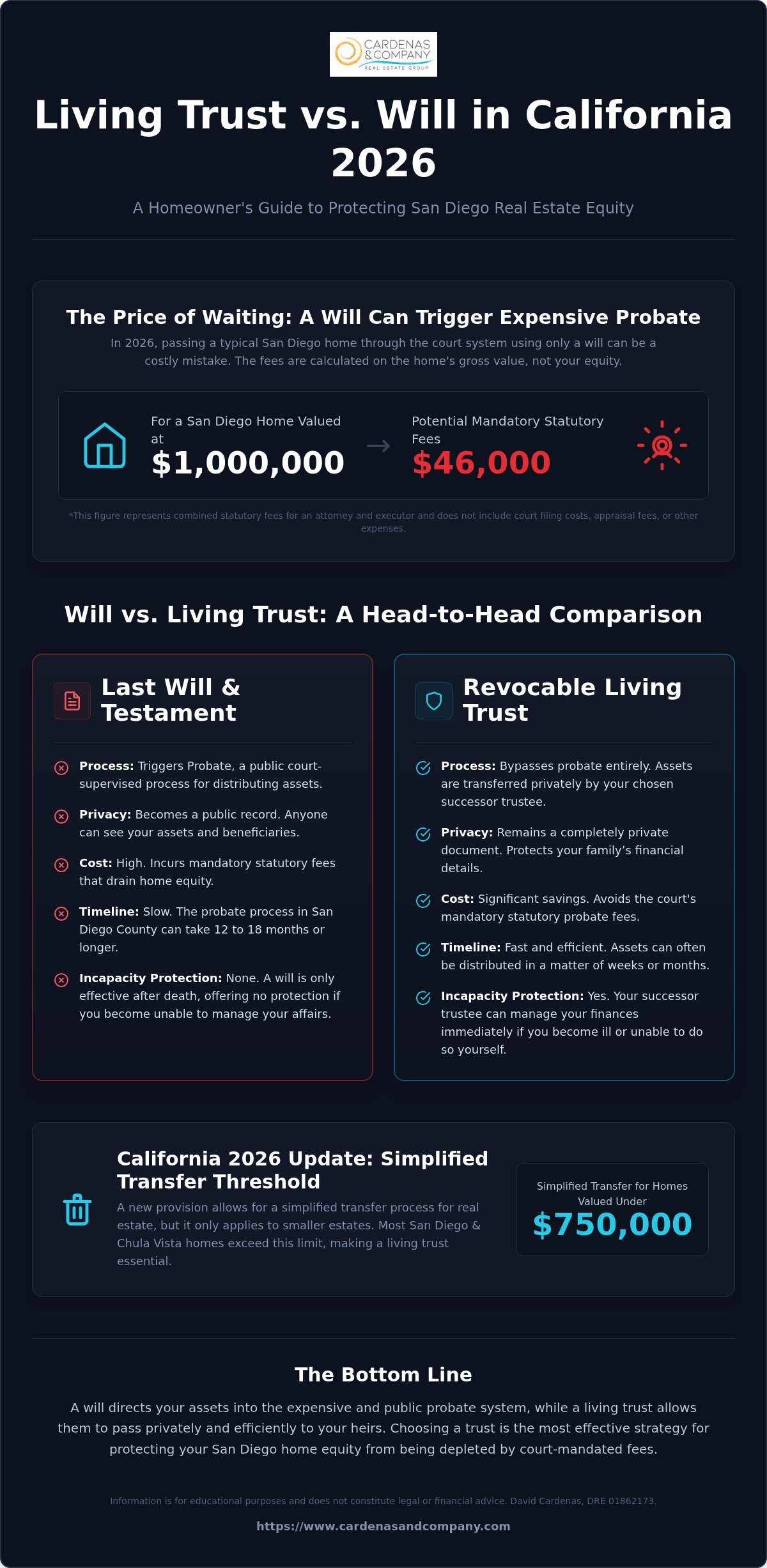
Did you know that in 2026, a $1,000,000 home in San Diego could cost your family $46,000 in mandatory statutory fees just to pass through the court system? This staggering figure doesn't even account for court filing costs or appraisal fees. When you weigh a living trust vs will in California 2026, you aren't just choosing a document; you're deciding how much of your wealth actually reaches your heirs. Most families assume a will provides total protection, but in reality, it often acts as a public invitation to probate.
We know the weight of trying to protect your legacy in a high-cost market like Chula Vista. Probate is the court-supervised process of distributing a deceased person's assets, and it's often slow, expensive, and entirely public. This guide clarifies the critical differences between these two estate planning tools so you can avoid court intervention and keep your family's financial details private. We will examine the new 2026 small estate thresholds, the $750,000 simplified transfer limit for real estate, and the specific strategies needed to secure your San Diego property for the next generation.
Key Takeaways
- Distinguish the legal mechanics of a living trust vs will in California 2026 to ensure your assets transfer privately without court interference.
- Understand the high cost of probate—the court-supervised process of asset distribution—where mandatory fees are calculated on your home's gross value rather than your actual equity.
- Identify how the 2026 simplified transfer threshold for homes valued under $750,000 provides a potential shortcut for smaller estates.
- Discover how a living trust maintains your family's privacy by keeping your financial records and inheritance details off the public record.
- Learn to integrate these tools into a broader San Diego wealth strategy that protects your home equity from being drained by administrative costs.
Table of Contents
Understanding Wills and Living Trusts in the 2026 California Landscape
Choosing between a living trust vs will in California 2026 represents the difference between a private family matter and a public court proceeding. While both documents aim to distribute your assets, they take radically different paths to reach that goal. A will acts as a letter of instruction addressed to a probate judge. In contrast, a revocable living trust is a private contract that holds your assets while you're alive and dictates their transfer after you pass.
The Role of the Will in 2026
Wills only take effect after your death. They require a judge's validation through probate, which is the court-supervised process of distributing a deceased person's assets. In San Diego, this process is often slow and burdensome. Because the court handles the distribution, your will becomes a public record. Any person can access the details of your estate, including the value of your Chula Vista property and the names of your beneficiaries.
A significant downside of a will is its lack of protection during your lifetime. If you become incapacitated or unable to manage your finances, a will offers no help. Your family might face a costly court conservatorship just to handle your property taxes or mortgage payments. This creates unnecessary stress and expense during an already difficult emotional time.
The Power of the Revocable Living Trust
A trust provides a seamless transition of authority. To understand the legal structure, you can learn more about What is a Trust? to see how it functions as a fiduciary arrangement. When comparing a living trust vs will in California 2026, the trust stands out as the proactive choice for wealth preservation. It bypasses the court system entirely, allowing your successor trustee to manage your affairs without a judge's permission.
Privacy remains a top priority for our clients. A trust keeps your financial life off the public record, ensuring your neighbors or predatory solicitors don't see what you've left behind. For homeowners in high-value areas like Otay Ranch or Eastlake, this privacy protects your heirs from unwanted attention and preserves the family's financial security.
- Immediate Effectiveness: Trusts work while you are alive and provide a plan if you become ill.
- Probate Avoidance: You skip the 12 to 18 month court delay common in San Diego County.
- Privacy: No public filings of your assets, debts, or beneficiary names.
- Cost Savings: You avoid the mandatory statutory fees that drain home equity in the probate system.
The Financial Reality: Why a Will is an Expensive Ticket to Probate
Probate is the court-supervised process of distributing a deceased person’s assets. It's often the most expensive financial mistake a San Diego homeowner makes. In California, statutory fees are set by law and based on the gross value of the estate, not the equity you've built. If you own a home in Chula Vista worth $800,000, probate fees can easily exceed $40,000. This money disappears to pay administrators and attorneys before your family receives a single dollar of their inheritance.
Deciding between a living trust vs will in California 2026 requires looking at these cold numbers. A will is essentially a ticket to the courtroom. While you might save a few dollars on the initial document setup, you're effectively shifting a massive financial and administrative burden onto your heirs. We believe in transparency, and the reality is that a will offers no protection against the state's mandatory fee schedule.
Calculating the Cost of Probate in San Diego
The court calculates fees based on the total appraised value of your property. It doesn't matter if you owe $600,000 on a $1,000,000 home; the state treats it as a million-dollar asset. For a $1,000,000 estate, the combined statutory fees for the attorney and executor total $46,000. These costs double because both parties are entitled to the same tiered percentage by law.
You can read more about the trade-offs in this Wills Vs. Trusts comparison from Forbes. Beyond these base fees, you must also pay a probate referee fee, which is 0.1% of the value of non-cash assets. Court filing fees of approximately $435 to open the case and another $435 for the final petition add even more to the final bill. Protecting your legacy requires a proactive wealth strategy that accounts for these mandatory drains on your equity.
The Time and Privacy Tax
Probate in San Diego County typically takes 12 to 18 months to conclude. During this time, your assets are frozen and your family's inheritance is stuck in legal limbo. Escrow, which is the neutral third party holding funds during a sale, cannot close on a property until the court grants specific permission. This delay often prevents families from selling a home when inventory levels are low and prices are high.
Privacy is another significant concern. Because probate is a public legal proceeding, anyone can view your filings. Family disputes, debt details, and your beneficiaries' addresses are aired in public courtrooms rather than behind closed doors. A trust avoids this exposure, keeping your private family matters out of the public eye.
Meta Title: Probate Costs in San Diego 2026: Why Wills Are Expensive
Meta Description: Learn why a will leads to $40,000+ in probate fees for an $800k San Diego home. Compare living trust vs will in California 2026 to save your equity.
Revocable Living Trusts: The Private Asset Bypass for Homeowners
A revocable living trust functions as a private contract that holds your assets for your benefit while you're alive. It keeps your family's financial business out of the public square and away from court oversight. When comparing a living trust vs will in California 2026, the most immediate benefit is the bypass of probate, which is the court-supervised process of distributing a deceased person's assets. A trust empowers your successor trustee, the person you appoint to manage your affairs, to handle your property without seeking a judge's permission.
In 2026, the privacy of a trust serves as a vital defense against predatory solicitations. Public probate records allow anyone to see your debts and the value of your assets, which often makes heirs targets for unscrupulous service providers. A trust keeps these details entirely private. This protection is especially valuable for San Diego families who want to ensure their transition into a new phase of life remains a personal matter of stability and security.
Beyond death, a trust provides essential protection if you become incapacitated. If you're unable to manage your affairs due to illness or injury, your successor trustee can step in immediately to pay bills and manage your Chula Vista property. Without this document, your family might be forced into a court-supervised conservatorship. This legal process is often slow, public, and drains the very equity you've worked hard to build. You can learn more about these protections at TrustSanDiego.com.
Asset Protection and Proposition 19
Proposition 19 fundamentally changed how property taxes, the annual tax based on your home's value, are reassessed when children inherit a family home. This law requires heirs to use the inherited property as their primary residence to maintain the existing tax basis. Even then, if the home's value has increased significantly, there may still be a partial reassessment. A properly structured trust helps you handle these complex rules. Protecting your San Diego property tax basis is essential for ensuring your home remains an affordable asset for the next generation.
Maintaining Control for Your Heirs
Trusts allow you to specify exactly how and when beneficiaries receive their inheritance. When evaluating a living trust vs will in California 2026, consider that a trust prevents heirs from receiving a large windfall before they are ready to manage it. You can include specific instructions for properties in Otay Ranch or Eastlake, such as keeping the home as a rental or selling it to fund a specific goal. This level of detail ensures your legacy provides long-term stability rather than a temporary financial peak.
How to Choose: Is Your Estate Rich Enough for a Trust in 2026?
The decision between a living trust vs will in California 2026 often comes down to a single question: do you own a home? If you own real estate in California, you have likely already crossed the financial line where a trust becomes an essential wealth-protection tool. For individuals passing away in 2026, the threshold for a simplified transfer of personal property is $208,850. While a simplified petition exists for homes valued at $750,000 or less, this process still involves court filings and legal delays.
You should consider a trust if your total assets exceed the $208,850 mark. This total includes your home's gross value, bank accounts, and life insurance policies. Remember that the court looks at the full market price of your home, not just the equity. Families with properties in multiple states face even higher risks. Without a trust, your heirs must open a separate probate case in every state where you own land. Probate is the court-supervised process of distributing a deceased person's assets, and doubling this process doubles the emotional and financial strain on your family.
The Military Relocation Factor
Military families PCSing (Permanent Change of Station) to San Diego frequently purchase homes using VA loans. These frequent moves across state lines make a centralized trust a necessity for managing global assets. Your trust acts as a single, private bucket for your property, BAH (Basic Allowance for Housing) savings, and military benefits. It ensures your estate plan remains consistent regardless of where your service takes you. This stability is vital for maintaining family security during the transition into a new phase of life. If you are active duty or a veteran, you can schedule a strategy session to see how these tools protect your unique benefits.
The Homeowner Checklist for 2026
Ask yourself these three questions to determine your next steps:
- Do you own property? Any primary residence or investment property in San Diego typically pushes an estate over the formal probate limit.
- Is privacy a priority? A trust keeps your financial details and beneficiary names off the public record, while a will becomes a public document.
- Do you want to maximize inheritance? Avoiding probate allows you to bypass the high closing costs and statutory fees that otherwise drain your home equity.
Integrating Estate Planning into Your San Diego Real Estate Strategy
Real estate serves as the anchor for wealth in most San Diego households. It is not a static asset; it is a dynamic investment that requires proactive management. We've seen many homeowners treat estate planning as a one-time task. However, asset protection is a continuous strategy that must adjust as your property value grows. When you weigh a living trust vs will in California 2026, you are choosing whether to protect your hard-earned equity or leave it vulnerable to the state.
Radical transparency is part of our process. Maintaining a trust requires ongoing diligence. Forgetting to fund a new asset into the trust can leave that specific property exposed to the very court system you tried to avoid. While a trust is a powerful tool, it only works if your real estate strategy and legal documents remain in sync.
Maximizing Equity in the South Bay
The Chula Vista Bayfront project is currently driving significant value increases for local homes. This massive development isn't just changing the skyline; it's boosting the home equity of thousands of South Bay residents. To protect this surging equity, your trust must reflect current market values and your specific family goals. We recommend reviewing your trust whenever you buy, sell, or refinance a property to ensure the title is correctly held.
Refinancing often involves escrow, which is a neutral third party holding funds and documents during a transaction. Lenders sometimes require you to move the property out of the trust temporarily during this phase. If you don't move it back, you've effectively canceled your protection from probate, the court-supervised process of distributing a deceased person’s assets. In a market where inventory levels are tight, preserving your home as a stable family asset is more important than ever.
Your Next Steps with Cardenas & Company
We view real estate as a tool for securing your family's future, not just a transaction. Our "Trusted Advisor" approach helps you see the big picture of your wealth beyond the closing costs, the fees paid at the end of a real estate transaction, of a single sale. We collaborate with your legal and financial teams to ensure your real estate holdings are fully integrated into your estate plan. You can read more about Protecting Your San Diego Home as an Asset on our blog.
Estate planning is about the peace of mind you have today. By aligning your property titles with your long-term goals, you ensure that your property taxes and home equity remain protected for your heirs. We are here to help you make these decisions with clarity and confidence.
Meta Title: Real Estate & Estate Planning San Diego 2026
Meta Description: Integrate your San Diego real estate strategy with a living trust. Protect Chula Vista home equity and avoid probate. Start your wealth strategy.
Bottom Line:
A living trust is the most effective tool for keeping your San Diego home equity out of the public probate court. Proper planning ensures your family’s wealth transitions privately and remains intact for the next generation.
We invite you to a strategy session with David & Angela Cardenas and the Cardenas & Company Real Estate Group to discuss your wealth protection goals. Visit us at cardenasandcompany.com or TrustSanDiego.com to get started.
Information is for educational purposes and does not constitute legal or financial advice. David Cardenas, DRE 01862173.
Securing Your Family’s San Diego Legacy
Protecting your wealth requires moving beyond simple documents to a comprehensive strategy. The choice between a living trust vs will in California 2026 determines whether your home equity stays with your heirs or is consumed by the court system. Probate fees are calculated on your property's gross market value; this means a million-dollar home can cost your family tens of thousands in mandatory fees. By establishing a trust, you maintain total privacy and ensure your successor trustee can manage your assets without a judge’s intervention. This is especially critical in high-growth areas like Chula Vista, where surging equity deserves a dedicated layer of protection. We provide over 25 years of market expertise and specialized support for military families to help you Schedule a Strategy Session at TrustSanDiego.com.
Bottom Line: A living trust is the primary vehicle to bypass the expensive and public California probate process. Proactive estate planning secures your home equity and provides your family with a clear, private path forward.
We invite you to a strategy session with David & Angela Cardenas and the Cardenas & Company Real Estate Group to discuss your wealth protection goals. Visit us at cardenasandcompany.com or TrustSanDiego.com.
Information is for educational purposes and does not constitute legal or financial advice. David Cardenas, DRE 01862173.
Frequently Asked Questions
Is a living trust better than a will in California in 2026?
A living trust is generally superior for San Diego homeowners because it bypasses probate. Probate is the court-supervised process of distributing a deceased person’s assets. While a will only dictates who receives property after death, a trust manages your assets while you are alive and after you pass. This choice between a living trust vs will in California 2026 ensures your family avoids public court records and expensive statutory fees.
How much does an estate have to be worth to go to probate in California in 2026?
In 2026, estates with personal property valued over $208,850 must generally undergo formal probate. However, real property has a different threshold. Under Assembly Bill 2016, a primary residence valued at $750,000 or less may qualify for a simplified transfer process. If your San Diego home exceeds this value, a full probate is likely required unless you have a trust in place to bypass the court system entirely.
Does a will avoid probate if I own a home in San Diego?
No, a will does not avoid probate. In fact, a will is a legal instruction to the probate court. Because a will is a public document, a judge must validate it before any assets are distributed to your heirs. If you own a home in neighborhoods like Otay Ranch or Eastlake, your property will likely be stuck in the court system for 12 to 18 months before your family can take ownership.
Can I change my revocable living trust after I sign it?
Yes, you maintain full control to amend or revoke your trust at any time as long as you have the mental capacity to do so. This flexibility is a core benefit of a revocable living trust. You can add new properties, change beneficiaries, or appoint a different successor trustee as your family situation changes. We recommend reviewing your trust during significant life events or when inventory levels in the market affect your investment strategy.
What is a pour-over will and why do I need one with my trust?
A pour-over will acts as a safety net for any assets you forget to title in the name of your trust. It instructs the court to "pour" those remaining assets into your trust after you pass. While this document is essential, any assets handled by a pour-over will may still have to go through probate. To avoid this, you must ensure your San Diego real estate is correctly funded into your trust during your lifetime.
How long does probate take in San Diego County?
Probate in San Diego County typically takes between 12 and 18 months to conclude. This timeline can stretch longer if the court is backlogged or if family disputes arise. During this period, your heirs cannot sell the home or access the equity without court permission. This delay often creates financial hardship, especially when trying to manage ongoing property taxes or mortgage payments during the lengthy legal proceedings.
Can a military family use a California living trust if they move out of state?
Yes, military families can maintain their California trust even after a PCS move out of state. The trust remains a valid legal entity, but you should have it reviewed by a professional in your new location to ensure it complies with local statutes. For families stationed at Naval Base San Diego who own local property, a California-based trust is often the best way to manage their West Coast assets from afar.
What are the statutory probate fees for an $800,000 home?
For an $800,000 home, the combined statutory fees for the attorney and the executor total $38,000. These fees are set by California law and are calculated on the gross value of the property, not your equity. This means even if you have a large mortgage, the court takes its percentage from the full market price. This staggering cost is a primary reason why comparing a living trust vs will in California 2026 is vital for wealth protection.
Bottom Line:
A living trust is the most effective tool for keeping your San Diego home equity out of the public probate court. Proper planning ensures your family’s wealth transitions privately and remains intact for the next generation.
We invite you to a strategy session with David & Angela Cardenas and the Cardenas & Company Real Estate Group to discuss your wealth protection goals. Visit us at cardenasandcompany.com or TrustSanDiego.com to get started.
Information is for educational purposes and does not constitute legal or financial advice. David Cardenas, DRE 01862173.
Disclaimer
The information provided on this blog is for educational and informational purposes only and does not constitute legal, financial, or investment advice. While we strive for accuracy, real estate markets and insurance regulations (including Living Trusts and IUL strategies) are subject to change. David Cardenas (DRE 01862173) is a licensed real estate salesperson; however, this content does not create an agency relationship. Please consult with a qualified attorney or tax professional regarding your specific situation.