
Most San Diego homeowners treat their property sale as a simple transaction, but in 2026, viewing it as a strategic wealth transition is the only way to avoid leaving six figures on the table. You've likely watched the median home price in San Diego County climb to $1,085,000 and wondered if high interest rates have sidelined your best buyers. It's natural to feel a sense of hesitation when local inventory levels sit between 2.2 and 3.0 months, making the question of how to sell a house in San Diego feel like a high-stakes gamble.
We're here to replace that anxiety with a transparent, no-fluff roadmap designed to maximize your net proceeds and protect your financial legacy. This guide provides the clarity you need on negotiable commissions and the 3.33% California state tax withholding while ensuring a smooth legal transition of your asset. We'll examine the specific impacts of the Chula Vista Bayfront project on South Bay values and outline the exact steps to secure your long-term stability in this resilient market.
Key Takeaways
- Leverage 2026 market dynamics and current inventory levels, including the impact of the Chula Vista Bayfront project, to time your sale for maximum leverage.
- Discover how to sell a house in San Diego using a strategic 5-step roadmap that prioritizes high-visibility marketing and precision pricing.
- Identify high-ROI property preparations that directly increase your final net proceeds, which is the actual cash you pocket after all expenses are paid.
- Gain full transparency on Real Estate Sales Commissions and brokerage transaction fees, which are flat administrative costs, to accurately calculate your home equity.
- Protect your family’s financial future by moving sale proceeds into a Living Trust; this is a legal document that holds your assets to ensure they are shielded.
Table of Contents
Analyzing the 2026 San Diego Real Estate Market Dynamics
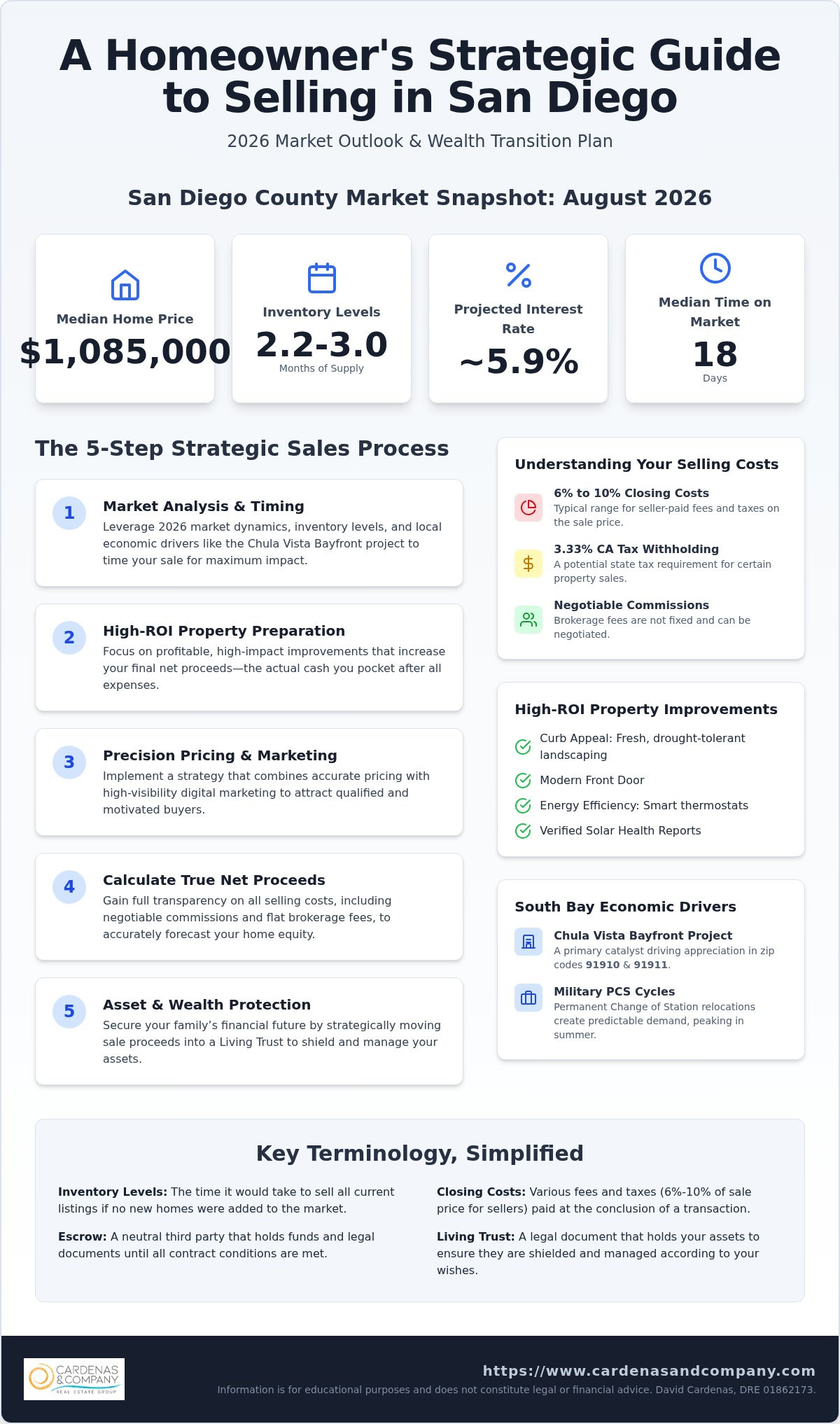
Success in today's market requires a cold, hard look at the data rather than relying on outdated headlines. As of August 2026, the median home price in San Diego County holds steady at $1,085,000. While prices remain high, the pace of the market has shifted. Understanding how to sell a house in San Diego now depends on your ability to interpret inventory levels. Inventory levels represent the number of months it would take to sell all current listings if no new homes were added to the market; currently, San Diego sits between 2.2 and 3.0 months of supply.
This inventory range indicates a balanced market that slightly favors sellers, but the days of automatic multiple offers have passed. We're seeing a direct correlation between interest rates and buyer urgency. With rates projected to settle near 5.9% by the end of 2026, demand in mid-tier neighborhoods like Serra Mesa and Mira Mesa is stabilizing. However, buyers are more discerning now. They often push back on properties that don't show perfectly or are priced based on 2024 expectations.
Inventory Levels and Buyer Competition
In Chula Vista, the gap between active listings and pending sales is widening in specific zip codes. While the median time on market across the county is 18 days, this is a trailing indicator that doesn't account for the current week's sentiment. High-demand micro-markets are still seeing quick turnarounds, but sellers must account for closing costs early in their planning. Closing costs are the various fees and taxes paid at the conclusion of a real estate transaction, typically ranging from 6% to 10% of the sale price for San Diego sellers. We track these shifts daily to ensure our clients don't get stuck with a stagnant listing.
Local Economic Drivers in South Bay
The San Diego's economic landscape is heavily influenced by large-scale infrastructure and a robust military presence. The Chula Vista Bayfront project serves as the primary catalyst for South Bay appreciation, transforming local property from residential holdings into high-demand coastal assets. This development, alongside the Amara Bay project, is creating a significant ripple effect on equity for homeowners in the 91910 and 91911 areas.
Seasonal demand is also tied to military PCS cycles. A PCS, or Permanent Change of Station, is the scheduled relocation of service members and their families to a new duty station. This influx of buyers often peaks in the summer months, providing a predictable window for those looking to exit the market. We integrate these local economic realities into every wealth strategy to ensure you aren't just selling a home, but capturing the maximum value of your investment.
Strategic Property Preparation: Maximizing Your Equity
Preparing your home for sale isn't about making it perfect; it's about making it profitable. Before your property hits the market, you must understand the role of Escrow. Escrow is a neutral third party that holds funds and legal documents until all conditions of the contract are satisfied. This process ensures that neither the buyer nor the seller is at risk during the exchange. When considering how to sell a house in San Diego for the highest possible price, your preparation strategy dictates your final net proceeds.
We've seen many sellers waste thousands on "pre-listing" renovations that don't return their cost. In 2026, San Diego buyers prioritize functional integrity and aesthetic simplicity over luxury fads. Professional photography is no longer an optional upgrade; it's the baseline requirement for a top-tier debut. High-quality imagery attracts the online traffic necessary to drive physical showings, which is where the real negotiation begins. If you're unsure where to start, a personalized property assessment can help identify which specific tasks will move the needle for your equity.
High-Impact Improvements for San Diego Homes
Curb appeal remains the strongest driver of first impressions in established neighborhoods like Del Cerro and Allied Gardens. Fresh, drought-tolerant landscaping and a modern front door often yield a higher return than a full kitchen remodel. In 2026, energy-efficient upgrades like smart thermostats and verified solar health reports are high on buyer wishlists. For a detailed room-by-room breakdown, check out our guide on 5 Staging Tips to Sell Your Chula Vista Home Fast.
The Cost of Selling 'As-Is'
Radical transparency is required when discussing "we buy houses" or iBuyer offers. These companies provide convenience but often at a steep cost to your family's wealth. Selling to an iBuyer typically sacrifices 10% to 15% of your home's fair market value in exchange for the convenience of a rapid close and no repairs. While an as-is sale might make sense for a distressed asset or a complex Probate situation, most families are better served by a traditional listing. Probate is the court-supervised legal process of validating a will and distributing a deceased person's estate.
When you choose a traditional listing, you maintain control over the process and the final price. You should also consider the tax implications of selling a home to ensure you're maximizing your actual take-home pay. Most sellers can exclude up to $250,000 (or $500,000 for married couples) of gain from their income, provided the home was their primary residence. We focus on these technical details to ensure your transition into the next phase of life is financially secure.
Calculating the Real Cost of Selling in San Diego
Determining your actual take-home pay requires looking past the sales price to the gritty details of your settlement statement. Real Estate Sales Commissions are the fees paid to professionals for marketing and negotiating the sale; in 2026, these are fully negotiable, typically ranging from 2% to 3% for the listing side. You must also account for Brokerage Transaction Fees, which are flat charges for administrative compliance and document storage. We believe in radical transparency, so you should expect total closing costs to land between 6% and 10% of the final sale price.
Market movements are often measured in Basis Points. Basis Points are one one-hundredth of a percentage point, and even a small shift of 25 or 50 points in mortgage rates can significantly impact what a buyer can afford to pay for your home. Beyond commissions, you'll face property taxes and potential supplemental tax bills. In San Diego, the effective tax rate usually sits between 1.1% and 1.25%, and escrow will prorate these amounts based on your specific closing date. You can find more about your legal obligations in California's official disclosure guide for home sellers.
Closing Costs and Seller Concessions
The seller typically covers the owner's title insurance policy, which protects the buyer from future ownership disputes and costs between $1,000 and $2,500. Additionally, the San Diego County Documentary Transfer Tax is $1.10 per $1,000 of the sale price. In the 2026 environment where rates hover near 5.9%, many sellers are offering concessions to help buyers buy down their interest rates. We recommend running a 'net sheet'—a line-by-line estimate of your proceeds—before you even list your property to avoid surprises at the finish line.
The Hidden Costs of Moving
For the many military families in San Diego and Chula Vista, relocation costs can add up quickly during a PCS cycle. If you are selling an investment property rather than a primary residence, the 3.33% California state capital gains withholding (Form 593) will be a major factor in your liquidity. This is a mandatory prepayment of state taxes collected at the close of the sale. To get a clear picture of your starting point, visit What's My Chula Vista Home Really Worth? to begin a professional valuation. Understanding these numbers is the first step toward securing your financial future and ensuring your equity works for you.
Download
Download as HTML
The 5-Step San Diego Sales Process
Our structured approach ensures you aren't just reacting to the market but leading it. When you master how to sell a house in San Diego, you realize the first 14 days are your most valuable asset. During this window, buyer interest peaks and the highest quality offers typically surface. We execute a high-visibility marketing plan across San Diego to ensure every potential buyer sees your property's value immediately.
Reviewing offers requires a focus on 'certainty of closing.' A high offer with weak financing often nets you less than a solid, well-structured bid with fewer contingencies. Once you enter Escrow, we manage the inspections, appraisals, and mandatory disclosures to keep the timeline on track. The process concludes with the final signing and the distribution of your sale proceeds, marking the successful transition of your asset into liquid wealth.
Pricing Strategy for 2026
Overpricing in a cooling market is a recipe for a stale listing. Buyers in 2026 are highly sensitive to value, and a property that lingers past the median 18 days on market often faces aggressive price cuts. If you're selling to purchase a new home, you must also consider your new Amortization schedule. Amortization is the process of paying off a debt over time through regular payments of principal and interest. Setting a realistic price from day one preserves your equity and your negotiating power.
Navigating the Disclosure Process
California law is notoriously strict regarding property disclosures. You must reveal all known material facts about the property to protect yourself from future legal claims. This is especially critical if you are handling a Probate sale. Probate is the legal process of distributing a deceased person's estate under court supervision. We act as your meticulous advocate during this phase, managing buyer repair requests and ensuring all paperwork meets professional standards. To see how we manage these complexities for our clients, you can explore our full suite of listing services.
Wealth Strategy: Beyond the Sale
The moment you sign the final closing documents is not the end of your journey; it's the start of your next financial chapter. Successfully learning how to sell a house in San Diego in 2026 means you now hold a significant amount of liquid capital that requires a protective shield. We view every sale as a wealth transition that demands a clear plan for reinvestment and asset protection. Without a strategy, your hard-earned equity can quickly erode through taxes or poor secondary investments.
Our role as your Trusted Advisor extends past the close of Escrow. We help you evaluate the 'step-up in basis' tax benefits that are vital for long-term family legacy planning. A step-up in basis is the adjustment of an inherited asset's value to its current market price at the time of the owner's death, which can significantly reduce future capital gains taxes for your heirs. Partnering with Cardenas & Company ensures you have a relationship-driven team focused on your total financial health rather than a single commission check.
Asset Protection and Living Trusts
Selling a home is the most logical time to update your estate plan. If your property was not already held in a Living Trust, your liquid proceeds are now more vulnerable to legal claims or the complexities of Probate. A Living Trust is a legal document that allows you to manage your assets while you are alive and ensures they are distributed according to your wishes without court intervention after you pass. For a deeper look at protecting your equity, review our guide on What is a Living Trust & Why San Diego Homeowners Need One.
Your Next Move: Buying or Investing
Whether you are planning a strategic 'buy-up' into a larger home or a 'downsize' into a more manageable property in Chula Vista, timing is everything. For those selling rental properties, we can facilitate a 1031 exchange to defer your tax liabilities. A 1031 exchange is a tax-deferment tool that allows you to reinvest sale proceeds into a "like-kind" investment property without immediately paying capital gains taxes. When you are ready for the next phase, see our Buying a Home in San Diego: The 2026 Strategic Guide to ensure your next purchase is as sound as your last sale.
Bottom Line: Selling your San Diego home is the beginning of your next financial chapter rather than the end of a transaction. Integrating estate planning with your real estate strategy ensures your hard-earned equity serves your family for generations.
We invite you to a warm, zero-pressure strategy session to discuss your unique situation and wealth goals. Connect with David & Angela Cardenas and the Cardenas & Company Real Estate Group today at cardenasandcompany.com or TrustSanDiego.com.
Information is for educational purposes and does not constitute legal or financial advice. David Cardenas, DRE 01862173.
Secure Your Financial Legacy in San Diego
Mastering the intricacies of the 2026 market requires more than a simple listing; it demands a comprehensive wealth strategy. You now understand how current inventory levels and projects like the Chula Vista Bayfront influence your home's value, and why transparency regarding closing costs is vital for your bottom line. By focusing on high-ROI preparations and integrating a Living Trust, you've moved beyond the basics of how to sell a house in San Diego to truly protecting your family's future.
Our team brings over 25 years of local experience to your side, serving as dedicated advocates for families and military relocation experts. We prioritize your long-term stability over high-volume sales, ensuring every technical detail is handled with precision and empathy. You deserve a partner who views your home sale as a vital means to a human end, securing your transition into a new phase of life with confidence.
Bottom Line: A successful home sale in the current market relies on precise data and proactive asset protection. Viewing your property as a strategic wealth component ensures you maximize your equity while securing long-term financial stability.
We invite you to a warm, zero-pressure strategy session with David & Angela Cardenas and the Cardenas & Company Real Estate Group. Connect with us at cardenasandcompany.com or TrustSanDiego.com to begin your journey.
Information is for educational purposes and does not constitute legal or financial advice. David Cardenas, DRE 01862173.
Frequently Asked Questions
How long does it take to sell a house in San Diego in 2026?
The median time on the market in San Diego County is currently 18 days as of June 2026. This metric tracks the time from the initial listing date to the day a seller accepts a formal offer. While well-priced properties in high-demand pockets move quickly, you should prepare for a total timeline of 30 to 45 days to account for the full Escrow period. Escrow is a neutral third party that holds funds and legal documents until all conditions of the sale are satisfied.
What are the average closing costs for a seller in San Diego County?
Sellers in San Diego typically pay between 6% and 10% of the final sale price in total closing costs. These expenses include the San Diego County Documentary Transfer Tax of $1.10 per $1,000, title insurance, and negotiated commissions. We provide a transparent line-by-line net sheet before your home hits the market so you can accurately calculate your final proceeds and protect your home equity.
Do I need to fix everything before listing my house for sale?
No, you should focus on high-ROI repairs that improve first impressions rather than exhaustive, expensive renovations. Prioritize curb appeal and ensure major systems like the roof and HVAC are in good working order to avoid complications during inspections. We help you identify which specific updates will move the needle for buyers in neighborhoods like Del Cerro or Allied Gardens without wasting your capital.
How do high interest rates affect my home's value in Chula Vista?
Interest rates directly influence buyer purchasing power, which can moderate the pace of price appreciation in areas like Chula Vista. With mortgage rates projected to settle near 5.9% by late 2026, demand remains steady but buyers are increasingly sensitive to small shifts in Basis Points. Basis Points are one one-hundredth of a percentage point used to measure changes in interest rates. A strategic pricing plan is essential to remain competitive as buyer budgets tighten.
What is the best month to sell a house in San Diego for the most money?
The summer months of May, June, and July typically yield the highest sale prices due to the peak of the military relocation cycle. Many families look to move during their PCS window to settle before the new school year begins. A PCS, or Permanent Change of Station, is the scheduled relocation of a service member to a new duty station. Capturing this motivated buyer pool often leads to stronger offers and more favorable terms for the seller.
Can I sell my San Diego home if it is currently in a Living Trust?
Yes, selling a property held in a Living Trust is a standard process that we manage frequently for our clients. A Living Trust is a legal document that holds your assets for your benefit during your lifetime and ensures their efficient transfer to your heirs. Selling as a trustee allows you to maintain control over the transaction while ensuring the proceeds are immediately protected within your established wealth strategy.
What happens if my home appraisal comes in lower than the offer price?
If an appraisal is lower than the agreed price, you can negotiate for the buyer to cover the gap in cash, lower your price, or meet in the middle. Low appraisals often occur when market values rise faster than the most recent comparable sales can document. We proactively provide appraisers with a detailed packet of data to justify your home's value, reducing the likelihood of a value dispute late in the process.
What are the tax implications of selling my primary residence in California?
Most sellers qualify for a federal exclusion of up to $250,000 in gain, or $500,000 for married couples, if the home was their primary residence. However, you must account for the mandatory 3.33% California state tax withholding (Form 593) on the gross sale price unless an exemption is filed. This withholding is a prepayment of state capital gains taxes collected at the close of the sale to ensure the state receives its portion of the transaction proceeds.
Bottom Line: Successfully learning how to sell a house in San Diego in 2026 requires a blend of local market data and a proactive wealth-building strategy. Understanding the technical details of the process allows you to maximize your proceeds while securing your family's long-term financial stability.
We invite you to a warm, zero-pressure strategy session with David & Angela Cardenas and the Cardenas & Company Real Estate Group. Connect with us at cardenasandcompany.com or TrustSanDiego.com to begin your journey.
Information is for educational purposes and does not constitute legal or financial advice. David Cardenas, DRE 01862173.
Disclaimer
The information provided on this blog is for educational and informational purposes only and does not constitute legal, financial, or investment advice. While we strive for accuracy, real estate markets and insurance regulations (including Living Trusts and IUL strategies) are subject to change. David Cardenas (DRE 01862173) is a licensed real estate salesperson; however, this content does not create an agency relationship. Please consult with a qualified attorney or tax professional regarding your specific situation.