
A strong San Diego offer isn’t automatically the highest one. This guide to how to buy a home in a competitive market San Diego buyers face starts with preparation, not panic. Set your budget and decide which terms matter before a showing makes you want to rewrite either one.
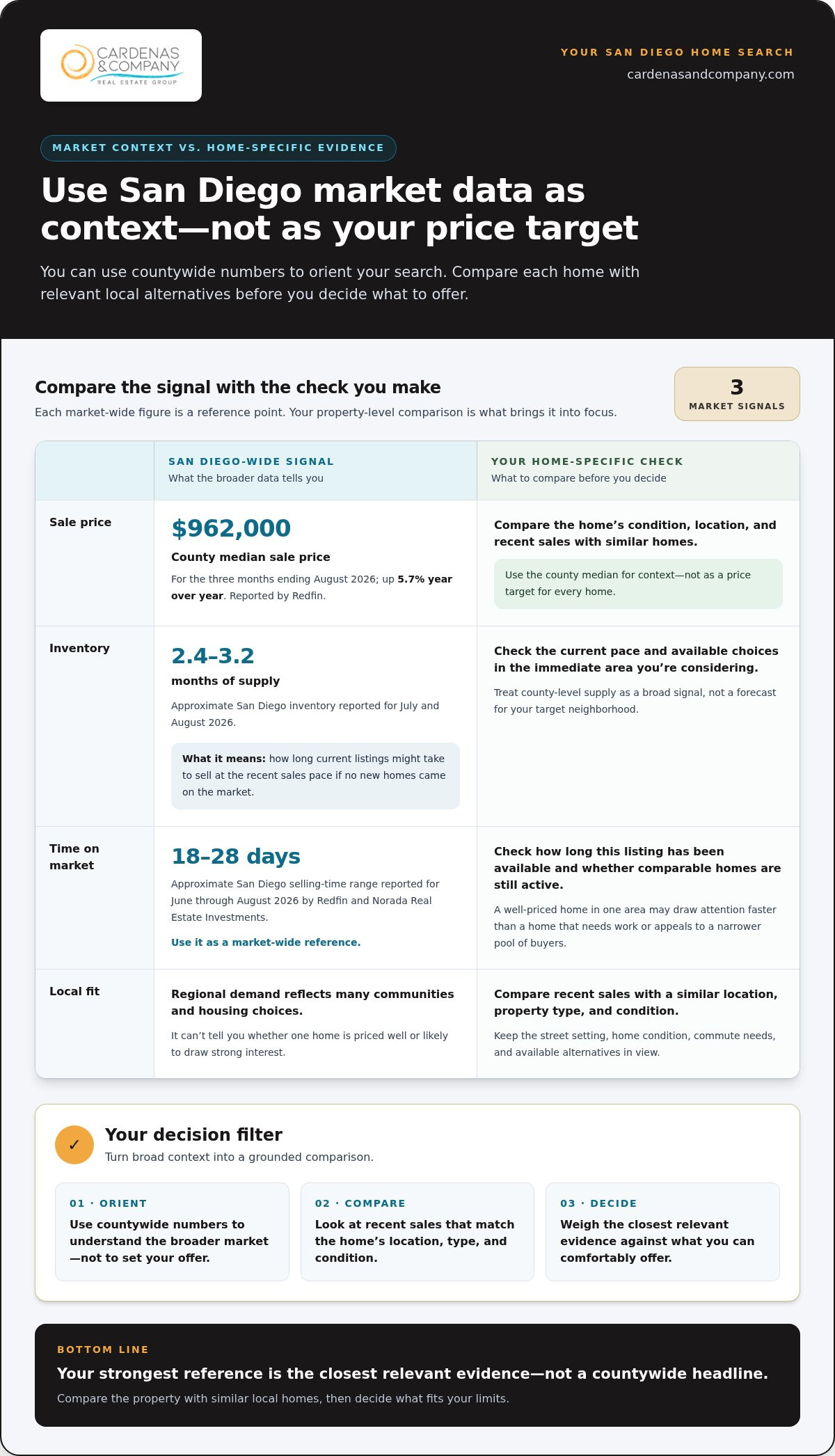
Redfin reported a San Diego County median sale price of $962,000 for the three months ending August 2026, up 5.7% year over year. That countywide figure gives you context, not a price target for every home. To assess a specific property, compare its condition, location, and recent sales with similar homes, then decide what you can comfortably offer.
Here, you’ll build a plan before touring, compare homes against your priorities, and weigh offer terms beyond the purchase price. You’ll also set a firm financial limit, understand the tradeoffs in your offer, and prepare for the next steps. The goal is a clear decision you can stand behind, whether you make an offer or keep looking.
Key Takeaways
- Learn how to buy a home in a competitive market San Diego buyers face by focusing on neighborhood-level conditions instead of broad market assumptions.
- Set your comfortable monthly housing budget and property priorities before touring, then treat lender pre-approval as a separate part of preparation.
- Compare homes using relevant recent sales, verified property details, condition, location fit, timing, and unresolved questions.
- Weigh changes to price, timing, or requested terms against your financial limits and the protections that matter to you.
- Use tailored buyer representation to connect your priorities with local context across San Diego, Chula Vista, and the South Bay.
Table of Contents
What makes buying in San Diego’s competitive market different?
A market feels competitive when buyer demand, available homes, and the terms sellers consider put pressure on your decisions. That doesn’t mean every San Diego home receives multiple offers. It means you need to understand the property and its local alternatives before deciding how quickly to act or which terms make sense for you.
As you consider where to live, keep San Diego’s varied employment base in mind. Defense, tourism, and technology are among the industries described in the broad Economy of San Diego overview, and they help shape where people seek housing. Regional demand alone can’t tell you whether a particular home is priced well or likely to draw strong interest.
Separate countywide context from property-level evidence. Start with the home’s location, condition, and recent comparable sales, then look at the current pace and available choices in the immediate area. A broad market headline is useful context, not a substitute for comparing the home with relevant alternatives.
How do San Diego neighborhoods change your home search?
Your shortlist should reflect the places you need to reach, the space your household uses, and the setting you want day to day. A search across San Diego, Chula Vista, and the South Bay can involve different commute routes and neighborhood tradeoffs. Compare your actual travel needs and the homes available in each area rather than treating one community as interchangeable with another.
Before touring, write down your location priorities: commute, household needs, and preferred setting. Then use a community guide to compare how each area’s location and lifestyle fit your longer-term plans.
What should you learn from current local market data?
For context, market reports put San Diego inventory at approximately 2.4 to 3.2 months of supply in July and August 2026, citing verified local housing insights and Cardenas & Company Real Estate Group. “Months of supply” estimates how long current listings would take to sell at the recent sales pace if no new homes came on the market. Treat it as a broad signal, not a forecast for your target neighborhood.
Redfin and Norada Real Estate Investments reported San Diego homes selling in approximately 18 to 28 days during June through August 2026. Use that range as a market-wide reference. A well-priced home in one area may attract attention faster than a property elsewhere that needs work or appeals to a narrower pool of buyers.
For a specific home, compare recent sales with similar location, property type, and condition. Check how long the listing has been available and whether comparable homes are still active. Countywide figures can’t account for a street’s setting, a property’s condition, or differences between San Diego, Chula Vista, and other South Bay communities. Use broad data to orient yourself, then base your decision on the closest relevant evidence.
How can you prepare to buy a San Diego home before you tour?
A clear plan helps you compare homes across San Diego, Chula Vista, and the South Bay without letting a compelling showing reset your financial limits. Start with your budget and property priorities, then organize your financing documents and search criteria before scheduling tours.
Use this sequence to get ready:
- Set your comfortable monthly budget. Decide what housing payment fits your household after regular expenses and savings goals.
- Talk with a lender. Learn what purchase range and loan options may fit your finances. Keep that estimate separate from the amount you personally want to spend each month.
- Define your non-negotiables. Write down what your household needs, such as enough usable space or a location that works for your commute.
- Sort flexible preferences. Identify what you’d consider changing, such as finishes or a preferred setting, so you don’t treat every preference as essential.
- Get ready to tour. Keep your criteria and lender materials organized, and note what you want to learn about each property during a showing.
How do you set a budget that protects your financial comfort?
A lender’s pre-approval is an assessment of the financing you may qualify for based on information the lender has reviewed. It isn’t a recommendation to spend the full amount. Review your monthly budget separately and account for ownership costs tied to the specific property, including taxes, insurance, utilities, and maintenance.
Those costs vary by property and location, so use property-specific information rather than a countywide estimate. Set your maximum purchase price and comfortable monthly payment before touring. If a home draws strong interest, those limits give you a clear reference for deciding whether to proceed.
Which documents and decisions can you prepare early?
Organize the income, asset, and lender documents needed for your financing conversation. Having current records accessible helps you discuss your situation and understand the next steps. Loan program details depend on your circumstances and the lender, so don’t assume another household’s financing terms will fit yours.
If you’re moving for military service, account for relocation timing and household needs as you organize your search. A move to San Diego or Chula Vista can involve location decisions alongside purchase planning, so keep those priorities visible as you prepare.
If you want to talk through your priorities and local search plan, explore buyer representation in San Diego at your own pace.
How do you compare San Diego homes and build a thoughtful offer?
Compare each property with your needs, verified details, and recent sales of similar homes. Price matters, but it doesn’t tell you whether the home’s condition, location, or terms make sense for your household. Keep a written comparison so a polished showing or asking price doesn’t become your only reference point.
Use a table to track what you know and what still needs attention. Separate confirmed property information from open questions, then consider how each difference affects your decision.
| Factor |
What to compare |
| Price |
Asking price, relevant comparable sales, and your maximum. |
| Condition |
Verified property details and questions that could affect your plans. |
| Location fit |
How the setting supports your commute, household needs, and daily routine. |
| Timing |
Whether the proposed closing schedule works with your move. |
| Uncertainties |
Information you still need to assess the home or proposed terms. |
A strong offer can reflect more than price. Your financing readiness, proposed timing, and requested terms also shape what the seller reviews. The highest offer isn’t automatically your best choice if it stretches your finances or depends on tradeoffs you don’t want. Use your comparison to decide what an offer can reasonably express about your interest and limits.
Which offer terms deserve a careful comparison?
Price is the amount you offer to pay. Your financing approach describes how you plan to fund the purchase, while closing timing sets the proposed schedule for completing it. A contingency is a contract condition that can affect how the transaction proceeds. Each term may affect how the seller evaluates your offer, but changing one can carry financial or practical consequences.
For example, a shorter timeline may conflict with your move, while changing a requested contingency may leave you with more uncertainty. Consider the purpose of each term and how it fits the property and your circumstances. A term isn’t automatically stronger just because it sounds decisive.
How can you set a firm limit before making an offer?
Set your limit using your budget, your evaluation of the property, and your tolerance for uncertainty. Decide what would make you stop, such as a price above your limit or a term that asks you to accept a risk you don’t understand. This boundary gives you a useful reference if you hear that the seller is considering other offers.
A considered offer reflects your analysis and priorities. An impulsive offer reacts to pressure without a clear reason for its price or terms. No strategy can guarantee acceptance or predict another buyer’s offer. Your goal is to make a decision you can explain and support, whatever the seller decides.
How can you negotiate without taking on more risk than you intend?
Seller feedback can help you decide what to do next, but it doesn’t change your budget or make every requested term right for you. Before revising an offer, compare the new information with your priorities, your evaluation of the home, and the limits you set before emotions entered the conversation.
Your buyer representative can communicate with the listing side and relay information shared about the seller’s preferences or offer process. Use that information to assess your choices, not to assume you know what another buyer will do. You can hold your terms, revise one part of the offer, or decide the property no longer fits. None of those choices guarantees acceptance.
What can you do when a seller receives competing offers?
First, reassess the home itself. If you’re considering a higher price, make sure the property details and relevant comparable sales support that decision, and that the new amount stays within your firm limit. If the price no longer works, you can choose not to increase it.
You can also review timing and requested terms. A schedule that better matches the seller’s needs may help if it works for your move, while changing a requested term could create more uncertainty for you. Treat each revision as a separate decision. You don’t have to change several terms just because the seller has other offers.
Ask your representative to relay what the listing side can share, then distinguish known information from assumptions. You may not learn another offer’s details or the seller’s final priorities. Keep your decision grounded in what you know about the home and what you’re prepared to accept.
How should you weigh speed against due diligence?
A prompt response can keep your offer moving, but speed doesn’t replace time to understand the property and contract terms. Review available condition information, identify questions that could affect your decision, and understand how any requested inspection or financing terms may affect your position. The details depend on the property, the offer, and your lender’s process.
A faster offer is not a substitute for informed consent. Before agreeing to revised terms, make sure you understand what changes, what uncertainty remains, and how the choice fits your finances and plans. If a term is unclear, pause for a plain-language explanation before you decide. No general tactic can replace understanding the specific offer in front of you.
Buying in a competitive San Diego market calls for deliberate choices under pressure, not matching every signal from the seller. You can act quickly and still keep your limits intact. A strong decision is one you can explain to yourself after the urgency of the moment has passed.
Discuss your San Diego home offer with a buyer representative
How can Cardenas & Company support your San Diego home purchase?
Buyer representation connects your priorities with the search, property comparisons, and offer decisions you make along the way. Cardenas & Company Real Estate Group helps you weigh local context and offer tradeoffs across San Diego, Chula Vista, and the South Bay without losing sight of what fits your household and finances.
That support matters when several decisions arrive close together. You can use one clear set of priorities to compare homes, identify what you still need to learn about a property, and consider whether an offer’s price and terms fit your plans. You remain in control of the decision. Guidance should make your choices easier to understand, not pressure you to act.
What does tailored buyer guidance look like in practice?
You bring your needs, preferred locations, and financial boundaries. Your representative helps organize those priorities and compare local options with you, so a home’s appeal doesn’t overshadow its practical fit. David Cardenas brings more than 25 years of experience in San Diego and Chula Vista real estate to that work.
Tailored guidance means discussing the tradeoffs that matter to you: whether a location fits your routine, whether property details raise questions, and whether proposed terms align with your priorities. You get clear explanations to inform your decision, not pressure to make an offer.
If your purchase connects to a military service move, include relocation timing and household needs in your plan. Cardenas & Company provides military relocation support alongside buyer representation, helping you consider local context as you prepare for a move to the region.
What should you do after deciding to move forward?
Bring your priorities, questions, and preferred communities into a direct conversation with Cardenas & Company Real Estate Group. The team is affiliated with Realty ONE Group Pacific and serves buyers across San Diego, Chula Vista, the South Bay, and greater Southern California. You can discuss your plans without treating the conversation as a commitment to make an offer.
Whether you’re comparing communities or ready to discuss a specific property, clarify what you need from your search. That gives your representative a practical starting point for guidance tailored to your situation.
Bottom Line
A sound plan for how to buy a home in a competitive market San Diego keeps your priorities connected to each decision, from choosing where to search through considering an offer. Local guidance can help you understand your options and tradeoffs, while the final decision stays yours.
If you’d like to talk through your goals or get buyer guidance for San Diego, Chula Vista, or the South Bay, you’re welcome to connect with the San Diego buyer guidance team at your own pace.
Bottom Line: Make your next move with clarity
Your next step doesn’t have to be an offer. It can be a focused conversation about what you want your purchase to make possible, which tradeoffs you can accept, and what you still need to learn before choosing a home. That clarity gives you a steadier foundation for how to buy a home in a competitive market San Diego.
Bring your questions, even if your plans are still taking shape. A thoughtful discussion can help you identify a useful next step without committing you to a timeline or a particular property.
Talk through your San Diego home-buying goals with our team
Whether you’re ready to begin a search or still weighing your options, you can move at a pace that respects your finances and priorities. The right decision is one you understand and feel prepared to stand behind.
Frequently Asked Questions
Is the highest offer always the strongest offer on a San Diego home?
No. A seller may weigh more than the offered price, including your financing readiness, proposed closing timing, and requested contract terms. Judge an offer by both its appeal to the seller and its fit for your finances and plans. A higher price may not suit you if it exceeds your limit or depends on terms you aren’t prepared to accept.
Can you make a competitive offer without waiving important protections?
Yes. You can make an offer that reflects your ability to proceed while keeping the protections you consider important. The right structure depends on your circumstances, the property, and the contract terms. Before changing a contingency or other condition, make sure you understand what it does and what uncertainty you’d take on. A competitive offer doesn’t require you to accept a risk you don’t understand.
What happens if an appraisal comes in below the agreed purchase price?
A low appraisal can create a gap between the appraised value and your agreed price, so review the result with your lender and representative. Depending on your financing and contract, possible next steps may include discussing a price change, considering whether you can cover a difference, or reviewing the terms that apply. Don’t assume one outcome is automatic. Understand the financial impact before agreeing to a change.
How does an escalation clause work when a home receives multiple offers?
An escalation clause describes how your offer may increase if the seller receives a competing offer, usually within a stated limit and under specified conditions. The wording matters: it should make clear what triggers an increase and how the competing offer is documented. A higher potential price can strengthen your offer, but it can also move you closer to your maximum. It can’t guarantee acceptance.
Can a seller accept a backup offer after choosing another buyer?
A seller may consider a backup offer while a purchase agreement with another buyer is in place. A backup offer generally sets out your position if the first transaction doesn’t proceed, but the contract terms determine how and when it could take effect. Before signing, understand what commitments you’re making and how your offer relates to the existing agreement. Your representative can explain the process for the specific transaction.
How long does it usually take to buy a home in San Diego?
There isn’t one reliable timeline for every San Diego purchase. Your search may take more or less time depending on your priorities, available homes, financing preparation, and whether an offer is accepted. After acceptance, the agreed contract schedule and the work needed to complete the transaction shape the next steps. You can prepare by organizing documents and deciding which property tradeoffs you’re willing to make before touring.
Can you buy a San Diego home while relocating from another city?
Yes. You can coordinate a home search from another city by setting location priorities, arranging property information and tours around your schedule, and keeping communication with your representative clear. If you’re relocating for military service, Cardenas & Company provides military relocation support. The team serves communities including San Diego, Chula Vista, Bonita, Del Mar, La Jolla, Otay Ranch, Carlsbad, Coronado, El Cajon, Santee, La Mesa, Lemon Grove, Encinitas, Imperial Beach, Oceanside, Poway, San Marcos, and Escondido.
Disclaimer
The information provided on this blog is for educational and informational purposes only and does not constitute legal, financial, or investment advice. While we strive for accuracy, real estate markets and insurance regulations (including Living Trusts and IUL strategies) are subject to change. David Cardenas (DRE 01862173) is a licensed real estate salesperson; however, this content does not create an agency relationship. Please consult with a qualified attorney or tax professional regarding your specific situation.