
When you purchase a condominium, you are not simply acquiring real estate; you are buying equity in an active corporation. Learning how to buy a condo in San Diego requires you to look past upgraded finishes and thoroughly examine the financial machinery operating behind the scenes.
You might worry that monthly dues averaging $300 to $600 will drain your purchasing power, or that deferred structural maintenance will trigger an unexpected special assessment. It's natural to feel hesitant when warrantability issues, pet limits, and strict lender questionnaires stand between you and homeownership.
You can move forward with complete certainty once you understand how to audit reserve studies, verify building compliance, and target financially stable communities. In this guide, you will learn the exact process to evaluate an association's health, secure loan approval without delays, and purchase a home that builds lasting wealth. Here is your roadmap to making a secure investment from offer to closing.
Key Takeaways
- Master the dual-approval mortgage process so you can verify that both your personal finances and the building meet conventional or VA warrantability guidelines.
- Audit association balance sheets, reserve study health, and mandatory structural disclosures to protect yourself from surprise special assessments.
- Understand the exact criteria for how to buy a condo in San Diego micro-markets that match your lifestyle while protecting long-term resale value.
- Protect your earnest money deposit by writing specific contractual contingencies that give you time to inspect HOA records before fully committing.
Table of Contents
What Should You Know Before Buying a Condo in San Diego?
Buying a condominium involves entering a Common Interest Development governed by California's Davis-Stirling Act. Unlike a traditional purchase where you acquire the dirt beneath your foundation, condo ownership divides real property into separate interests and common interests. Knowing what is a condominium under state law helps you understand that you are stepping into a collective business structure alongside your neighbors.
Before touring properties, review our guide on buying a home in San Diego to weigh property types against your wealth-building goals. When you master how to buy a condo in San Diego, you evaluate the governing homeowner association (HOA) with the same diligence you apply to the physical unit. Overlooking association bylaws or legal standing can trap you in expensive litigation long after escrow closes.
How Condominium Ownership Differs from Detached Homes
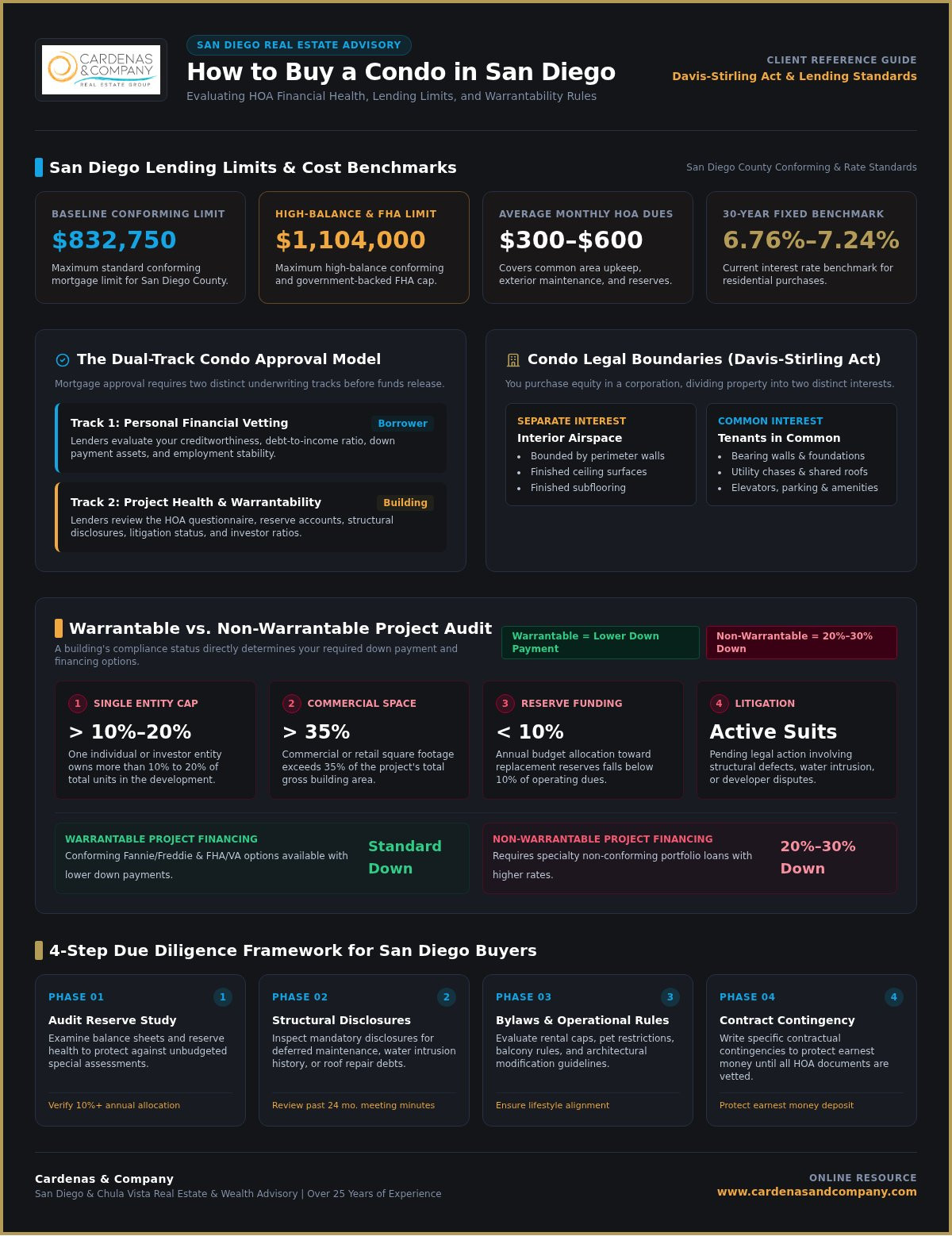
Your property deed grants you exclusive fee-simple title to the interior airspace bounded by your perimeter walls, finished ceilings, and subfloors. Everything outside that cubic volume belongs undivided to all unit owners as tenants in common. This shared infrastructure includes:
- Structural bearing walls, foundations, and building roofs
- Utility supply lines running through shared chases and hallways
- Community amenities, parking structures, and exterior elevators
Exterior maintenance responsibilities transfer from you to the association's hired property management team. You trade weekend yard chores for collective oversight, which requires regular assessment dues to fund repairs and daily operations.
Evaluating the Real Trade-Offs of Common Interest Living
Shared amenities such as pools, fitness centers, and gated security lower your personal upkeep burdens compared to single-family lots. Professional groundskeeping protects the development's physical condition without cutting into your weekend schedules.
Communal living trades individual autonomy for shared maintenance responsibilities. That trade-off comes with strict operational guardrails. HOA architectural guidelines restrict what you can modify inside your space, dictate acceptable window coverings, and limit what you place on private balconies. Pet limits and tenant screening rules also impact how freely you utilize your home. Factoring these operational realities into your search ensures you select a building aligned with your lifestyle.
How Do You Finance a San Diego Condo and Secure Loan Approval?
Condo underwriting involves two separate approvals. Your mortgage company evaluates your personal creditworthiness, but it also vets the financial and structural health of the building. With 30-year fixed mortgage rates averaging between 6.76% and 7.24%, unexpected project delays can cost you money through rate lock extensions or forfeited earnest money. Studying the CFPB's home loan resources provides helpful context on standard lending disclosures before you begin this dual-track process.
For 2026, San Diego County's baseline conforming loan limit sits at $832,750, while the high-balance conforming and FHA limits reach $1,104,000. That higher cap provides substantial purchasing power, but your loan still hinges entirely on how Fannie Mae, Freddie Mac, or government agencies classify the project itself.
Understanding Warrantable Versus Non-Warrantable Developments
A warrantable condo meets secondary mortgage market standards, allowing lenders to issue conventional financing with lower down payments. If a building fails these standards, it becomes non-warrantable. A project triggers non-warrantable status when it possesses:
- A single entity or investor owning more than 10% to 20% of the total units
- Commercial or retail space exceeding 35% of the total square footage
- Pending litigation involving structural defects, water intrusion, or developer disputes
- Inadequate annual budget allocations toward replacement reserves, typically below 10%
Non-warrantable units require non-conforming portfolio loans. These specialty products often require 20% to 30% down and carry higher interest rates. Partnering with a skilled advisor for buyer representation services helps you identify a project's warrantability before you submit an earnest money deposit.
Securing VA and FHA Financing on Attached Homes
Active military personnel and veterans have powerful options across San Diego County, but the complex must appear on the VA's approved list. If a building is unapproved, your lender must pursue a VA single-unit approval before closing. Review our analysis of military relocation in San Diego to understand how to align your benefits with local housing options.
VA financing offers 0% down payment terms, though buyers typically pay a VA funding fee of 2.15% for first-time use or 3.3% for subsequent use. Putting down 5% drops that fee to 1.5%. Ensure the HOA bylaws contain zero rental-leasing restrictions that conflict with Department of Veterans Affairs requirements, or the underwriter will immediately reject the loan file.
How to Review HOA Documents to Protect Your Investment
California Civil Code Section 4525 requires sellers to provide prospective buyers with complete association records before purchase contingencies expire. Standard home inspectors evaluate fixtures inside your drywall, but they cannot assess the structural integrity of common elevators, roofs, or shared plumbing stacks. Reviewing these corporate disclosures protects your earnest money deposit and guarantees you uncover hidden capital liabilities before taking title.
Mastering how to buy a condo in San Diego means treating the HOA package as an essential audit. A building with low monthly dues often conceals deferred maintenance and underfunded accounts. Digging into the balance sheets confirms that the community possesses the financial capacity to maintain its physical plant without levying surprise emergency charges.
Decoding the Annual Budget and Reserve Study
A reserve study forecasts the remaining useful life of every major mechanical and structural component across the development. When analyzing the report, pay close attention to the percent funded metric:
- 70% or higher: Signals strong financial health with minimal risk of unplanned cash calls
- 50% to 69%: Represents moderate funding, often requiring steady, planned dues increases
- Below 50%: Warns of severe underfunding and an imminent risk of major special assessments
California law mandates specific structural disclosures that buyers must review. Senate Bill 326 required associations to complete inspections of exterior elevated wood elements like decks and walkways by January 1, 2026. Under Senate Bill 410, effective January 1, 2026, sellers must provide this inspection report to prospective buyers. An association facing mandatory balcony repairs without adequate reserves will issue a special assessment to cover the shortfall.
Scrutinizing Meeting Minutes and CC&R Restrictions
Request the past 12 months of board meeting minutes to uncover operational realities that never appear in marketing brochures. Minutes highlight ongoing pipe leaks, roof failures, rising insurance premiums, or disputes with contractors. They also document neighbor complaints and pending legal actions involving developers or individual unit owners.
Review the Covenants, Conditions, and Restrictions (CC&Rs) to confirm the community matches your long-term ownership goals. CC&Rs detail rental caps, leasing minimums, and strict pet limits on weight or breeds. If an association permits short-term rentals, non-owner occupancy may rise high enough to jeopardize conventional financing options.
Examining Master Insurance Policies and Deductibles
Determine whether the complex carries a "bare-walls" policy, covering only exterior framing, or "walls-in" coverage that includes original interior fixtures. Master policy deductibles for water damage have climbed dramatically, sometimes reaching $25,000 to $50,000 per occurrence. Protect your personal assets by securing an individual HO-6 condo insurance policy with a matching loss assessment endorsement. Verify whether the community maintains earthquake coverage, as standard California associations rarely fund private seismic policies.
Which San Diego Neighborhood Fits Your Lifestyle and Long-Term Equity Goals?
San Diego County attached-home inventory sits at a balanced 4.0 months of supply, with units averaging 44 days on market. These market metrics give you breathing room to compare regional submarkets before making an offer. Finding how to buy a condo in San Diego that supports your long-term equity means matching property type, HOA overhead, and parking logistics to your specific lifestyle goals.
Attached properties across the county posted a median sales price of $670,000, but neighborhood dynamics shift substantially depending on density and proximity to water. Evaluate our complete guide to South Bay San Diego homes for sale to see how suburban townhomes stack up against coastal urban properties.
Urban Density in Downtown, Little Italy, and East Village
High-rise buildings in the 92101 zip code command a median condo price near $795,000, or roughly $695 per square foot. These towers provide concierge lobbies, fitness centers, and rooftop pools, but high-maintenance amenities carry a cost. Monthly HOA dues frequently range from $600 to well over $1,000 to maintain high-speed elevators, window-washing rigs, and subterranean parking structures. The core advantage remains genuine walkability to dining, transit, and regional office employers.
Uptown Character in North Park, Hillcrest, and Mission Hills
Uptown neighborhoods feature garden-style low-rise and mid-rise communities built between 1970 and 2000. Dues stay closer to $350 to $500 monthly because these complexes skip staffing and complex mechanical amenities. Street parking remains scarce throughout University Heights, Hillcrest, and North Park. You must verify whether your purchase includes deeded, assigned, or tandem garage stalls in the purchase contract.
Master-Planned Communities Across Chula Vista and Otay Ranch
Master-planned developments provide two-story and three-story townhomes with attached two-car garages and private entry courtyards. These developments often carry a dual HOA structure, where you pay both a sub-association fee for building maintenance and a master association fee for regional parks and community clubhouses. New construction opportunities like Chula Vista Bayfront Condos offer major coastal redevelopment upside that supports enduring long-term household wealth.
Schedule a consultation to evaluate condo communities across San Diego County
How Do You Write a Winning Offer and Close Escrow Safely?
Condo transactions in San Diego County require specialized purchase contract clauses that protect your earnest money deposit. Understanding how to buy a condo in San Diego means building safeguards directly into your purchase agreement rather than relying on informal promises. With regional sale-to-list ratios holding firm at 0.999, your purchase price must be competitive while your contract terms remain strictly defensive.
Your offer must balance seller appeal with concrete discovery rights. Setting clear boundaries around document delivery dates and inspection horizons ensures you maintain full control of your deposit throughout the transaction.
Drafting Contract Contingencies for Physical and Legal Review
Never waive your statutory right to inspect association disclosures. Structure your offer with an explicit contingency timeline tied directly to the actual receipt of all HOA records, not the simple opening of escrow. This ensures management company delivery delays do not eat into your investigation window.
Independent physical inspections remain vital even though the association insures common structural components. Your inspector must verify interior HVAC compressors, electrical breaker panels, water heater connections, and interior plumbing lines. Discovering an outdated electrical subpanel or hidden bathroom pipe leaks before releasing contingencies gives you vital leverage to negotiate repair credits.
Managing Escrow Settlements, Transfer Fees, and Move-In Rules
Condominium purchases trigger unique administrative charges that do not exist in single-family transactions. In your contract, specify whether you or the seller will pay third-party management processing fees, condo certification questionnaires, and association transfer costs. Your contract should explicitly account for:
- Association transfer and document fees charged by property management companies
- Move-in deposits and elevator reservation fees required by high-rise building managers
- Working capital contributions billed to buyers at close of escrow
Contact building management as soon as escrow opens to secure your move-in window. Many urban communities restrict moving hours to weekdays and require advance elevator reservations.
Protecting Your New Equity Through Long-Term Estate Planning
Taking title to your property marks a major milestone, but holding title correctly preserves that wealth for future generations. Leaving property in your personal name exposes your home to California's statutory probate system, causing unnecessary delays and administrative fees for your heirs.
A Trust Is a Must when securing real estate assets for your family, and you can explore estate planning resources through Trust San Diego. When you are ready to evaluate properties with strategic guidance, schedule a consultation with Cardenas & Company Real Estate Group to start your search.
The Bottom Line on Securing Your San Diego Condo
Mastering how to buy a condo in San Diego requires you to vet the health of the underlying association just as thoroughly as you inspect the unit itself. You protect your wealth when you confirm warrantability early, evaluate reserve funds against structural repair schedules, and keep contractual contingencies firmly in place until every document clears scrutiny.
Our team brings over two decades of local transaction experience across San Diego, Chula Vista, and the South Bay. We act as your rigorous fiduciaries, auditing association balance sheets and handling complex VA condo approval requirements with clarity and precision. You can step into ownership knowing your investment is built on solid ground.
Schedule a private condo consultation with our team
We are here to provide clear, zero-pressure guidance whenever you are ready to evaluate local properties. Reach out to David Cardenas and Christian Cardenas at Cardenas & Company Real Estate Group, affiliated with Realty ONE Group Pacific (DRE #01309289, CA Life License #4375068), for expert buyer representation tailored to your family's financial security.
Frequently Asked Questions
How much are typical monthly HOA fees for a condo in San Diego?
Most San Diego condo HOA fees range from $300 to $600 per month. Suburban garden-style complexes in Chula Vista or North Park tend to fall between $350 and $500, covering common landscaping, exterior maintenance, and basic insurance. High-rise developments in Downtown San Diego frequently exceed $1,000 monthly due to elevator maintenance, concierge staffing, and secure subterranean parking garages. Always verify what utilities are included in those fees before budgeting your monthly payment.
Is buying a condo in San Diego a good real estate investment?
Purchasing a condominium provides a stable entry point for building long-term equity, particularly with detached single-family home prices climbing out of reach. When learning how to buy a condo in San Diego, you must evaluate both property appreciation and HOA health. Stable complexes with well-funded reserves protect your resale value, while high rental demand near job centers like UTC, Mission Valley, and Downtown delivers reliable tenant demand if you convert the property into a rental.
Can I use a VA loan to purchase an attached condo in San Diego?
You can use a VA loan to purchase a condo, provided the entire complex appears on the Department of Veterans Affairs approved condominium list. If your desired community isn't approved, your lender can submit a VA single-unit approval application before closing escrow. Active military and veteran buyers secure 0% down payment financing under this program, though the complex must meet strict criteria regarding owner-occupancy rates and financial reserves.
What happens if a San Diego condo building is hit with a special assessment?
A special assessment is an unexpected one-time charge levied by the HOA board when capital repair costs exceed available reserve funds. Each homeowner receives a bill based on their proportional ownership interest, payable either as a lump sum or through temporary monthly dues surcharges. If an assessment occurs during your escrow period, your purchase contract determines whether you or the seller must pay off the balance before title transfers.
How does an HO-6 insurance policy differ from the building master insurance?
The association master policy covers exterior framing, roofs, shared foundations, and common community hallways, leaving interior living areas to you. An individual HO-6 condo insurance policy covers your interior drywall, flooring, cabinets, personal belongings, and personal liability. You should also add loss assessment coverage to your HO-6 policy. This endorsement protects your personal finances if the HOA issues a shared assessment to cover massive master policy deductibles, which often exceed $25,000.
Can an HOA board ban pets or restrict leasing in my condo unit?
Under California Civil Code Section 4715, an association cannot prohibit you from keeping at least one pet, though bylaws can enforce reasonable rules regarding pet size, breed, and leash requirements. Leasing rules are also strictly governed. Assembly Bill 3182 allows HOAs to enforce a rental cap of no lower than 25% of total units, but boards cannot completely ban rentals or restrict short-term rentals beyond existing CC&R definitions.
What is the difference between a warrantable and non-warrantable condo loan?
A warrantable condo satisfies Fannie Mae and Freddie Mac lending requirements, giving you access to standard conventional loans with down payments as low as 3% to 5%. Non-warrantable condos fail secondary market guidelines due to active construction litigation, high commercial space ratios, or investor concentration. In our experience guiding clients on how to buy a condo in San Diego, non-warrantable units require non-conforming portfolio loans demanding 20% to 30% down and higher interest rates.
Disclaimer
The information provided on this blog is for educational and informational purposes only and does not constitute legal, financial, or investment advice. While we strive for accuracy, real estate markets and insurance regulations (including Living Trusts and IUL strategies) are subject to change. David Cardenas (DRE 01862173) is a licensed real estate salesperson; however, this content does not create an agency relationship. Please consult with a qualified attorney or tax professional regarding your specific situation.