
Did you know that passing a $1,000,000 home to your heirs through a will in San Diego can trigger $46,000 in mandatory fees? Learning how to avoid probate in San Diego is essential for protecting your family's inheritance from Probate, which is the court-supervised legal process used to validate a will and distribute assets. We've seen how these costs eat into the equity you worked decades to build in neighborhoods from La Jolla to Chula Vista.
We understand the anxiety of thinking your private family matters might end up in a public courtroom. Our goal is to provide you with the exact legal and real estate strategies to ensure a private, immediate transfer of your wealth. This guide provides the technical clarity you need to protect your home from unnecessary financial leakage and family conflict.
We'll break down the new $239,700 small estate threshold and the specific timeline for recording a Transfer on Death deed. You'll also see how these moves impact your Escrow, which is the neutral third-party account that holds funds and documents during a property transfer. We even look at how a few Basis Points, which are units of measure equal to 1/100th of a percentage point, can change your long term financial outcome. By the end, you'll have a clear roadmap to keep your estate out of the hands of the court and in the hands of your family.
Key Takeaways
- Discover how to avoid probate in San Diego, which is the court-supervised legal process used to verify a Will, to keep your family's financial legacy private.
- Understand why a Revocable Living Trust provides a more robust defense than a simple Will by allowing for an immediate asset transfer without court interference.
- Learn how the $46,000 in statutory fees on a $1,000,000 home in San Marcos is calculated based on gross market value rather than your actual equity.
- Identify title strategies like Community Property with Right of Survivorship that offer specific tax advantages for married couples in San Diego County.
- Identify the critical steps to inventory your real estate assets and build a proactive wealth protection plan with a Trusted Advisor.
Table of Contents
What is Probate and Why San Diego Homeowners Should Avoid It?
Probate is often described as a safety net, but for many local families, it feels more like a legal hurdle. Understanding What is Probate is the first step toward protecting your assets. Formally, Probate is a court-supervised legal process used to verify a Will, pay debts, and distribute assets. It’s a slow-moving machine. In San Diego, the process often takes 12 to 18 months to finalize, leaving your heirs in a state of legal limbo while they wait for a judge's signature.
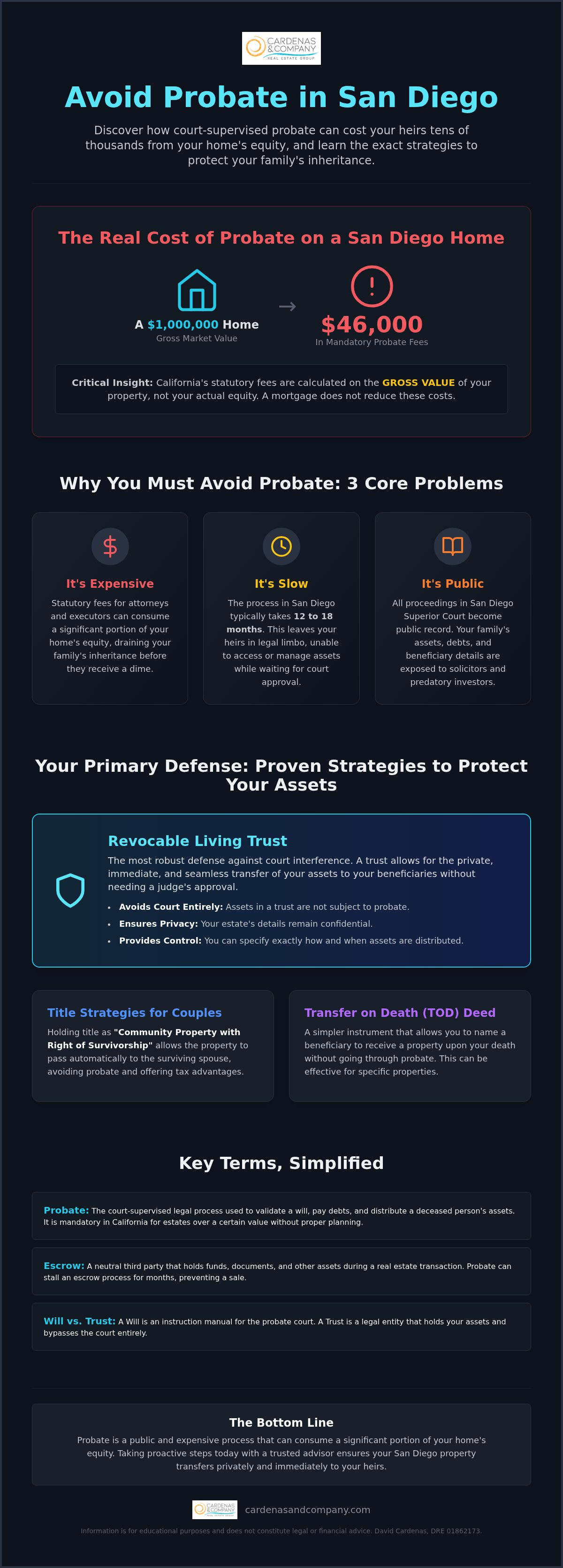
California law sets "statutory fees" for attorneys and executors based on the gross value of your estate. This is where many homeowners get caught off guard. The court calculates these fees based on the market price of your home, not what you actually own after your mortgage. Learning how to avoid probate in San Diego isn't just about paperwork; it's about preventing the government from dictating how your equity is spent. For a $1,000,000 home in our region, these combined fees total $46,000 before the family receives a dime.
As the region sees major developments like the Chula Vista Bayfront project, the value of local real estate continues to rise. This growth increases your property taxes and, unfortunately, the potential costs of a court-supervised settlement. Knowing how to avoid probate in San Diego is the most effective way to ensure that rising home values benefit your children rather than paying for court administrative costs.
The Public Nature of California Court Proceedings
When an estate enters the San Diego Superior Court, it becomes a matter of public record. Anyone can access your family’s inventory of assets, a list of your debts, and the contact information for your beneficiaries. This exposure leaves your loved ones vulnerable to aggressive solicitors, telemarketers, and predatory investors who scan court filings for leads. For homeowners in high-profile areas like Del Mar or Coronado, this lack of privacy can be invasive. We believe your family's financial details should remain a private matter, handled within the home rather than a courtroom.
Immediate Definitions: Escrow, Amortization, and Basis Points
To understand the full impact of court delays, you must grasp how they affect standard real estate mechanics. Escrow is a neutral third party that holds funds and documents during a real estate transaction. When a property is stuck in probate, the escrow process cannot close until the court grants specific permissions, which can stall a sale for months. Similarly, you must consider your loan's Amortization, which is the process of paying off a home loan over time through regular installments. Even if you've spent years diligently managing your amortization to build equity, probate fees are still calculated on the full market value of the home. Finally, even a few Basis Points, which are units of measure equal to 1/100th of a percentage point, can add up when calculating the interest on estate debts during a long court delay. We focus on strategies that bypass these inefficiencies entirely.
Bottom Line: Probate is a public and expensive process that can consume a significant portion of your home's equity. Taking proactive steps today ensures your San Diego property transfers privately and immediately to your heirs.
We invite you to a strategy session with David & Angela Cardenas and the Cardenas & Company Real Estate Group to secure your legacy. Visit cardenasandcompany.com or TrustSanDiego.com to get started.
Information is for educational purposes and does not constitute legal or financial advice. David Cardenas, DRE 01862173.
The Revocable Living Trust: Your Primary Defense Against Court Interference
Many homeowners mistakenly believe a Will protects their family from court. In reality, a Will is simply a letter to a judge that initiates the legal process. If you want to know how to avoid probate in San Diego, you must look toward a Revocable Living Trust. This legal tool allows you to maintain full control of your assets while you're alive, but it provides a clear path for your heirs once you pass.
A trust works like a private contract. You name yourself as the initial trustee and appoint a successor to take over later. This structure ensures that your home in Chula Vista or Bonita doesn't get caught in the "frozen asset" trap. Without a trust, your family might wait over a year to sell the property or access equity to pay for final expenses while the court moves at its own pace.
Avoiding the San Diego Probate Court Entirely
The primary benefit of a trust is the immediate transfer of title. Because the trust technically owns the property, not you as an individual, no court action is required to move the asset to your beneficiaries. This bypasses the San Diego Superior Court entirely, keeping your private affairs away from public record. For more detailed guidance on these legal structures, you can explore TrustSanDiego.com for education.
Special Considerations for Military Families
San Diego is home to a massive service community near the San Diego Naval Base. Military families often face unique challenges, including frequent PCS moves and out-of-state relocations. A Revocable Living Trust offers the portability needed to manage assets across state lines while ensuring your California real estate remains protected. It provides peace of mind that your home remains a secured asset for your family, regardless of where your orders take you. If you're looking to integrate your real estate into a broader legacy plan, we recommend starting with Living Trust Education.
However, a trust only works if it is "funded." This means you must record a new deed that titles the home in the name of your trust. If you leave your property in your own name, the trust is an empty vessel, and your estate will still face Probate, which is the court-supervised legal process used to verify a Will and distribute assets. We often help clients review their current title to ensure their wealth protection remains intact.
Bottom Line: A Revocable Living Trust is the most effective tool to ensure your real estate transfers to your heirs without the delays or costs of a courtroom. It provides the privacy and control that a simple Will cannot offer in the California legal system.
We invite you to a strategy session with David & Angela Cardenas and the Cardenas & Company Real Estate Group to secure your legacy. Visit cardenasandcompany.com or TrustSanDiego.com to get started.
Information is for educational purposes and does not constitute legal or financial advice. David Cardenas, DRE 01862173.
Title Strategies and Transfer on Death Deeds for California Real Estate
Title is the legal foundation of your homeownership. Many people think a simple deed is enough, but how you hold title determines whether your heirs face Probate, which is the court-supervised legal process used to verify a Will and distribute assets. If you're researching how to avoid probate in San Diego, you must evaluate your current vesting to ensure your home transfers without a judge's interference.
Joint Tenancy with Right of Survivorship is a popular choice because it allows the property to pass automatically to the surviving owner. However, it often fails married couples during tax season. Community Property with Right of Survivorship is usually a superior option in California. It provides a "double step-up" in basis, which can save your family a fortune in capital gains taxes when they eventually sell the home.
The Role of Step-Up in Basis
A step-up in basis resets the property's value to its current market price upon your death. This minimizes the tax hit for your children. Basis Points, which are units of measure equal to one one-hundredth of one percent (0.01%), might seem small, but they matter when calculating long-term tax liabilities on a high-value La Jolla estate. Simply adding a child's name to a deed is a common mistake. It can trigger an immediate gift tax and strip them of the full step-up in basis they would otherwise receive.
Real Estate Title in the South Bay
We pay close attention to title for our clients in Otay Ranch and near the Chula Vista Bayfront project. As property values rise with these new developments, your property taxes and potential tax exposure grow. The Transfer on Death (TOD) deed is a simple tool, but it carries risks. Title insurance companies often require a 120-day waiting period after death before they will issue a policy. This delay can stall a sale during a critical window while your heirs are trying to manage closing costs or other debts.
Our team reviews your title during the listing process to catch these issues early. We ensure your strategy aligns with your long-term wealth goals. This proactive approach is much more effective than filing a reactive petition after a crisis occurs. We help you look at the big picture, from current inventory levels to your family's future stability.
Bottom Line: Choosing the right title vesting is a simple but powerful way to keep your San Diego property out of court. It protects your heirs from both legal delays and unnecessary capital gains taxes.
We invite you to a strategy session with David & Angela Cardenas and the Cardenas & Company Real Estate Group to secure your legacy. Visit cardenasandcompany.com or TrustSanDiego.com to get started.
Calculating the Real Cost: Probate Fees vs. Proactive Planning
Many homeowners assume that a mortgage reduces their estate's liability in court. This is a costly misconception. Probate, which is the court-supervised legal process used to verify a Will and distribute assets, calculates fees based on the "gross value" of your property. If you own a $1,000,000 home in San Marcos, the court ignores your loan balance and sets statutory fees on the full million. This single oversight is why learning how to avoid probate in San Diego is the most impactful financial decision you can make for your heirs.
The math is unforgiving. Under California law, the attorney and the executor each receive a percentage of the gross estate. For a $1,000,000 property, these combined fees reach $46,000. This doesn't include the initial $435 filing fee at the San Diego Superior Court, appraisal costs, or bond premiums. These expenses act as a percentage-based penalty on your family's inheritance, often requiring heirs to take out loans or sell the home just to cover the closing costs of the estate.
Beyond the direct fees, you must consider the opportunity cost. A home stuck in probate for 18 months cannot be easily rented or sold without court permission. This delay often results in lost rental income and leaves the property vulnerable to market fluctuations. We've seen families lose significant equity simply because they couldn't act quickly during a market shift.
Comparing the Cost of a Trust vs. Probate
A Revocable Living Trust requires a one-time upfront investment that is a fraction of court costs. We view this as proactive wealth protection rather than a reactive legal expense. Waiting until later to organize your affairs is the most expensive strategy a family can choose. If you're considering Selling Your Home in Chula Vista, ensuring your trust is funded first protects your equity from these statutory leaks.
Impact on Inventory Levels and Market Timing
Probate isn't just expensive; it's slow. While your home sits in a court cycle, you face the risk of market downturns. In 2026, San Diego inventory levels remain tight, but a sudden shift could leave a "frozen" asset losing value while your family is powerless to sell. Being able to list a home in Santee or El Cajon immediately allows you to capitalize on peak demand. This flexibility is a core part of how to avoid probate in San Diego and maintain control over your financial timing. To explore your options, consult with a wealth strategist today.
Bottom Line: Probate fees are calculated on your home's full market value regardless of your mortgage balance. A proactive trust strategy prevents tens of thousands of dollars from leaving your family's pockets.
We invite you to a strategy session with David & Angela Cardenas and the Cardenas & Company Real Estate Group to secure your legacy. Visit cardenasandcompany.com or TrustSanDiego.com to get started.
Information is for educational purposes and does not constitute legal or financial advice. David Cardenas, DRE 01862173.
Building Your Wealth Protection Plan in San Diego and Chula Vista
Securing your legacy requires a structured approach that goes beyond simple legal documents. If you want to master how to avoid probate in San Diego, you must treat your real estate as a dynamic part of your wealth strategy. We recommend a four-step process to ensure your assets stay protected and your family remains out of the San Diego Superior Court.
- Step 1: Inventory your real estate assets. List every property you own in San Diego County, including primary residences and rentals.
- Step 2: Consult with a Trusted Advisor. Work with someone who understands the intersection of real estate markets and Probate, which is the court-supervised legal process used to verify a Will and distribute assets.
- Step 3: Draft and fund your Revocable Living Trust. A trust only works if you record a deed moving the property from your name into the trust's name.
- Step 4: Review your plan regularly. Update your strategy every 3 to 5 years or after major life events like a birth, death, or marriage.
Integrating Real Estate and Financial Strategies
Your real estate agent and estate planner must work in sync to protect your equity. This is especially true for investment properties in Imperial Beach or Oceanside where market values can shift rapidly. We provide specialized "Living Trust Education" to help you understand how these legal tools impact your property taxes and long-term wealth. Our goal is to ensure that your Amortization, which is the process of paying off a home loan over time through regular installments, translates into actual inheritance for your children.
As the Chula Vista Bayfront project continues to transform the local landscape, property values in the South Bay are reaching new heights. This growth makes proactive planning even more critical. If your plan is outdated, you risk losing a larger portion of your home's value to court fees and administrative delays. We help you stay ahead of these changes by reviewing your inventory levels and market position.
Your Next Strategy Session
We invite you to a zero-pressure wealth strategy session at our Chula Vista office. We’ve spent over 25 years supporting our local community and helping families manage these complex systems. You can start your journey toward total asset protection by visiting cardenasandcompany.com. We’ll help you look at the big picture, from closing costs to your final legacy.
Bottom Line: A wealth protection plan is a living strategy that requires consistent updates and professional oversight. Taking these four steps today ensures your San Diego property remains a private, secure asset for your heirs.
We invite you to a strategy session with David & Angela Cardenas and the Cardenas & Company Real Estate Group to secure your legacy. Visit cardenasandcompany.com or TrustSanDiego.com to get started.
Information is for educational purposes and does not constitute legal or financial advice. David Cardenas, DRE 01862173.
Secure Your Legacy with Proactive Planning
Protecting your home is about more than maintaining a structure; it's about safeguarding the equity you've built over decades. We've explored how a Revocable Living Trust and strategic title vesting keep your family out of the San Diego Superior Court. Understanding how to avoid probate in San Diego, which is the court-supervised legal process used to verify a Will and distribute assets, ensures your heirs receive their inheritance privately and without the $46,000 in statutory fees associated with a $1,000,000 estate.
Our team brings over 25 years of local market expertise and specialized Living Trust Education to every homeowner we represent. As an affiliate of Realty ONE Group Pacific, we combine high-level real estate strategies with grounded, compassionate guidance. You have the power to turn a complex legal process into a seamless transition for your loved ones.
Bottom Line: Proactive estate planning prevents the high costs and public exposure of the California court system. A funded trust remains the most reliable way to ensure your real estate assets transfer directly to your heirs.
We invite you to schedule your private wealth strategy session with David & Angela Cardenas and the Cardenas & Company Real Estate Group. Visit cardenasandcompany.com or TrustSanDiego.com to take the first step toward long-term stability.
Information is for educational purposes and does not constitute legal or financial advice. David Cardenas, DRE 01862173.
Frequently Asked Questions
Does a Will avoid probate in San Diego?
No, a Will does not bypass the court system. A Will is a public document that acts as an instruction to the San Diego Superior Court to begin Probate, which is the court-supervised legal process used to verify a Will and distribute assets. To keep your family matters private and ensure an immediate transfer of your home, you must use a Revocable Living Trust instead of relying solely on a Will.
What is the small estate limit in California for 2026?
For deaths occurring on or after April 1, 2026, the small estate threshold is $239,700. If your estate's gross value is below this amount, your heirs may use a simplified affidavit process. However, because most residential properties in San Diego County exceed this value, learning how to avoid probate in San Diego is essential for homeowners who want to protect their real estate from a full court proceeding.
How much does a living trust cost compared to probate fees?
A Revocable Living Trust is a one-time investment that is significantly more affordable than court-mandated fees. In California, probate fees are calculated on the gross value of the estate, meaning a $1,000,000 home can trigger $46,000 in statutory costs. A trust prevents this financial leakage, ensuring your equity remains with your family rather than being spent on court filing fees and mandatory attorney percentages.
Can I sell a house while it is in probate in San Diego?
Yes, you can sell a property during the probate process, but it requires specific court permissions. Under the Independent Administration of Estates Act, an executor can list the home, but the timeline is often dictated by court schedules rather than market demand. This can be problematic if inventory levels shift quickly in neighborhoods like Santee or El Cajon, making a trust-owned sale a much faster and more flexible alternative.
What is a Heggstad Petition and can it save my house?
A Heggstad Petition is a legal remedy used when a homeowner intended to put their home in a trust but failed to record the deed. If the court finds clear evidence of your intent, the property can be transferred into the trust without a full probate cycle. While this can "save" the asset, it is a reactive and expensive legal step that is easily avoided by properly funding your trust while you are alive.
How does a Transfer on Death deed work for San Diego real estate?
A Transfer on Death (TOD) deed allows you to designate a beneficiary who will inherit your property automatically upon your death. To be valid, you must record this deed with the San Diego County Recorder within 60 days of notarization. While it is a simple tool, it can complicate Escrow, which is the neutral third party that holds funds during a real estate transaction, due to a 120-day title insurance waiting period.
Do I need a lawyer to avoid probate in California?
You are not legally required to hire an attorney, but professional oversight is highly recommended to ensure your trust is funded correctly. Mistakes in titling can lead your estate back to the San Diego Superior Court. We provide Living Trust Education to help you coordinate your real estate with your wealth goals, ensuring your property taxes and inheritance are managed with the precision of a 25-year market veteran.
How long does the probate process take in San Diego County?
The probate process in San Diego County typically takes between 9 and 18 months to finalize. During this period, the property is often "frozen," preventing heirs from selling or refinancing to pay for closing costs. This delay can be costly if market interest rates change by several Basis Points, which are units of measure equal to 1/100th of a percentage point, potentially reducing the final inheritance for your beneficiaries.
Bottom Line: Proactive estate planning is the only way to ensure your San Diego home transfers to your heirs without court interference. A funded Revocable Living Trust provides the privacy, speed, and cost savings that a simple Will cannot offer.
We invite you to a strategy session with David & Angela Cardenas and the Cardenas & Company Real Estate Group to secure your legacy. Visit cardenasandcompany.com or TrustSanDiego.com to get started.
Information is for educational purposes and does not constitute legal or financial advice. David Cardenas, DRE 01862173.
Disclaimer
The information provided on this blog is for educational and informational purposes only and does not constitute legal, financial, or investment advice. While we strive for accuracy, real estate markets and insurance regulations (including Living Trusts and IUL strategies) are subject to change. David Cardenas (DRE 01862173) is a licensed real estate salesperson; however, this content does not create an agency relationship. Please consult with a qualified attorney or tax professional regarding your specific situation.