
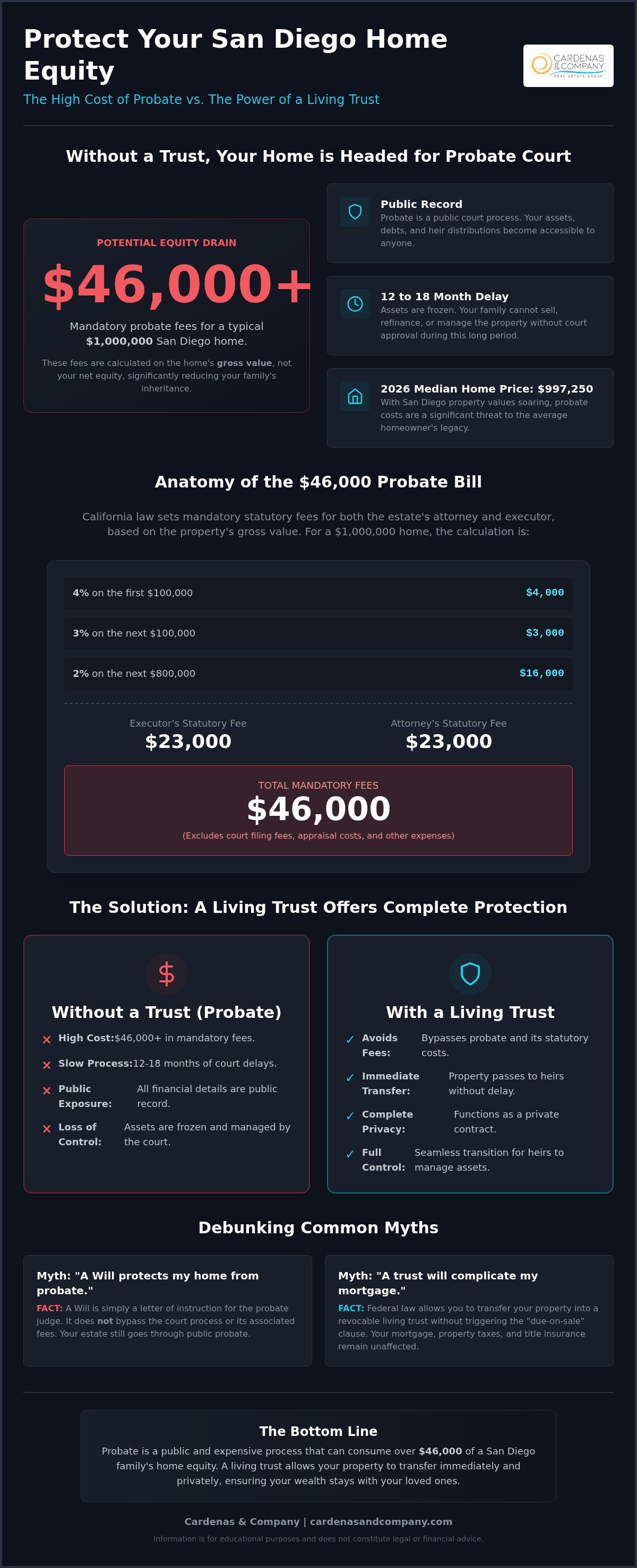
If you own a house in our community, the state of California might be your unintended primary beneficiary. With the 2026 median price for a detached home in San Diego reaching $997,250, a standard property transfer through the courts can trigger over $46,000 in mandatory statutory fees. Understanding how a living trust protects your San Diego home is no longer a luxury for the wealthy; it's a critical defensive move for every local family. Probate, which is the court-supervised process for distributing a deceased person's assets, is notoriously slow, expensive, and entirely public.
We understand that the thought of legal paperwork feels heavy, especially when you're already managing high property taxes and mortgage payments. You want to ensure your family's hard-earned equity stays with them, rather than being frozen in a San Diego County courtroom for over a year. This guide promises to clarify exactly how to bypass these hurdles while keeping your financial legacy private. We will examine the updated 2026 thresholds, explain why your current mortgage remains unaffected, and show you how to secure your real estate wealth for the next generation.
Key Takeaways
- Learn how to avoid the 2026 probate backlog, which is the court-supervised legal process of distributing assets that often drains home equity in mandatory fees.
- Discover how a living trust protects your San Diego home by keeping your real estate assets private and under your full control.
- Identify the hidden risks of relying on Joint Tenancy or "Transfer on Death" deeds that can complicate future sales and title clearance.
- Master the two-step method for transferring your title into a trust without triggering a reassessment of your property taxes or affecting your mortgage.
- See how a trust provides a seamless transition for heirs to manage high-value investments in local growth areas like the Chula Vista Bayfront.
Table of Contents
Why San Diego Homeowners Risk Losing Equity to Probate
If you own property in San Diego County without a clear estate plan, your home is headed for probate. We define Probate as the court-supervised legal process of distributing a person’s assets after they die, which is often slow and expensive. In 2026, local courts face a significant backlog because the gross assessed value of taxable property in our county reached a record $845 billion. This volume of wealth creates a bottleneck that leaves families waiting for months just to get an initial hearing.
The most painful part of this process is the "Equity Drain." California law calculates probate fees based on the gross value of your home, not your net equity. If you own a house worth $1,000,000 with a $900,000 mortgage, the court and attorneys calculate their percentages based on the full million dollars. Your family could lose tens of thousands of dollars in fees on a property they barely have equity in. This is exactly how a living trust protects your San Diego home; it removes the property from the court's reach entirely.
Privacy is another major concern for local homeowners. A comprehensive overview of living trusts shows that these documents function as private contracts. Conversely, probate is a public matter. Anyone can access court records to see your home’s value, your outstanding debts, and exactly how much your heirs will receive. For families in high-profile areas or those building wealth in the Chula Vista Bayfront, this lack of privacy can be a security risk.
The High Cost of Dying Without a Trust in California
California Probate Code §10810 sets mandatory fees for both the attorney and the executor. These fees are cumulative and aggressive:
- 4% on the first $100,000
- 3% on the next $100,000
- 2% on the next $800,000
- 1% on the next $9,000,000
For a median-priced home in Chula Vista valued at $1,000,000, the combined statutory fees for the attorney and executor total $46,000. This does not include filing fees, appraisal costs, or closing costs if the home must be sold. Many residents believe a Will protects them, but a Will is simply a letter to the probate judge. It does not bypass the court; it only tells the judge who should get what after the fees are paid.
Time Delays and Family Stress
The current timeline for a standard probate case in San Diego is 12 to 18 months. During this period, your heirs are in a state of legal limbo. They cannot easily sell the home, refinance the mortgage, or manage property taxes without court approval. If the market shifts or inventory levels rise, your family cannot react quickly to protect the home's value. This delay adds immense emotional weight to an already difficult season of grieving.
Bottom Line: Probate is a public and expensive process that can consume over $46,000 of a San Diego family's home equity. A living trust allows your property to transfer immediately and privately, ensuring your wealth stays with your loved ones.
If you want to ensure your San Diego property remains a legacy rather than a legal burden, let's talk. We invite you to a zero-pressure strategy session with David & Angela Cardenas and the Cardenas & Company Real Estate Group at cardenasandcompany.com or TrustSanDiego.com.
Information is for educational purposes and does not constitute legal or financial advice. David Cardenas, DRE 01862173.
The Mechanics: How a Living Trust Shields Your Property
Think of a living trust as a legal "bucket" designed to hold your most valuable assets. While you're healthy and active, you hold the handle of this bucket. You have the absolute authority to put property in, take it out, or even tip the bucket over and start again. This structural shift is precisely how a living trust protects your San Diego home from the friction of the public court system.
When you buy or sell property within a trust, you still use Escrow. We define Escrow as a neutral third party that holds funds and documents during a real estate transaction until all conditions are met. The only difference is that the trust, rather than you as an individual, is the entity listed on the title. Most homeowners choose a "Revocable" trust, which simply means you can change the terms or cancel the trust entirely at any time during your life.
The Successor Trustee is the individual you appoint to manage the bucket if you pass away or can no longer make decisions. This person steps into your shoes immediately. They don't need to ask a judge for permission to pay the mortgage or manage the property. This seamless handoff is the primary way how a living trust protects your San Diego home from being frozen during a legal crisis.
Maintaining Control While You Are Alive
Transferring your home into a trust doesn't change your day-to-day life or your tax filing. The trust uses your Social Security number, so you don't need to file a separate tax return. You can still sell, refinance, or lease your property exactly as you did before the transfer. There's no loss of autonomy, only an increase in protection.
Protection during your lifetime is just as vital as protection after death. If you become incapacitated due to illness or injury, your Successor Trustee can manage your real estate affairs without a costly, public court conservatorship. These strategic benefits of a living trust ensure your family maintains stability when you are at your most vulnerable.
Impact on Your Mortgage and Property Taxes
Many homeowners worry that moving their home into a trust will trigger a "due on sale" clause in their mortgage. However, the federal Garn-St. Germain Act protects you. Lenders cannot demand immediate payment of your loan just because you moved your primary residence into a revocable living trust. Your loan terms and interest rates remain exactly the same.
In San Diego County, a properly executed transfer also protects your property taxes. Under Proposition 13 and Proposition 19, moving your home into a revocable trust is not a "change of ownership" that triggers a reassessment. Your tax base stays protected, provided the paperwork is filed correctly with the county recorder. If you're unsure if your current deed is optimized, we can help you review your Smart Homeownership Strategy to confirm your equity is safe.
Bottom Line: A living trust functions as a private legal vessel that keeps your home out of the public courts while you maintain total control. It preserves your existing mortgage terms and tax benefits while providing a clear path for your heirs.
We're here to help you navigate these technical steps with confidence. We invite you to a warm, zero-pressure strategy session with David & Angela Cardenas and the Cardenas & Company Real Estate Group at cardenasandcompany.com or TrustSanDiego.com.
Information is for educational purposes and does not constitute legal or financial advice. David Cardenas, DRE 01862173.
Comparing Protection: Living Trusts vs. Traditional Deeds
While many homeowners rely on simple deeds to transfer property, these methods often leave your equity exposed to unnecessary taxes and legal disputes. Understanding how a living trust protects your San Diego home requires looking past the monthly mortgage payment and focusing on the long-term preservation of your wealth. As you progress through your loan's Amortization; which is the process of paying off a debt over time through regular installments of principal and interest; your equity grows. Protecting that growing asset requires more than just a standard deed.
Many residents consider Transfer on Death (TOD) deeds as a shortcut to avoid court. However, in 2026, these deeds remain risky because many title companies find them difficult to clear. If a title company cannot verify the validity of a TOD deed quickly, your heirs may face significant delays when trying to sell the property. A trust provides a much more robust legal framework that title officers and lenders accept without hesitation.
The Step-Up in Basis Advantage
The "Step-Up in Basis" is perhaps the most significant financial benefit of a living trust. This tax rule resets the value of your home to its current market price at the time of your passing. For long-term owners in neighborhoods like Rancho San Diego or Allied Gardens, this is vital. If you purchased a home in 1995 for $225,000 and it is valued at $1,100,000 in 2026, your heirs would normally face massive capital gains taxes on that $875,000 difference. A living trust ensures they receive the full market value as their new "basis," potentially saving them over $150,000 in federal and state taxes.
Why Joint Tenancy Often Fails Families
Joint Tenancy is a common way for couples to hold title, but it often functions as a trap. One major risk is "Accidental Disinheritance." If a surviving spouse remarries and places the home in joint tenancy with a new partner, the original children of the first marriage could be completely cut out of the estate. Furthermore, adding a child to your deed as a joint tenant exposes your home to their financial liabilities. If that child faces a lawsuit, bankruptcy, or a divorce, a lien could be placed against your property. A trust keeps the title "clean" for future Residential Listing Services, ensuring your home remains a protected family asset rather than a target for creditors.
Bottom Line: Traditional deeds and joint tenancy often create tax traps and liability risks that a living trust easily avoids. By utilizing a trust, you ensure your heirs receive the maximum tax benefit while keeping the property safe from external legal claims.
We're ready to help you evaluate your current deed and build a strategy that truly protects your family. We invite you to a warm, zero-pressure strategy session with David & Angela Cardenas and the Cardenas & Company Real Estate Group at cardenasandcompany.com or TrustSanDiego.com.
Step-by-Step: Moving Your San Diego Property into a Trust
Moving your property into the trust is the most critical step in your estate plan. If you sign the trust documents but never update your property title, the court will still treat your home as a personal asset. This failure to "fund" the trust is the most common reason why families still end up in Probate; the court-supervised legal process of distributing assets that is often slow and expensive. This section outlines exactly how a living trust protects your San Diego home through a formal transfer of ownership.
- Step 1: Consult with a qualified estate planning attorney to ensure your documents meet 2026 California standards.
- Step 2: Execute a Grant Deed; a legal document used to transfer real estate ownership from one party to another; to move the title from your name to the Trust.
- Step 3: Record this document with the San Diego County Recorder’s Office to make the transfer a matter of official record.
- Step 4: Notify your homeowners insurance and title insurance carriers to add the Trust as an "Additional Insured" on your policies.
- Step 5: Ensure your Successor Trustee knows exactly where to find the original, notarized documents.
Recording Your Deed in San Diego County
You can record your deed at several local offices, including Downtown San Diego, Chula Vista, or Kearny Mesa. You must include a Preliminary Change of Ownership Report (PCOR); a mandatory form that tells the County Assessor whether a property transfer should trigger a tax reassessment. In 2026, recording fees include a $14.00 base fee for the first page and a $75.00 SB 2 fee for most real estate documents. If you miss a signature or fail to include the PCOR, the recorder will reject your filing and delay your protection.
Funding the Trust: Beyond the Real Estate
A trust is essentially an empty vessel until you fill it with your assets. Beyond your primary residence, you should link your savings accounts, brokerage accounts, and life insurance policies to the trust. If you own property in another state, you must execute a deed in that specific jurisdiction to move it into your California-based trust. Leaving these assets outside the trust may force your heirs into multiple court proceedings across different states. To ensure your entire portfolio is optimized, we recommend a Real Estate Investment Consulting session to review your asset structure.
Bottom Line: Creating the trust document is only half the battle; you must legally transfer your property title to ensure the trust functions as intended. Recording your deed correctly with the San Diego County Recorder is the final safeguard that keeps your equity out of the public court system.
We're ready to help you navigate these technical steps with confidence. We invite you to a warm, zero-pressure strategy session with David & Angela Cardenas and the Cardenas & Company Real Estate Group at cardenasandcompany.com or TrustSanDiego.com.
Information is for educational purposes and does not constitute legal or financial advice. David Cardenas, DRE 01862173.
A living trust is more than a shield; it is a springboard for future growth. In the 2026 market, even minor fluctuations in mortgage rates, often measured in Basis Points; which are units of measure used in finance to describe the percentage change in the value of financial instruments (1/100th of 1%); can shift your investment capability. Understanding how a living trust protects your San Diego home allows you to use your property as a clean asset for future leverage while keeping your family wealth intact.
If your family intends to keep the property as a rental, the trust ensures a smooth transition without the interference of court-appointed administrators. This is vital for homes near major developments like the Chula Vista Bayfront, where rental demand is projected to stay high. A trust allows your heirs to manage the asset immediately, avoiding the loss of income and high closing costs that occur during a typical 18-month probate delay.
Chula Vista Market Insights and Wealth Preservation
The South Bay market is currently seeing a surge in equity due to massive infrastructure projects like Amara Bay. We view your home as a form of "forced savings" that deserves the highest level of security against legal or bureaucratic threats. As your advisors, we help you monitor inventory levels and property taxes to ensure your real estate portfolio remains profitable and protected. Our team focuses on the personal story of each family, treating your technical trust work as a vital part of your long-term stability.
Next Steps for San Diego Homeowners
Real estate wealth is not static, so your protection strategy shouldn't be either. We recommend an annual "Equity Check-up" to see how your home's value stacks up against your retirement or legacy goals. You should also review your trust every 3 to 5 years to account for changes in tax law or family dynamics. If you are considering a move to capitalize on your current equity, review our latest guide on Selling Your Home in Chula Vista: The 2026 Strategy.
Bottom Line: A living trust is a sophisticated tool that secures your home equity while providing a clear path for future investment growth. It transforms your real estate from a static asset into a protected legacy for the next generation.
We are here to help you bridge the gap between homeownership and true wealth strategy. We invite you to a warm, zero-pressure strategy session with David & Angela Cardenas and the Cardenas & Company Real Estate Group at cardenasandcompany.com or TrustSanDiego.com.
Information is for educational purposes and does not constitute legal or financial advice. David Cardenas, DRE 01862173.
Protecting Your San Diego Legacy for 2026
Your home represents your family's future. Leaving its fate to the San Diego probate courts risks losing tens of thousands of dollars to mandatory fees. By understanding how a living trust protects your San Diego home, you take active control of your legacy. You ensure your equity stays within your household rather than being consumed by the state's legal backlog.
With over 25 years of local expertise, we help families in Chula Vista and the South Bay protect their wealth. We focus on relationship-driven strategies that turn homeownership into a long-term wealth plan. It's time to secure your property for the next generation and ensure your financial stability remains unshakable.
Take the first step toward peace of mind. Schedule a Strategic Wealth & Real Estate Session with Cardenas & Company today.
Bottom Line: A living trust is the most effective tool for bypassing the California probate process and preserving your family's real estate wealth. It provides immediate legal protection while ensuring your heirs receive the full tax benefits of your home's appreciation.
We invite you to a warm, zero-pressure strategy session with David & Angela Cardenas and the Cardenas & Company Real Estate Group at cardenasandcompany.com or TrustSanDiego.com.
Information is for educational purposes and does not constitute legal or financial advice. David Cardenas, DRE 01862173.
Meta Title: 2026 Guide: How Living Trusts Protect San Diego Homes
Meta Description: Shield your property from probate and build a legacy. Learn how a living trust protects your San Diego home with our 2026 guide. Book a strategy session today.
Frequently Asked Questions
What is the difference between a Will and a Living Trust in San Diego?
A Will is a public document that must go through Probate; the court-supervised legal process of distributing assets; while a living trust is a private contract that bypasses court entirely. A trust allows for the immediate transfer of property, whereas a Will can leave your heirs waiting 12 to 18 months. This is how a living trust protects your San Diego home from the public eye and the expensive court delays currently impacting our local legal system.
Does putting my home in a trust protect it from creditors or lawsuits?
A standard revocable living trust does not shield your home from your own creditors or personal lawsuits. Because you maintain total control and can revoke the trust at any time, the law treats these assets as your personal property. Its primary function is to avoid the expensive Probate process. If you require advanced asset protection from lawsuits, you should discuss irrevocable trust structures with a qualified attorney who understands the 2026 legal landscape.
Can I still get a mortgage or refinance if my house is in a living trust?
You can absolutely get a mortgage or refinance your property once it is in a trust. Most lenders in the San Diego market are very comfortable working with revocable trusts. The federal Garn-St. Germain Act specifically prevents banks from calling your loan due just because you moved your home into a trust. You continue making your payments according to your Amortization schedule; the process of paying off debt over time through regular installments.
How much does it cost to set up a living trust for my San Diego home?
The cost to set up a living trust depends on the complexity of your estate and the professional you choose. While we don't provide legal pricing, you should account for San Diego County recording fees in 2026, which include a $14.00 base fee and a $75.00 SB 2 fee. Investing in a trust now prevents the $46,000 in statutory fees a $1,000,000 estate would face during a standard court distribution process.
Do I need a lawyer to put my house in a trust, or can I do it myself?
You can technically do it yourself, but we don't recommend it for homeowners with significant equity. A single mistake in the deed or the Preliminary Change of Ownership Report (PCOR); a mandatory form for the County Assessor; can lead to a rejected filing or an accidental tax reassessment. Given that the 2026 median home price is nearly $1,000,000, the risk of a technical error far outweighs the cost of professional guidance.
What happens to my property taxes when I transfer my home to a trust?
Transferring your primary residence into a revocable living trust does not trigger a property tax reassessment in California. Under Proposition 13 and Proposition 19, this is considered a non-reassessable transfer. You must file the PCOR to confirm the transfer is for estate planning purposes only. This ensures your tax base remains protected and your annual increases are capped at 2% as mandated by state law.
Can I sell my home if it is currently held in a living trust?
You can sell your home at any time if it is held in a living trust. You simply sign the listing agreement and closing documents as the Trustee. During the sale, you will still use Escrow; a neutral third party that holds funds and documents; to manage the transaction. The process is virtually identical to a standard sale, and it does not negatively impact your inventory levels or your ability to negotiate terms.
What is a "Pour-Over Will" and do I need one with my trust?
A Pour-Over Will is a specific type of Will that acts as a safety net for your trust. It ensures that any assets you forgot to formally link to the trust "pour over" into it upon your death. While these assets may still face Probate; the court-supervised distribution process; the document ensures they eventually reach your intended beneficiaries. It is a standard and necessary part of a complete 2026 estate plan.
Bottom Line: A living trust is the most effective way for San Diego families to avoid the high costs and delays of the probate court system. It provides a seamless way to manage your real estate assets while maintaining your existing tax benefits and mortgage terms.
We invite you to a warm, zero-pressure strategy session with David & Angela Cardenas and the Cardenas & Company Real Estate Group to discuss your wealth goals at cardenasandcompany.com or TrustSanDiego.com.
Information is for educational purposes and does not constitute legal or financial advice. David Cardenas, DRE 01862173.
Meta Title: San Diego Living Trust FAQ: Protecting Your Home in 2026
Meta Description: Get answers on how a living trust protects your San Diego home. Learn about property taxes, mortgages, and probate avoidance in our 2026 guide. Book a session.
Disclaimer
The information provided on this blog is for educational and informational purposes only and does not constitute legal, financial, or investment advice. While we strive for accuracy, real estate markets and insurance regulations (including Living Trusts and IUL strategies) are subject to change. David Cardenas (DRE 01862173) is a licensed real estate salesperson; however, this content does not create an agency relationship. Please consult with a qualified attorney or tax professional regarding your specific situation.