
Your sale price is not your take-home amount. The cost of selling a home in San Diego can include transaction expenses, negotiated compensation, your mortgage payoff, and possible tax obligations. These are separate items, and each affects your proceeds differently.
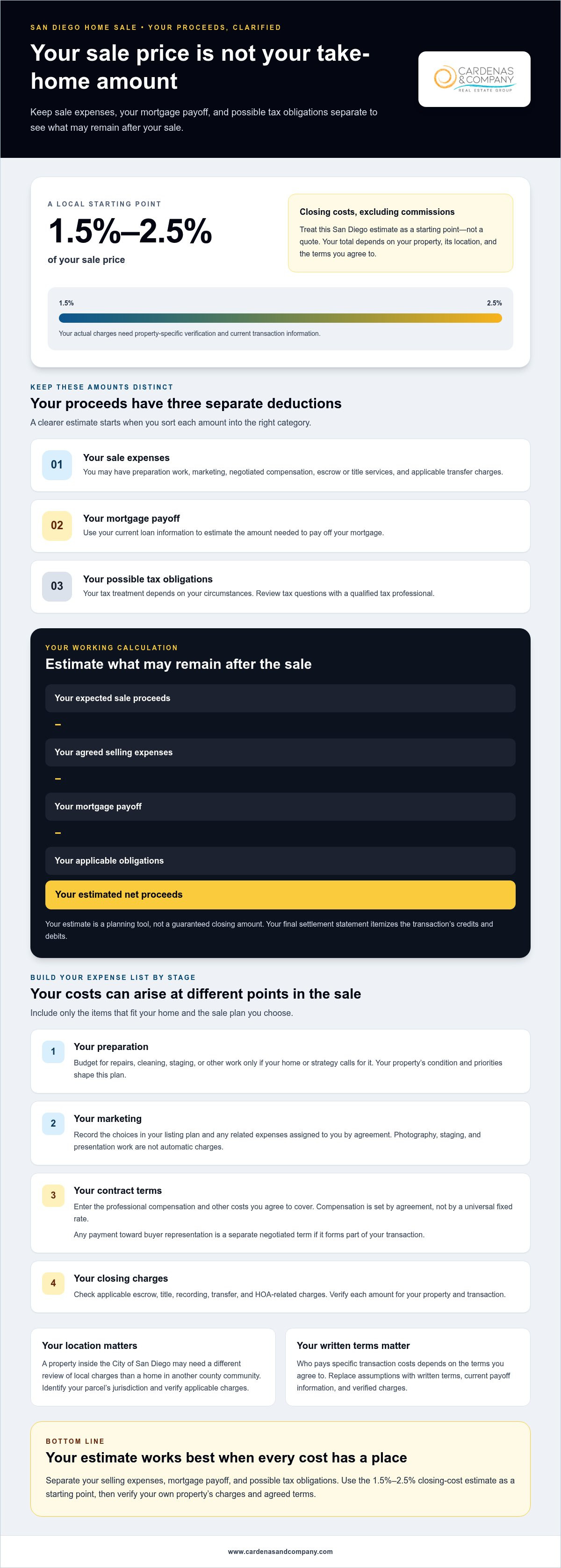
San Diego estimates place closing costs excluding commissions at about 1.5% to 2.5% of the sale price. Treat that range as a starting point, not a quote: your total depends on the property, its location, and the terms you agree to.
This guide helps you build a property-specific estimate, separate selling expenses from your loan payoff and potential taxes, and identify costs that need current documentation. You’ll see how transfer charges, escrow, title, HOA documents, and property preparation may affect your proceeds, and how to compare selling strategies without relying on a one-size-fits-all percentage.
Key Takeaways
- Separate sale expenses from your mortgage payoff and possible tax obligations to get a clearer view of what you may take home.
- Organize potential costs by when they arise, from preparing the property through closing, and include only items that fit your home and sale plan.
- Use the cost of selling a home in San Diego as a property-specific estimate, not a universal percentage. Local charges can depend on your parcel’s location.
- Estimate net proceeds by subtracting agreed expenses, your loan payoff, and applicable obligations from your expected sale proceeds. Replace assumptions with current documents and written terms as you get them.
- Use local listing guidance to align your property details, priorities, timing, and expense assumptions before you choose a selling strategy.
Table of Contents
What Costs of Selling a Home in San Diego Can Reduce Your Proceeds?
The sale price is the amount in your contract, not the amount you keep. Selling costs are expenses tied to preparing, marketing, and completing the sale. Your mortgage payoff and any tax obligations are separate deductions, so combining everything into one vague “fee” makes your estimate harder to use.
Sort each amount into the right category. Depending on your home and transaction, sale expenses may include preparation work, marketing, negotiated compensation, escrow or title services, and applicable transfer charges. Closing costs is a broad term for expenses involved in completing a real estate transaction. The specific charges and who pays them depend on the transaction terms.
Which numbers belong in a seller proceeds estimate?
Keep three figures distinct: expenses associated with the sale, the amount needed to pay off your mortgage, and possible tax obligations. Your current loan statement can inform the payoff estimate. Tax treatment depends on your circumstances, so review those questions with a qualified tax professional. A preliminary calculation is not your final settlement statement.
A settlement statement itemizes the transaction’s final credits and debits. Before closing, your estimate relies on assumptions and available documents; final figures can change as transaction details are confirmed. This matters when you’re planning your next purchase, a move, or how much cash you may have after the sale.
Why is there no single San Diego selling-cost figure?
The cost of selling a home in San Diego depends on the property, the agreement, its location, and the selling approach you choose. A home that needs repairs can require a different preparation budget from a move-in-ready property. Negotiated terms can also change which expenses you agree to cover. Build your estimate around your actual plan, not a generic percentage applied without context.
Location matters, too. A property inside the City of San Diego may require a different review of local charges than a home in another county community. County-level charges, city-specific charges, and service-related expenses such as escrow or title are separate line items. Identify the parcel’s jurisdiction and use current transaction information to verify applicable charges.
Net proceeds are what remains after you subtract agreed selling expenses, your mortgage payoff, and applicable obligations from your sale proceeds. That gives you a practical starting point, not a guaranteed closing amount. Your estimate becomes more reliable as you replace assumptions with written transaction terms, current payoff information, and verified charges for your property.
Which Home-Sale Expenses Should You List Before You Sell in San Diego?
Build your expense list around the sale timeline. This helps you separate work you choose to do before listing from charges tied to your contract or closing. Not every category applies to every home, so make your budget fit the property and sale plan you choose.
Use these stages as a working checklist:
- Preparation: List repairs, cleaning, staging, or other work only if your home or strategy calls for it.
- Marketing: Record the marketing choices in your listing plan and any related expenses assigned to you by agreement.
- Contract: Track negotiated professional compensation and other costs you agree to cover as part of the transaction.
- Closing: Allow for applicable escrow, title, recording, transfer, and HOA-related charges. Verify amounts for your property and transaction.
Which preparation and transaction expenses may apply?
Start with the home’s condition and your priorities. A property that needs repairs before it is ready for the market may require a different plan from one that needs only cleaning. Staging and other presentation work are choices, not automatic seller expenses. Weigh each item against your timing, budget, and goals instead of assuming every suggested task belongs on your list.
Your marketing plan also shapes what you prepare for. Photography, staging, and other presentation decisions should support the strategy for your property; don’t treat every possible activity as a standard charge. For a nearby example, this Chula Vista home-selling strategy can help you think through local planning. Your property and agreed terms determine your own budget.
How should you understand commissions and closing charges?
Professional compensation is set by agreement, not by a universal fixed rate. Your listing representation terms should state the compensation you agree to. Any payment toward buyer representation is a separate negotiated term if it forms part of your transaction. Cardenas & Company Real Estate Group provides residential listing services with percentage-based compensation tied to the final sale price, as set out in the agreed terms. Put each agreed amount into your estimate rather than relying on a customary assumption.
Closing charges are different. Escrow coordinates transaction funds and documents, title services address ownership records and title insurance, and recording charges relate to filing documents in public records. HOA document or transfer charges may apply if your property belongs to an association. A brokerage transaction fee may also apply; this is a flat fee per transaction for administrative costs, compliance, and insurance, typically settled at the close of escrow. Review the written terms and current transaction documents for the amounts and payment responsibilities.
Keep your list practical: note each expense, when it arises, whether you’ve agreed to pay it, and which document supports the estimate. That turns the cost of selling a home in San Diego into a property-specific plan instead of a broad guess. If you want to organize the assumptions around your home and priorities, discuss your sale plan with Cardenas & Company Real Estate Group.
Which San Diego Location and Property Details Can Change Your Closing Costs?
Your property’s address matters because a San Diego mailing address doesn’t, by itself, tell you which city or county charges apply. A home in the City of San Diego, Chula Vista, or La Mesa may require a different review of local requirements. Check the parcel’s jurisdiction and verify applicable city and county charges for that address before relying on an estimate.
Keep location-related items separate from costs driven by the property or contract. That makes the cost of selling a home in San Diego easier to assess without assuming every seller pays the same charges. Use the table as a checklist for what to investigate, not as a fee schedule.
| Estimate input |
What can affect it |
What to verify |
| City or county charges |
The parcel’s jurisdiction, including whether it falls within a city or an unincorporated county area |
Current requirements and charges for the specific address |
| Recording charges |
Documents involved in the transaction and current recording requirements |
Applicable charges and transaction documents |
| HOA documents or charges |
Whether your property belongs to an association and what the transaction requires |
Current association documents, fees, and payment responsibilities |
| Property-tax proration |
Tax figures, billing periods, and the closing date |
Relevant tax records and the transaction’s proration calculation |
| Condition and contract terms |
Repair needs and expenses assigned to you in the agreement |
Property condition and written transaction terms |
How can the property’s location affect your estimate?
Use San Diego, Chula Vista, and La Mesa as examples of locations to compare, not as shorthand for a particular fee. First identify the parcel’s actual jurisdiction; nearby addresses can fall under different local authorities. Then review current city and county requirements for that address. Don’t carry a charge from one community into another without verifying that it applies to your property and transaction.
What property-specific items deserve a separate line?
Check whether your property belongs to an HOA, or homeowners association, and whether the sale involves association documents or charges. Keep property condition, contract terms, and location as separate estimate inputs because they affect different line items. For property-tax prorations, use verified figures and transaction timing rather than a rough monthly assumption.
Before treating any tax, recording charge, or HOA expense as a firm number, use current documentation tied to the property or transaction. If a figure remains unknown, label it as pending verification instead of filling the gap with a charge from another sale. This gives you a cleaner estimate and shows which details still need attention before closing.
How Can You Estimate Your Net Proceeds Before Listing a San Diego Home?
Start with a worksheet that keeps the sale price, agreed expenses, mortgage payoff, and possible tax obligations in separate places. This helps you see which assumptions affect your estimate and update them as you get firmer information. Don’t treat the cost of selling a home in San Diego as a single figure detached from your property and transaction terms.
Use this fill-in formula:
Estimated net proceeds = expected sale price − agreed sale expenses − estimated mortgage payoff − other applicable obligations
Enter an estimate for each line, even if you don’t yet have a final amount. Update the worksheet as written terms, current documents, and property-specific charges become available.
What information do you need for a first estimate?
Use a supportable expected sale price based on your property and the current market, rather than a number chosen only to produce a preferred result. Gather a current mortgage payoff figure and list known property-specific expenses. Keep proposed transaction terms separate from confirmed agreements so you can revise an assumption without losing track of what you’ve accepted.
- Expected sale price: Record the estimate and the information supporting it.
- Agreed sale expenses: Include amounts established by written transaction terms, and label proposed costs as estimates.
- Mortgage payoff: Use current loan information, then replace the estimate with an updated payoff amount when available.
- Other obligations: Note property-specific charges or obligations separately, with their source and verification status.
Keep potential tax obligations in a separate tax-planning note, not as a guessed amount in your transaction worksheet. Whether a tax applies and how it may be calculated depend on your circumstances. Take those questions to a qualified tax professional; a preliminary proceeds estimate is not tax advice.
How do you compare selling strategies without false precision?
Compare each option using the same expected sale price and mortgage payoff assumptions. Change only the expenses or terms that differ between strategies, such as preparation choices or agreed transaction costs. This shows how a revised assumption affects estimated proceeds without implying that either scenario guarantees a particular sale price or closing result.
Numbers aren’t the only tradeoff. Consider how much preparation you want to manage, your preferred timing, and how showings fit your plans. A strategy with fewer preparation steps may suit your priorities, while another may call for more work before the home is presented to the market. Include these practical considerations alongside your worksheet rather than assigning them invented dollar values.
An estimate is a planning tool, not a guaranteed closing amount. Your final proceeds depend on the completed transaction, current payoff information, and confirmed charges and terms. Review the worksheet as details firm up, and keep unresolved items clearly marked instead of treating them as settled.
Plan a seller net-proceeds review
How Can Local Listing Guidance Help You Plan Your San Diego Sale?
A listing discussion can turn a rough cost estimate into a plan tied to your home, priorities, and timing. Review the property’s condition, decide which preparation steps fit your goals, and separate confirmed transaction terms from assumptions that still need verification.
Cardenas & Company Real Estate Group is a San Diego residential listing team affiliated with Realty ONE Group Pacific. The team helps families buy, sell, and manage residential real estate in San Diego, Chula Vista, Bonita, Del Mar, La Jolla, Otay Ranch, Carlsbad, Coronado, El Cajon, Santee, La Mesa, Lemon Grove, Encinitas, Imperial Beach, Oceanside, Poway, San Marcos, Escondido, and the greater Southern California area. Local listing guidance helps you organize decisions around your property without promising a sale price, savings, or timeline.
What can you prepare for a listing-planning conversation?
Bring the information that shapes your estimate and choices. Current mortgage details, known repair needs, HOA information, and your preferred timing help focus the conversation on the expenses and tradeoffs relevant to your home. You don’t need every figure finalized; label unknown amounts clearly so you can distinguish a working assumption from a documented cost.
- Your current mortgage information and any available payoff details.
- Known repairs, maintenance concerns, and preparation choices you’re considering.
- HOA details and property documents that may affect sale-related requirements.
- Your preferred timing, showing preferences, and priorities for the transition.
- Questions about charges that depend on your address, property, or contract terms.
Sort your priorities before choosing preparation work. You may decide certain repairs matter to you, while staging or other presentation steps remain optional. A useful discussion weighs each choice against your budget, timing, and goals instead of treating every possible expense as mandatory.
How can you move forward with clarity?
Review the assumptions in your proceeds estimate item by item, not as a single unsupported percentage. Separate figures based on current documents from those that depend on written transaction terms or still need property-specific verification. Then you can revise one assumption at a time without confusing it with your mortgage payoff or possible tax questions.
Local details deserve attention before you commit to a plan. Your address, property condition, HOA status, and agreed terms can affect different parts of the estimate. Listing guidance can help you organize those inputs and compare the practical tradeoffs of preparation, timing, and showing preferences. Use current documents for charges and seek qualified tax advice for tax questions.
You can discuss your priorities and estimated net proceeds without treating the first worksheet as a final number. A careful planning conversation gives you room to understand the assumptions, consider the tradeoffs, and decide what fits your next move. You don’t need every answer before you begin.
Discuss your San Diego home sale
Make Your Next Sale Decision With Confidence
Start with what you want your sale to make possible, then let that priority guide your decisions. A clear estimate helps you compare options while keeping the costs, loan payoff, and possible tax obligations in the right places.
Bottom Line
Cardenas & Company Real Estate Group provides residential listing guidance across San Diego and nearby communities and is affiliated with Realty ONE Group Pacific. A clear plan helps you make informed decisions while leaving room to adjust as your circumstances change.
If you’d like to talk through your sale and estimated proceeds, reach out to Cardenas & Company Real Estate Group for a no-pressure conversation. The team can help you organize your property details, priorities, and selling plan.
Discuss your San Diego home sale
Take the next step at your own pace, with your priorities at the center of the decision.
Frequently Asked Questions
How much does it cost to sell a home in San Diego?
There’s no single reliable total for every San Diego seller. For your own estimate, record the source and date for each figure so you can distinguish a current document from an early assumption. The cost of selling a home in San Diego can change as you receive updated transaction information or revise your plan. Note unresolved items, then replace them with documented figures as they become available.
What fees do sellers pay when they sell a house in San Diego?
Your actual charges depend on the property and the terms you accept. For each proposed expense, note who is expected to pay it, where that responsibility appears in writing, and whether the amount is final or still an estimate. If a charge appears in a preliminary document, compare it with later transaction paperwork before relying on it. This record helps you spot changed or duplicated assumptions.
Are real estate commissions fixed in California?
No universal rate should be assumed for your transaction. Before you agree to representation terms, read the compensation language and clarify how any separate payment involving buyer representation would be handled in your transaction. Keep a copy of the signed terms with your planning records. If a provision is unclear, Cardenas & Company can explain the agreement in plain language before you decide.
Does San Diego County charge a transfer tax when you sell a home?
Don’t assume a charge based only on a San Diego mailing address. The parcel’s jurisdiction and current requirements determine what belongs in your transaction review. Use the property’s exact address when reviewing applicable rules, and make sure the figure you record matches the transaction documents. If the property sits near a city boundary, resolve the jurisdiction question before relying on a location-based estimate.
How do I calculate my net proceeds after selling my home?
Use your planning worksheet as a living record, not a one-time calculation. Date each revision and note what changed, such as a new expected sale price or updated payoff information. Keep supporting documents with the corresponding line items so you can trace each figure to its source. Before closing, compare your latest estimate with the transaction’s final paperwork and review any amount you don’t recognize with your listing team.
Do I have to pay capital gains tax when I sell my San Diego home?
Your tax liability depends on your personal circumstances and current federal and California rules, so this article can’t determine whether you owe tax. For a useful conversation with a qualified tax professional, gather records that may help document your ownership, purchase, and property-related costs. Ask how the relevant rules apply to your situation. Keep that tax review separate from your real estate transaction paperwork.
Can I reduce the cost of selling my home without lowering its sale price?
You can review optional preparation, marketing choices, timing, and negotiated terms, but each decision has tradeoffs and no approach guarantees savings or a particular sale price. To compare options fairly, hold your property assumptions constant and change one choice at a time. Note practical effects too, such as the work involved or how showings fit your schedule. Decide based on the tradeoffs you value, not an assumed outcome.
Disclaimer
The information provided on this blog is for educational and informational purposes only and does not constitute legal, financial, or investment advice. While we strive for accuracy, real estate markets and insurance regulations (including Living Trusts and IUL strategies) are subject to change. David Cardenas (DRE 01862173) is a licensed real estate salesperson; however, this content does not create an agency relationship. Please consult with a qualified attorney or tax professional regarding your specific situation.