
The listing price you see online for a Chula Vista home reveals very little about what you will actually pay each month. You already know that finding the right fit feels challenging when homes sell in a median of 19 days at a median sale price of $858,000. That is why understanding what to look for when buying a house in Chula Vista means looking straight past cosmetic staging to examine the underlying tax structures and infrastructure.
Special assessments in master-planned communities like Eastlake and Otay Ranch typically add $1,500 to $6,000+ per year on top of your base property taxes. This shifts your purchasing power dramatically compared to established streets in West Chula Vista. In this guide, you will discover the exact neighborhood factors, hidden fees, and structural considerations you must evaluate before purchasing a Chula Vista home. We will break down how local tax rates, transit corridors, and property build quality impact your family's long-term equity.
Key Takeaways
- Understand how the Interstate 805 corridor divides your options between larger, restriction-free lots in West Chula Vista and master-planned amenities in the east.
- Calculate the real impact of Mello-Roos and HOA fees so you know exactly what to look for when buying a house in Chula Vista before signing a contract.
- Evaluate how inland microclimates, school district boundaries, and peak commute times to downtown San Diego or local naval bases affect your daily routine.
- Spot age-specific inspection hazards, including aging cast iron plumbing in pre-1980 builds and expansive soil movement in newer developments.
- Apply strategic negotiation practices to protect your earnest money deposit and secure repair credits that safeguard your family's equity.
Table of Contents
West vs. East Chula Vista: Which Side Fits Your Daily Life?
A single freeway, Interstate 805, separates two radically different living environments. Real estate portals lump the entire city together under general averages, but your daily routine changes completely depending on which side you choose. As you study Chula Vista's history and geography, you will see how early agricultural plots in the west evolved into classic mid-century neighborhoods, while the east developed through synchronized master plans. Knowing what to look for when buying a house in Chula Vista begins with deciding whether you prefer personal property control or structured community design.
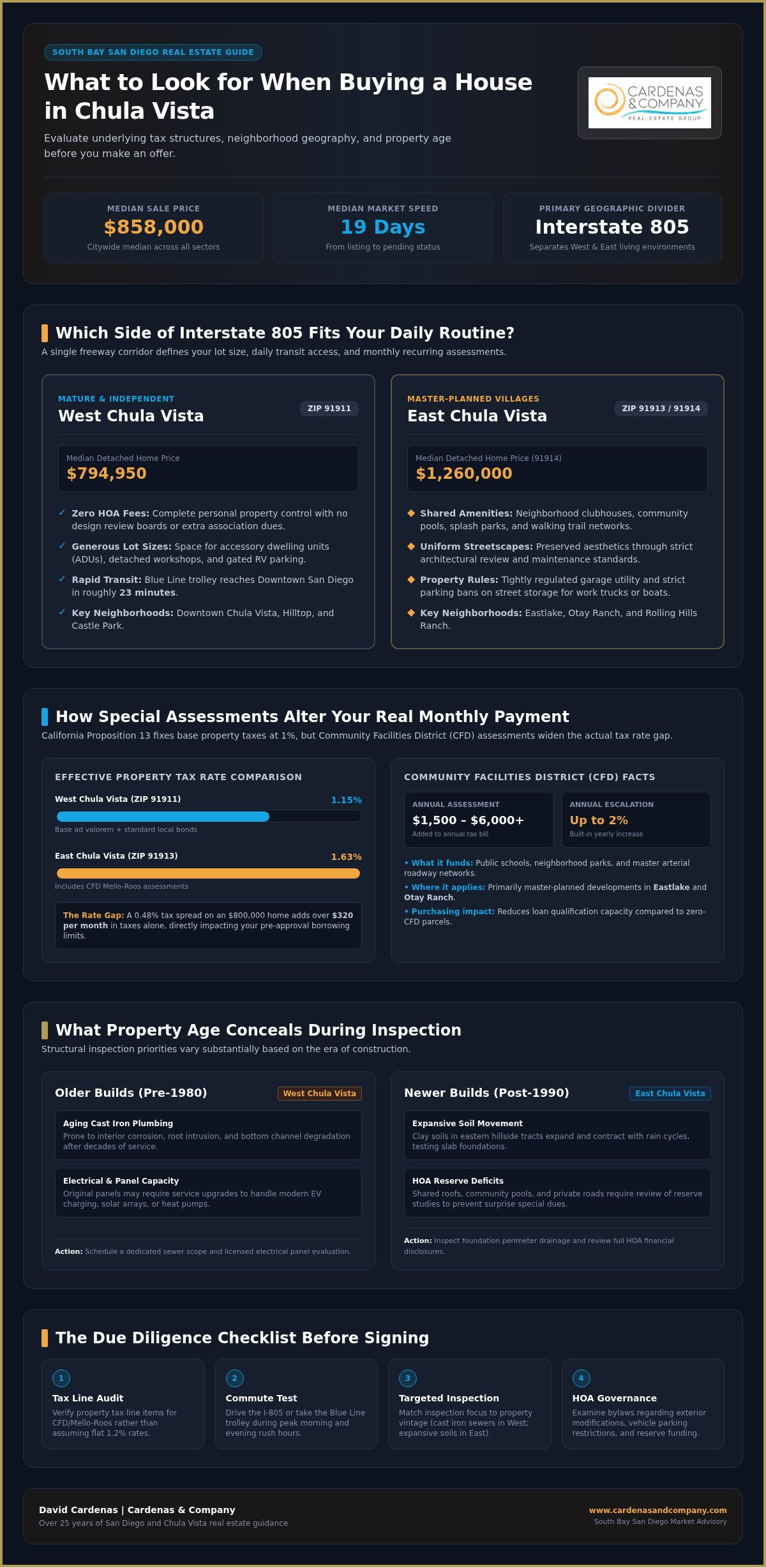
Price points also reflect this geographic divide. In the western 91911 ZIP code, the median detached home price sits around $794,950. Head across town to eastern 91914, and that figure climbs to $1,260,000. Setting this boundary early keeps you from touring homes that do not match your financial plan or personal habits.
West Chula Vista: Character, Lot Size, and Freedom from HOAs
Neighborhoods like Downtown Chula Vista, Hilltop, and Castle Park offer mature residential blocks free from homeowners associations. You own your land without paying third-party committees to approve your exterior choices. The primary advantages include:
- Substantial lot dimensions that easily accommodate accessory dwelling units (ADUs), detached workshops, or RV parking behind private gates.
- Older municipal infrastructure that gives each street an independent visual profile rather than uniform tract architecture.
- Closer proximity to the bayfront development and the UC San Diego Blue Line trolley, which reaches downtown San Diego in roughly 23 minutes.
You trade uniform architectural aesthetics for individual property rights and significantly lower recurring fees.
East Chula Vista: Master-Planned Villages and Modern Amenities
The eastern sector, anchored by Eastlake, Otay Ranch, and Rolling Hills Ranch, relies on master-planned village models. Here, residential enclaves feature shared clubhouses, community pools, splash parks, and connected walking trails. Every facade follows strict design guidelines, preserving a manicured streetscape across every block.
If you review the latest updates on our South Bay San Diego real estate blog, you will notice that this uniformity comes with trade-offs. Lots are smaller, garage space is tightly regulated, and neighborhood rules prohibit street parking for work vehicles or boats. Understanding what to look for when buying a house in Chula Vista means weighing these organized amenities against the daily restrictions enforced by active community associations.
Mello-Roos and HOA Fees: How Special Assessments Impact Your Monthly Budget
A lower purchase price does not always mean a lower monthly payment. Online real estate calculators often apply a flat default property tax of roughly 1.2%, but South Bay tax bills rarely work that simply. When you evaluate what to look for when buying a house in Chula Vista, reviewing the property tax line items matters just as much as checking the interest rate.
California's Proposition 13 caps your base ad valorem property tax at 1% of the assessed purchase value. In East Chula Vista, however, Community Facilities Districts (CFDs), commonly called Mello-Roos, fund public schools, parks, and arterial roadways. In the 91913 ZIP code, these assessments push the effective property tax rate up to 1.63%, compared to just 1.15% in western 91911. That gap translates to several hundred dollars each month directly out of your housing budget.
Demystifying Community Facilities District (CFD) Taxes
A CFD is a special taxing district created by local government agencies to finance public improvements through municipal bonds. These annual assessments in Eastlake and Otay Ranch typically range from $1,500 to $6,000+ per year and often include a built-in annual escalation clause of 2%. Each $250 increase in monthly tax liability cuts roughly $35,000 to $40,000 from your purchasing power with a lender.
Always pull the seller's secured property tax bill to examine bond expiration dates. Some early 1990s phases in Eastlake Greens have already retired their initial school bonds, while newer construction in Otay Ranch retains bond obligations that run for decades. Partnering with a dedicated team for buyer representation services ensures you verify these specific bond schedules before writing an offer.
Scrutinizing HOA Financial Reserves and Special Assessment Risks
Monthly homeowners association dues in master-planned communities typically run between $150 and $400. Some developments carry dual HOAs, where you pay both a sub-association fee for your immediate complex and a master fee for shared community infrastructure. Beyond the headline number, you must review the association's reserve study to evaluate their financial health.
- Examine reserve fund levels to confirm the board holds enough cash for scheduled roof replacements, asphalt resurfacing, and perimeter fencing.
- Identify pending special assessments, which occur when an underfunded board votes to bill owners for unexpected capital expenses.
- Check bylaws for operational restrictions on rental caps, exterior paint choices, street parking rules, and allowable pet sizes.
Verifying both the CFD line items and HOA balance sheets shows you the true monthly overhead, keeping your long-term equity plan intact.
Microclimates, Commutes, and School Districts: Evaluating Daily Neighborhood Realities
Weather and traffic in the South Bay change block by block. A coastal afternoon near the bayfront might sit at a brisk 68 degrees under a heavy marine layer, while inland tracts near Proctor Valley reach 85 degrees on the same day. Knowing what to look for when buying a house in Chula Vista requires analyzing how these microclimates, arterial routes, and school boundaries dictate your daily schedule.
The city's average one-way commute sits at 26.1 minutes, but that number shifts drastically during peak rush hours. Driving to downtown San Diego or Naval Base San Diego at 32nd Street takes 15 to 20 minutes in clear traffic, yet morning gridlock pushes trips to 30 to 45 minutes. Selecting the wrong neighborhood on-ramp can add ten unpaid hours to your car every month.
South Bay Commute Corridors: Highway 805, 5, and the SR-125 Toll Road
Your primary transit corridor determines your true fuel and toll expenses. Homes situated along the western edge access Interstate 5 and Interstate 805 directly, keeping you off toll lanes entirely. If you choose an eastern village along the State Route 125 South Bay Expressway, you gain faster moving lanes but take on monthly electronic toll fees that quickly add up.
Before making an offer, drive your route during morning duty call or rush hour. Active-duty service members can consult our military relocation guides to map base gate backups against specific highway exits.
Evaluating South Bay Elementary and High School Districts
School governance in Chula Vista splits into two separate entities. The Chula Vista Elementary School District administers kindergarten through sixth grade, while the Sweetwater Union High School District manages middle and high schools. Citywide, public schools outperform California benchmarks with 38% math proficiency and 55% reading proficiency, while Eastlake High School maintains a 97% graduation rate.
- Confirm school assignments directly through district boundary maps rather than relying on automated portal listings or postal ZIP codes.
- Investigate dual-language Spanish immersion pathways, which are widely available across elementary campuses throughout the South Bay.
- Review career technical education tracks offered at individual high schools, ranging from engineering to healthcare programs.
Verifying classroom assignments and road networks early ensures your purchase supports both your work routine and your children's educational path.
Property Age and Inspection Red Flags: What Older vs. Newer Chula Vista Homes Conceal
Cosmetic renovations frequently mask expensive structural failures. A freshly painted living room tells you nothing about the condition of the slab beneath the flooring or the drain lines buried underground. Knowing what to look for when buying a house in Chula Vista means matching your physical inspection strategy directly to the property's construction era. South Bay homes built in the 1960s face completely different structural risks than properties completed in the early 2000s.
Sewer Scopes, Foundation Shifts, and Outdated Wiring in Mature Homes
If you purchase a pre-1980 single-family residence in western neighborhoods, order a dedicated sewer lateral camera inspection during your contingency period. Mature tree roots throughout older corridors routinely penetrate original cast iron pipes, causing subterranean collapses that require trenching through yards or driveways. You must also examine the main electrical service panel for outdated Zinsco or Federal Pacific equipment, which many insurance carriers refuse to underwrite due to documented failure rates.
Inspect exterior perimeter walls and interior slabs for stair-step or horizontal cracking. Heavy seasonal rain cycles cause regional clay soils to expand and contract, placing severe hydrostatic pressure on mature residential footings.
Solar Leases, Roof Lifespans, and HVAC Systems in Newer Builds
Properties constructed across planned communities after 1995 present distinct mechanical and contractual checkpoints. Concrete roof tiles can last 50 years, but the organic felt underlayment beneath them regularly breaks down after 20 to 25 years of sun exposure. Eastlake summer heat places immense demands on air conditioning units; an undersized or aged compressor will struggle to cool a two-story floor plan and inflate your summer utility costs.
Examine rooftop solar paperwork during seller disclosure reviews. Leased solar agreements and power purchase agreements (PPAs) impose credit qualification hurdles that can stall loan underwriting. Spotting these mechanical and contractual pitfalls early is a vital part of what to look for when buying a house in Chula Vista before you release your inspection contingencies.
Connect with our South Bay advisory team
How Strategic Representation Protects Your Family and Builds Long-Term Wealth
Structuring Winning Offers in Chula Vista's Competitive Market
Inventory remains tight across the South Bay, with supply dropping to 1.4 months in high-demand pockets. Winning an offer does not require waiving your rights or wildly overpaying on appraisal. We deploy structured escalation formulas and precise contingency timelines that keep your deposit safe while appealing directly to sellers.
Our bilingual English and Spanish advisory team also draws on long-standing South Bay broker relationships to source off-market opportunities before they reach public feeds. For broader market insights and financing frameworks across the county, review our resources on buying a home in San Diego.
Asset Protection and Estate Planning: Preserving Your New Equity
Building equity is only half the equation; preserving it across generations is equally vital. In California, leaving real property outside of a formal estate plan exposes your heirs to statutory probate fees and months of public court delays. Titling your residential real estate into a revocable living trust shields your equity and guarantees private transfers to your beneficiaries. A Trust Is a Must, and you can explore this process directly at TrustSanDiego.com.
Bottom Line: Partner with Chula Vista Specialists
Spotting what to look for when buying a house in Chula Vista comes down to analyzing the complete picture: verifying Mello-Roos line items, understanding neighborhood divisions along Interstate 805, and inspecting age-specific structural components. When you master these elements, you build genuine wealth rather than taking on unexpected monthly liabilities.
David Cardenas brings over 25 years of hyper-local South Bay experience backed by Realty ONE Group Pacific, serving more than 400 families across San Diego County. Whenever you are ready to review neighborhoods, run property numbers, or discuss your goals, reach out to David Cardenas and Cardenas & Company Real Estate Group for a zero-pressure conversation.
The Bottom Line on Buying Smart in Chula Vista
Finding the right home requires balancing property lines, local commute routes, and monthly tax assessments. When you know what to look for when buying a house in Chula Vista, you avoid unexpected CFD expenses and protect your investment against deferred maintenance. Every South Bay neighborhood brings specific financial advantages when you approach negotiations with verified local data.
Real estate decisions work best when backed by decades of proven guidance. Ranked in the top 1% across San Diego County with over 25 years of local leadership, our bilingual team at Realty ONE Group Pacific has guided over 400 families to lasting equity with more than 150 5-star verified reviews. You deserve direct, transparent counsel at every stage of your purchase.
Connect with David Cardenas and the team for a zero-pressure Chula Vista buyer strategy session
Take your time, evaluate the numbers carefully, and step into your next chapter with total confidence in your South Bay investment.
Frequently Asked Questions
What is Mello-Roos and how much does it cost when buying in Chula Vista?
Mello-Roos is an annual special property tax assessment that finances local infrastructure like arterial roadways, parks, and school facilities. In developments like Eastlake and Otay Ranch, these bonds typically add $1,500 to $6,000+ annually to your property tax bill. Most bonds carry an annual escalation clause of 2% and stay active for 20 to 40 years before expiring.
Is East Chula Vista better than West Chula Vista for families?
Neither side is inherently superior; your decision depends on lifestyle and budget priorities. East Chula Vista features planned village parks, community pools, and modern campuses like Eastlake High School, which maintains a 97% graduation rate. West Chula Vista provides larger lots for backyards, lower recurring tax bills with no Mello-Roos, and shorter travel times to coastal San Diego jobs.
How do I check if a Chula Vista home has an active HOA or special assessment?
You can verify special assessments by reviewing the parcel's current San Diego County secured property tax bill. The bill lists every active Community Facilities District line item alongside municipal bond debt. For homeowners associations, your purchase contract requires the seller to provide a complete HOA document package, including the CC&Rs, current operating budget, and the latest reserve study during your disclosure contingency.
What inspections are most critical for older single-family homes in West Chula Vista?
A standard home inspection is insufficient for mature properties built prior to 1980. You should order a specialized sewer lateral camera inspection to check for tree root intrusion or cracked cast iron lines. Additionally, hire a licensed electrician to inspect the service panel for outdated Zinsco or Federal Pacific equipment, and have a structural expert assess the perimeter foundation for soil-related movement cracks.
Can active-duty military buyers use their VA loan for homes with Mello-Roos taxes in Chula Vista?
Yes, you can use a VA loan to purchase a home with Mello-Roos taxes in Chula Vista. Your mortgage lender will factor the specific annual CFD assessment into your debt-to-income ratio and residual income calculations. When studying what to look for when buying a house in Chula Vista, remember that higher annual tax assessments lower your maximum approved loan amount, even with zero down payment.
How do Chula Vista property tax rates compare to the rest of San Diego County?
The countywide general property tax rate typically falls between 1.1% and 1.3% of a home's assessed value. In West Chula Vista's 91911 area, the effective tax rate averages 1.15%. In eastern communities like 91913, active Mello-Roos bonds raise the effective rate to roughly 1.63%, which is among the higher municipal tax rates across Southern California.
Disclaimer
The information provided on this blog is for educational and informational purposes only and does not constitute legal, financial, or investment advice. While we strive for accuracy, real estate markets and insurance regulations (including Living Trusts and IUL strategies) are subject to change. David Cardenas (DRE 01862173) is a licensed real estate salesperson; however, this content does not create an agency relationship. Please consult with a qualified attorney or tax professional regarding your specific situation.