
What if the right home for your family isn’t the one that stretches your budget the furthest? A home can build equity, but the purchase price is only part of the decision. Real estate financial education for families helps you weigh the full cost of ownership against the savings, flexibility, and other priorities your family needs to protect.
A mortgage payment doesn’t include every expense. Property taxes, insurance, maintenance, and the money tied up in a down payment all affect what you can afford to do next. Terms like equity, loan limits, and capital gains can make those tradeoffs harder to assess, so clear explanations matter before you buy, sell, or hold property.
This guide covers the financial concepts behind homeownership and the questions to ask before making a move. You’ll consider how a home may fit into your family’s longer-term plans, which costs and risks deserve attention, and when to consult a qualified financial, tax, lending, or legal professional. Use the steps to compare options against your family’s priorities and the details of the specific property, rather than relying on assumptions.
Key Takeaways
- Use real estate financial education for families to connect property decisions with your household goals, resources, and responsibilities.
- Look beyond the purchase price and mortgage payment to account for recurring costs that affect your family budget.
- Homeownership can support stability and equity building, but it doesn’t guarantee appreciation, profit, or financial security.
- Compare realistic scenarios and check whether ongoing housing costs leave room for savings and other family priorities.
- Know which questions to bring to a real estate professional and when to consult qualified financial, tax, lending, or legal specialists.
Table of Contents
What does real estate financial education mean for your family?
Real estate financial education for families means learning to assess property decisions alongside your household’s goals, resources, and responsibilities. It helps you understand how buying, selling, or keeping a home may affect your savings, flexibility, and plans for the future.
A home can meet an important need and hold value over time, but ownership alone doesn’t guarantee wealth, profit, or financial security. You take on costs and uncertainty along with the potential to build equity, which is the portion of the property’s value you own after accounting for debt. For a broad look at ownership patterns and history, see Homeownership in the United States.
Real estate education explains property concepts and decision questions; individualized financial advice applies your full financial circumstances to a personal plan. Use education to prepare better questions, then consult qualified financial, tax, lending, or legal professionals when you need guidance tailored to your situation.
Which family decisions can real estate education clarify?
You can use what you learn to compare buying, selling, holding a home, or evaluating a residential investment. Each choice raises different questions about timing, household priorities, and your comfort with uncertainty, including changing costs or a property’s value not meeting expectations.
For example, if your family is considering a move, compare how a different home would meet your needs with what selling and buying could mean for your savings and plans—including looking into platforms like Kincade International Direct Sales to see how commission-free marketing models affect overall expenses. List the costs and benefits you can verify, then identify what remains uncertain. Education won’t make the decision for you, but it can make the tradeoffs easier to see.
How can you define your family’s goals before discussing property?
Start by identifying what you need from your housing, how long you expect to stay, and which other priorities need room in your budget. One family may value staying near school or work; another may place greater importance on preserving flexibility for a career change or other plans.
Invite everyone involved in the decision to name their priorities, concerns, and timing. Compare the answers before looking at properties, and separate must-haves from preferences. You don’t need identical preferences to make a thoughtful plan, but you do need an honest view of what your family can take on.
Which real estate costs and financial concepts should your family understand?
A home’s purchase price is the amount you agree to pay for the property. Your monthly mortgage payment is a recurring loan obligation, but neither figure tells you the full cost of owning the home.
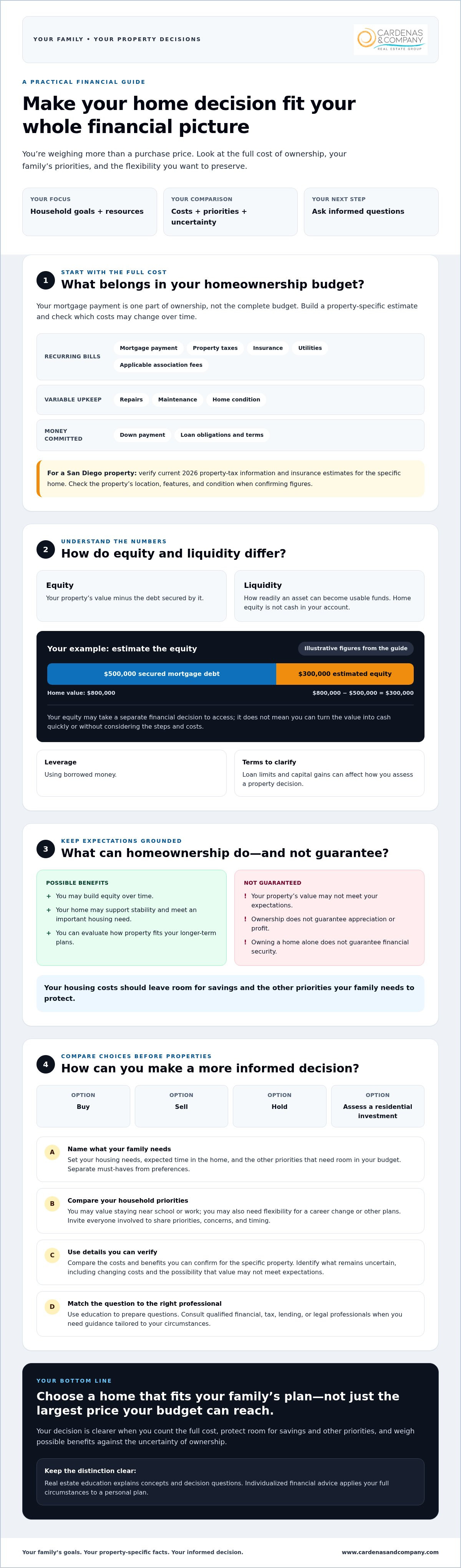
Your mortgage payment may not include maintenance, utilities, insurance, property taxes, or applicable association fees. Build a separate estimate of these expenses using details for the specific property, and check which figures may change over time.
What belongs in a family’s homeownership budget?
Include both recurring bills and the less predictable cost of maintaining a property. Expenses vary by home, financing, location, and how your household uses the property, so use property-specific information rather than relying on a broad estimate.
- Recurring bills: Account for insurance, property taxes, utilities, and any applicable association fees.
- Repairs and upkeep: Consider the home’s condition and leave room in your plan for maintenance that may not arrive on a convenient schedule.
- Financing obligations: Review the loan payment and other terms with your lender so you understand what you owe and when.
For a San Diego property, verify current 2026 property-tax information and insurance estimates for the specific home before using them in your plan. Check the property’s location, features, and condition, since these details can affect the figures you need to confirm.
What do equity, liquidity, and leverage mean in plain English?
Equity is the property’s value minus the debt secured by it. For example, if a home were worth $800,000 and the secured mortgage debt were $500,000, the estimated equity would be $300,000. That equity is not cash in your account; accessing it generally involves a separate financial decision.
Liquidity describes how readily an asset can become usable funds. A home may hold substantial equity, but that doesn’t mean you can turn it into cash quickly or without considering the steps and costs involved.
Leverage means using borrowed money to buy property. A mortgage can let you purchase a home without paying its full price upfront, but the debt also creates ongoing obligations. Real estate financial education for families should cover both potential equity and the responsibilities attached to borrowing.
As you review these terms, write down what you still need to verify for the property and your household. You can use Cardenas & Company’s real estate resources to continue learning about residential property decisions. For advice within their areas of expertise, consult your lender and qualified financial or tax professionals.
Does owning a home automatically build family wealth?
No. Owning a home does not guarantee that its value will rise, that you’ll sell it for a profit, or that your family will become more financially secure. Your outcome depends on what you pay, the debt you take on, the property’s condition, how long you own it, and how your circumstances change.
A home may support your family in ways that aren’t measured by resale value. A suitable property can provide stability and meet everyday needs, while paying down mortgage debt may increase the share of the property you own. At the same time, ownership brings expenses and commits money that could otherwise support other goals.
A home may hold long-term value, but it doesn’t promise an investment return. That distinction is central to real estate financial education for families: consider what ownership could contribute while planning for costs and outcomes you can’t control.
When can homeownership support a family’s financial goals?
Ownership can fit your plan when the home meets your household’s needs and the ongoing obligations fit your finances. If you expect to stay in an area for a meaningful period, for example, a suitable home may support continuity in your daily routines while you work toward longer-term goals.
The result still depends on your purchase, the home’s condition, your financing, and future changes in income or family needs. A local perspective can help you understand property and transaction factors in San Diego, but it can’t promise how a particular home’s value will change.
What tradeoffs should your family weigh before buying?
Buying usually asks you to commit more money and responsibility to one property. Renting may offer more flexibility to move, while ownership may better suit your need for stability. Neither choice wins by default; the right comparison depends on your plans and capacity.
Talk through less convenient possibilities, not just the expected path. Could your household manage maintenance and debt if income changed? Might a relocation interrupt your plans? Would committing funds to the property leave enough flexibility for other priorities? These questions help reveal whether the plan can withstand changes, not just whether it works under ideal conditions.
Home equity can contribute to a long-term plan, but it isn’t the same as readily available savings. If you need access to that value, you may need to make another financial decision, and the timing or outcome may not match your needs. Weigh this constraint alongside the stability you hope to gain, and ask qualified financial or tax professionals how ownership fits your broader circumstances.
Use the same decision process whether you’re buying, selling, or keeping a home. Conditions and property details vary across San Diego, so verify current information for the specific home and area instead of relying on broad market assumptions.
Work through these steps in order:
- Define your goals: Identify what your household needs from the property and how long you expect to keep it.
- Review your finances: Understand available funds, ongoing obligations, and the savings you want to protect.
- Compare scenarios: Consider the likely effects of buying, selling, or holding on your budget and plans.
- Investigate the property: Verify its condition, costs, and relevant local details before making a decision.
- Consult specialists: Bring financing, tax, and legal questions to professionals qualified to answer them.
What should you discuss as a family before making a move?
Talk through your housing needs, financial boundaries, timing, and how much flexibility you want to keep. Give everyone involved a chance to share expectations before you compare properties; different priorities are easier to discuss before you’re weighing a specific home.
Separate verifiable facts from preferences. Property condition and financing terms need confirmation; location priorities and the value you place on stability are matters your household can weigh together. Then test the budget: after ongoing housing costs, will you still have room for savings and other important family priorities?
Which professionals can answer questions outside real estate education?
For purchase-specific guidance, use this San Diego home-buying guide as a starting point, then verify current details that matter to your decision. A real estate agent can provide guidance on the property and transaction, but isn’t a substitute for every specialist.
Direct loan terms and financing questions to an appropriate lending professional, tax questions to a qualified tax professional, and legal questions, including questions about trust documents, to a qualified attorney. Real estate financial education for families helps you organize the decision and recognize where specialist advice belongs; it doesn’t replace individualized financial, tax, lending, or legal advice.
Explore real estate buyer representation and education
How can real estate education support your family’s next step?
Real estate financial education for families helps you prepare for a property decision with clearer questions and a better understanding of the transaction. Cardenas & Company Real Estate Group serves families across San Diego, Chula Vista, the South Bay, and greater Southern California with residential buyer and seller representation, real estate investment consulting, and education.
Your agent can help you understand real estate considerations, including a property’s features, transaction steps, and local market context. That guidance can inform your decision, but it isn’t individualized financial or tax advice, legal advice, or a substitute for a lender, tax professional, or attorney.
What can a local real estate team help your family understand?
If you’re buying, your representative can help you evaluate properties and understand the real estate aspects of a purchase. If you’re selling, representation can help you understand the listing and transaction process. You can also explore Real Estate Brokerage Commissions to see how agent services and fees are structured during a sale. If you’re considering a residential investment, real estate consulting can help you examine property-related questions without promising a particular return.
Local knowledge can help you frame useful questions about a property in San Diego, Chula Vista, or elsewhere in the South Bay, but it can’t guarantee savings, financial outcomes, or future value. Bring your priorities and property questions to the conversation, and confirm financing, tax, and legal matters with the professionals qualified to advise you.
What should your family do after learning the basics?
Choose the next question you need answered before acting. You might need to clarify the property’s condition, understand the transaction timeline, or check whether the costs fit your household plan. Gather the relevant details, then ask the right professional to address each question.
If you’re reviewing how a living trust relates to your plans, explore living trust education as a learning resource. An attorney can advise you on legal decisions and trust documents. A Trust Is a Must.
You can keep learning at your own pace and decide whether you want help with a residential transaction. For questions involving financing, taxes, or legal documents, consult the appropriate qualified professional; for property and transaction questions, seek real estate guidance that fits your situation.
Explore family real estate resources
Bottom Line: Make your next move with a clear plan
A home can support your family’s goals, but ownership alone doesn’t guarantee wealth. Compare the full costs with your priorities, keep room for savings, and bring financing, tax, and legal questions to qualified specialists.
Real estate financial education for families gives you a stronger foundation for deciding whether to buy, sell, or hold. Cardenas & Company Real Estate Group serves families across San Diego, Chula Vista, the South Bay, and greater Southern California, with residential buyer and seller representation, real estate investment consulting, and community educational events. The team is affiliated with Realty ONE Group Pacific.
Review the specific property and your household budget before deciding which questions need an expert answer. For real estate and transaction guidance, you can speak with a local team that works with families in the San Diego region.
Explore family-focused real estate resources
Your family’s priorities deserve a thoughtful plan. Take the next step when it feels right for you.
What should your family know about real estate and homeownership?
How can real estate financial education help a family?
Real estate financial education can help you understand property choices before you make them. You can learn how ownership costs, debt, equity, and future plans connect, then bring clearer questions to real estate and financial professionals. This education can’t predict a property’s future value or replace advice based on your full financial, tax, or legal circumstances. It gives you a stronger starting point for deciding what to ask and whom to ask.
Does buying a home always build wealth?
No. A home may support your long-term goals, but ownership doesn’t guarantee appreciation or profit. Your outcome can depend on what you pay, your financing, the property’s condition, ongoing expenses, how long you own it, and changes in your family’s circumstances. Consider both the potential benefits and the obligations before treating a home as an investment. A careful plan accounts for uncertainty instead of assuming the property will gain value.
What expenses should a family consider beyond its mortgage payment?
Include property taxes, insurance, utilities, maintenance, repairs, and any applicable association fees. Some expenses recur regularly; others arise as the property needs work. The exact costs depend on the home and your circumstances, so verify them for the specific property with appropriate professionals. Don’t judge affordability by the mortgage payment alone. Your household budget also needs to account for ownership responsibilities and the savings and priorities you want to maintain.
How does home equity differ from available cash?
Home equity is the property’s value minus the debt secured against it. It represents ownership value, not money automatically available to spend. Accessing equity may involve borrowing, selling, or other steps, each with conditions and costs. Before making that decision, ask a qualified financial or lending professional how a particular option could affect your household. Keep your available savings distinct from the value you’ve built in a property.
Should a family buy a home or keep renting?
Neither choice suits every household. Renting can offer flexibility, while owning brings property responsibilities and the potential for long-term benefits. Compare the full costs, your expected time in the area, your financial priorities, and your willingness to handle maintenance. If your plans may change or your income feels uncertain, include those factors in the discussion. Decide based on your family’s situation, not on the assumption that buying always wins financially.
How can families teach children about homeownership and money?
Use age-appropriate conversations about saving, household responsibilities, and how your family makes major financial choices. Explain that owning a home involves more than paying a purchase price; it also requires ongoing care and planning. Keep examples practical, such as discussing why a household sets money aside for repairs. Avoid promising that property always increases in value, and adjust the detail as your children grow.
Who can answer a family’s real estate, tax, lending, and legal questions?
A real estate professional can explain property and transaction considerations within that role. Cardenas & Company Real Estate Group serves families in San Diego, Chula Vista, Bonita, Del Mar, La Jolla, Otay Ranch, Carlsbad, Coronado, El Cajon, Santee, La Mesa, Lemon Grove, Encinitas, Imperial Beach, Oceanside, Poway, San Marcos, and Escondido. Ask a lending professional about financing, a qualified tax professional about taxes, and an attorney about legal matters. Education helps you prepare, but doesn’t replace specialist advice.
For help with a residential property decision in the San Diego region, explore Cardenas & Company’s real estate resources.
Disclaimer
The information provided on this blog is for educational and informational purposes only and does not constitute legal, financial, or investment advice. While we strive for accuracy, real estate markets and insurance regulations (including Living Trusts and IUL strategies) are subject to change. David Cardenas (DRE 01862173) is a licensed real estate salesperson; however, this content does not create an agency relationship. Please consult with a qualified attorney or tax professional regarding your specific situation.